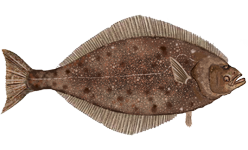
A massive Pacific flatfish — both eyes on the right side; one of the largest food fish in the world. Sustainably managed commercial fishery in Alaska is one of the model US fisheries.
§ Quick facts
§ Encyclopedia
Hippoglossus stenolepis, the Pacific halibut, is a species of righteye flounder. This very large species of flatfish is native to the North Pacific and is fished by commercial fisheries, sport fishers, and subsistence fishers.
Source: Wikipedia — Pacific halibut Licensed under CC BY-SA 4.0
§ Identification
Field marks. Massive flatfish with both eyes on right side; olive-brown to nearly black upper surface; pure white belly.
Similar species. Atlantic Halibut (different ocean). California Halibut (different fin pattern). Greenland Halibut (smaller, dark belly).
Voice. Silent.
§ Diet & behavior
Diet. Bottom fish, crustaceans, mollusks, squid.
Behavior. Largest flatfish in the Pacific. Both eyes on the right side (the "right-eye flounder" family). Sustainably managed by International Pacific Halibut Commission since 1923. Among the most economically valuable Pacific fisheries. Males rarely exceed 20 kg; nearly all market fish are females.
§ Range
North Pacific from California to Bering Sea
§ Habitat
Cold deep Pacific waters; juveniles in shallower nursery areas
§ Threats
Bycatch in commercial fisheries, climate-driven prey shifts, illegal harvest.
§ Conservation status
According to the IUCN Red List, the pacific halibut is currently classified as Least Concern.
§ What helps
Buy MSC-certified Pacific halibut from Alaska. Support precautionary catch limits.
§ Further reading
- Wikipedia — Pacific halibut
- www.nwf.org — authoritative profile of Hippoglossus stenolepis
- IUCN Red List · taxon 10097
- iNaturalist · taxon 49593
- GBIF occurrence records
- Encyclopedia of Life — Hippoglossus stenolepis
§ Sources cited
- International Pacific Halibut Commission
- NOAA Fisheries Alaska
- Marine Stewardship Council
- IUCN Red List 2010


