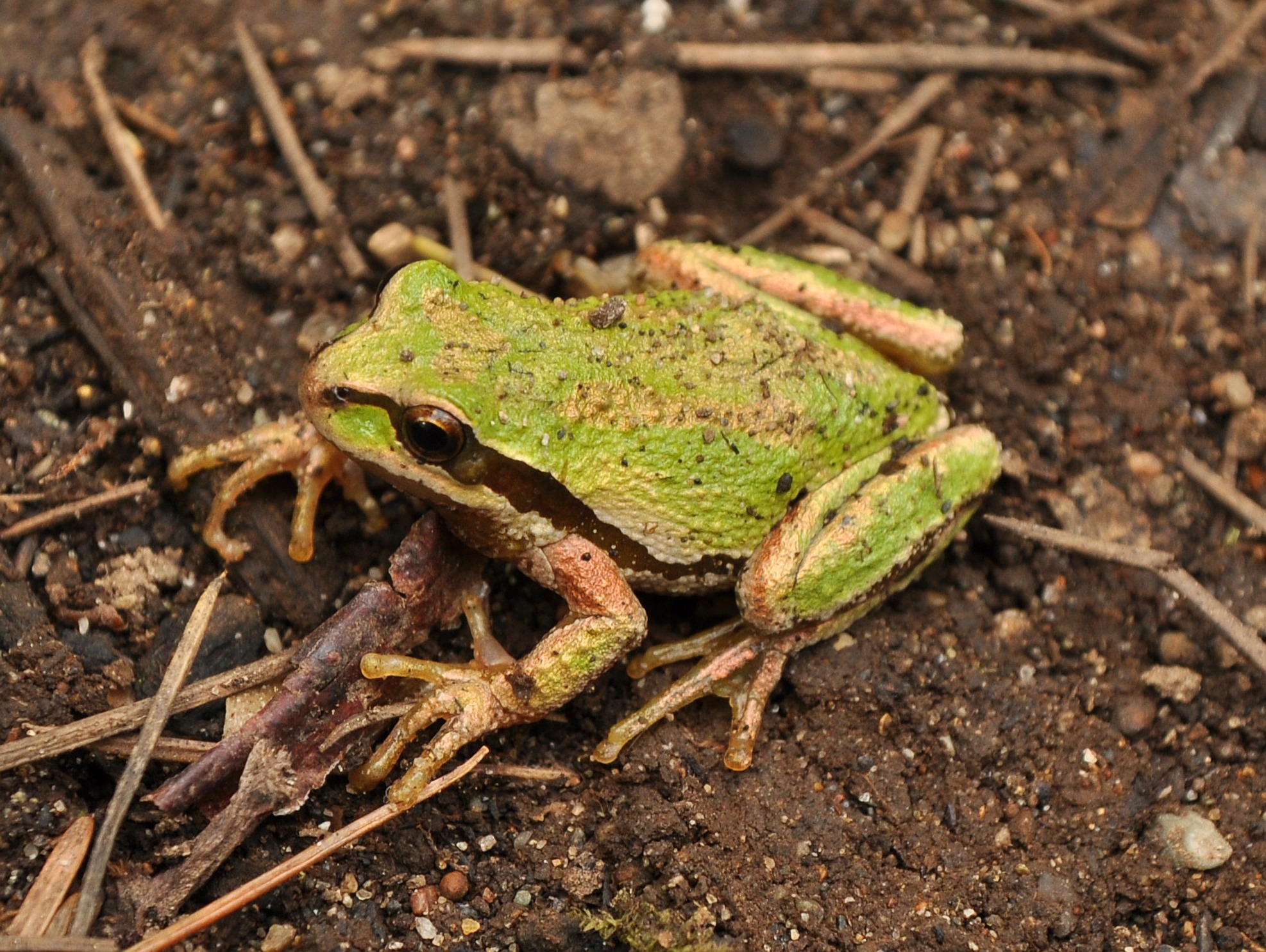
A small but vocally massive frog — their "krek-ek" calls are the iconic frog sounds in nearly every Hollywood movie, including ones set thousands of miles outside their range.
§ Quick facts
§ Encyclopedia
The Pacific tree frog, also known as the Pacific chorus frog, has a range spanning the Pacific Northwest, from Northern California, Oregon, and Washington to British Columbia in Canada and extreme southern Alaska. They live from sea level to more than 10,000 feet in many types of habitats, reproducing in aquatic settings. They occur in shades of greens or browns and can change colors over periods of hours and weeks.
Source: Wikipedia — Pacific tree frog Licensed under CC BY-SA 4.0
§ Identification
Field marks. Small frog with smooth skin in variable green, bronze, gray, or brown; distinctive dark eye stripe from nostril past ear; round adhesive toe pads.
Similar species. Sierran Tree Frog (split from Pacific Chorus Frog 2006 — interior California). Other treefrogs lack the dark eye stripe.
Voice. Loud "kreck-eck" — the classic Hollywood "ribbit" used in nearly all film and television frog sound effects, regardless of geographic setting.
§ Diet & behavior
Diet. Small insects, spiders, isopods, slugs.
Behavior. The "frog you hear in every movie" — the iconic "ribbit" call is recorded almost exclusively from Pacific Chorus Frogs. Found from southern British Columbia to Baja California — by far the most abundant amphibian across most of the Pacific states. Can change color from green to bronze to gray over hours, depending on humidity, temperature, and background.
§ Range
Pacific coast from British Columbia to Baja California
§ Habitat
Backyard ponds, streams, grasslands, forest edges
§ Threats
Chytrid fungus disease, stream pollution, climate-driven drought.
§ Conservation status
According to the IUCN Red List, the pacific chorus frog is currently classified as Least Concern.
§ What helps
Build a backyard pond. Reduce pesticides. Don't move amphibians between regions (disease spread).
§ Further reading
- Wikipedia — Pacific tree frog
- www.nwf.org — authoritative profile of Pseudacris regilla
- IUCN Red List · taxon 55895
- iNaturalist · taxon 25569
- GBIF occurrence records
- Encyclopedia of Life — Pseudacris regilla
§ Sources cited
- AmphibiaWeb
- USGS PWRC Amphibian Research and Monitoring Initiative
- IUCN Red List 2014


