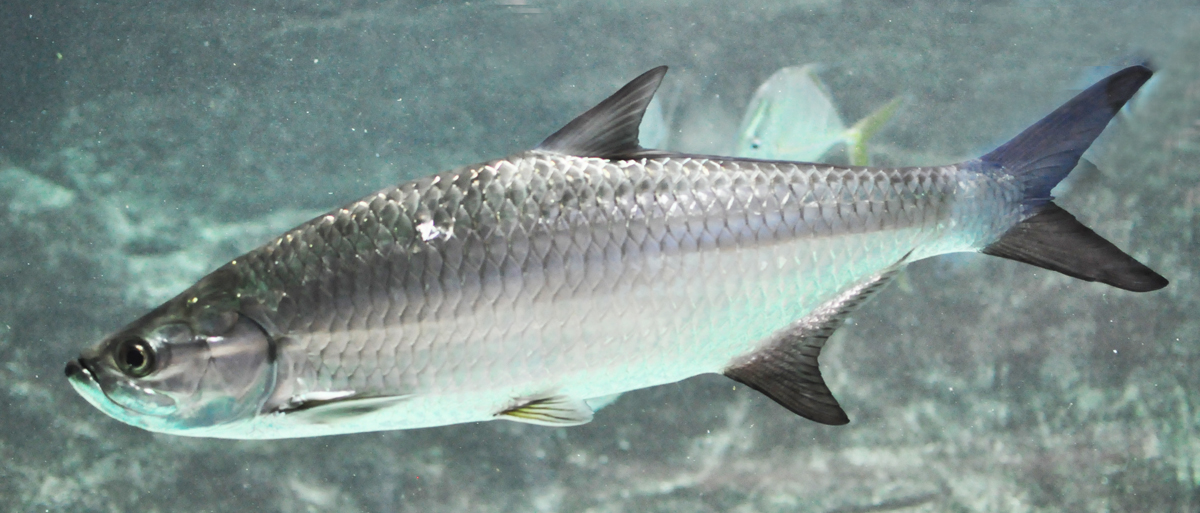
A massive silver "silver king" gamefish that can exceed 8 feet and 280 lbs. Famous for spectacular leaping fights after taking a fly. Highly migratory; protected as catch-and-release only in many waters.
§ Quick facts
§ Encyclopedia
The Atlantic tarpon is a ray-finned fish that inhabits coastal waters, estuaries, lagoons, and rivers. It is also known as the silver king. It is found in the Atlantic Ocean, typically in tropical and subtropical regions, though it has been reported as far north as Nova Scotia and the Atlantic coast of southern France, and as far south as Argentina. As with all elopiformes, it spawns at sea. Its diet includes small fish and crustaceans.
Source: Wikipedia — Atlantic tarpon Licensed under CC BY-SA 4.0
§ Identification
Field marks. Massive silver "silver king" with large mouth, deeply forked tail, and last dorsal-fin ray extending into a long filament. Reflective scales the size of silver dollars.
Similar species. Ladyfish (much smaller). Bonefish (smaller, different shape).
Voice. Silent.
§ Diet & behavior
Diet. Mullet, sardines, anchovies, crabs, shrimp.
Behavior. Can breathe atmospheric air through a modified swim bladder — survives in oxygen-poor backwaters. Spawn offshore in warm water; leptocephalus larvae drift to coastal nurseries. Highly migratory along Gulf and Atlantic coasts. Among the most prized saltwater gamefish; mandatory catch-and-release in many US waters.
§ Range
Atlantic and Gulf coasts from Virginia to Brazil
§ Habitat
Coastal flats, mangroves, estuaries
§ Threats
Coastal habitat loss, commercial fishing in some Caribbean waters, climate change.
§ Conservation status
According to the IUCN Red List, the atlantic tarpon is currently classified as Vulnerable.
§ What helps
Practice strict catch-and-release with proper handling. Support coastal habitat conservation. Buy only sustainably caught.
§ Further reading
- Wikipedia — Atlantic tarpon
- www.nwf.org — authoritative profile of Megalops atlanticus
- IUCN Red List · taxon 191823
- iNaturalist · taxon 49696
- GBIF occurrence records
- Encyclopedia of Life — Megalops atlanticus
§ Sources cited
- NOAA Fisheries
- Bonefish & Tarpon Trust
- FWC
- IUCN Red List 2018


