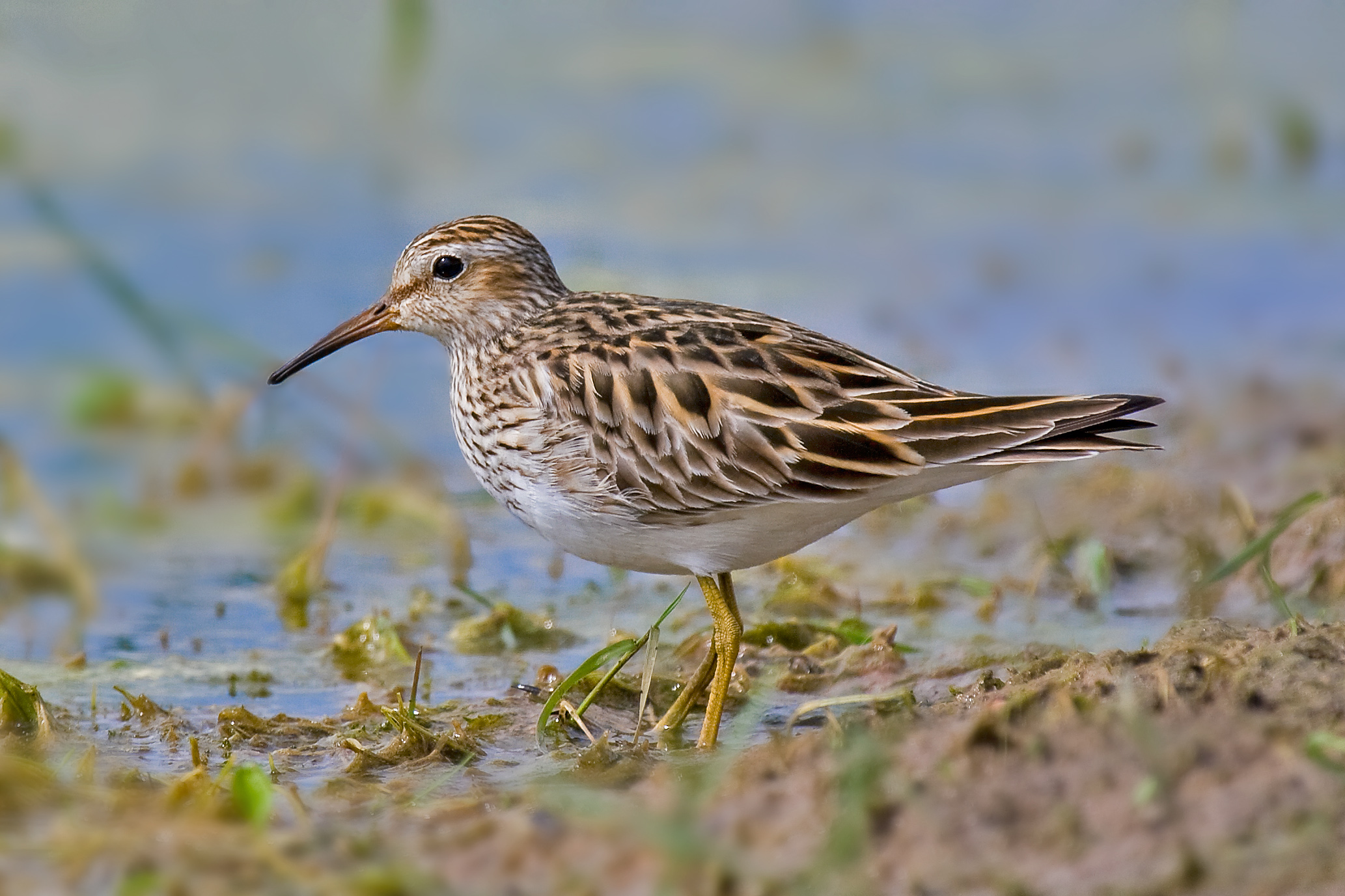
A medium sandpiper named for breeding males' inflated chest sac during courtship. Migrates from Arctic to southern South America.
§ Quick facts
§ Encyclopedia
The pectoral sandpiper, often abbreviated pec, is a small, migratory wader that breeds in arctic regions of North America and Asia, wintering in South America and Oceania. It eats small invertebrates. Its nest, a hole scraped in the ground and with a thick lining, is deep enough to protect its four eggs from the cool breezes of its breeding grounds. The pectoral sandpiper is 19–23 cm (7.5–9.1 in) long, with a wingspan of 38–46 cm (15–18 in).
Source: Wikipedia — Pectoral sandpiper Licensed under CC BY-SA 4.0
§ Identification
Field marks. Medium sandpiper with dense breast streaking that ends in a sharp line against the white belly (the 'pectoral' bib), yellowish legs, and a slightly drooped bill.
Similar species. Least Sandpiper is much smaller; the sharply demarcated streaked bib and larger size mark the Pectoral.
Voice. A low, harsh, reedy 'churk' or 'krrrt'.
§ Diet & behavior
Diet. Invertebrates probed from mud, sand, or shallow water.
Behavior. A grass-loving 'grasspiper' that feeds in wet meadows and marsh edges; males inflate a fat throat sac and give booming hoots in arctic display flights.
§ Range
Across North America during migration; Arctic breeders
§ Habitat
Grassland edges, wet meadows
§ Threats
Wet meadow loss, climate change.
§ Conservation status
According to the IUCN Red List, the pectoral sandpiper is currently classified as Least Concern.
§ What helps
Support grassland wetland conservation.
§ Further reading
- Wikipedia — Pectoral sandpiper
- www.allaboutbirds.org — authoritative profile of Calidris melanotos
- IUCN Red List — search for Calidris melanotos
- GBIF occurrence records
- Encyclopedia of Life — Calidris melanotos
§ Sources cited
- Cornell Lab of Ornithology — All About Birds
- National Audubon Society
- iNaturalist
- IUCN Red List


