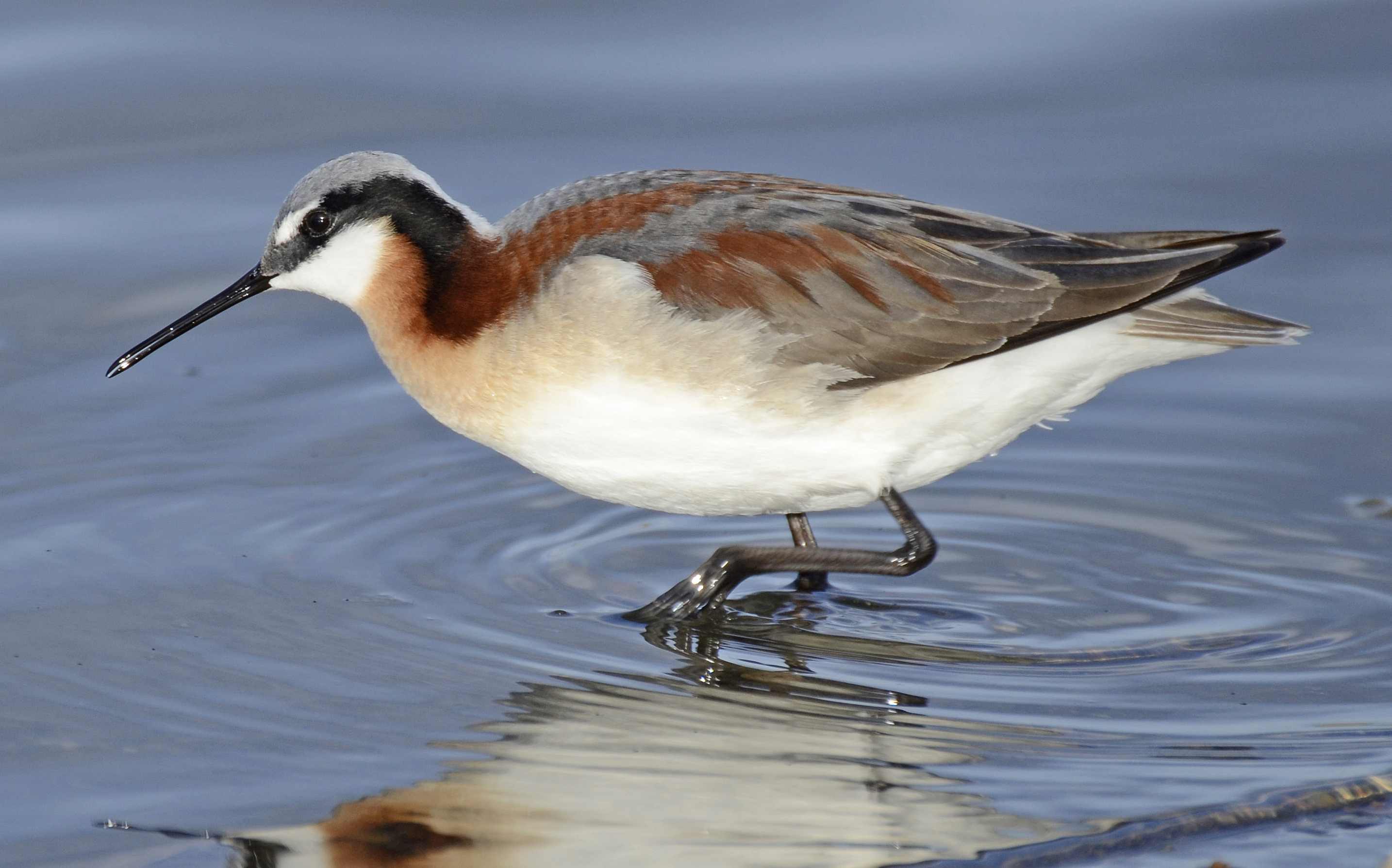
A small phalarope famous for two unusual traits: females are more colorful than males (females also do the territory defense), and they swim in circles to stir up food.
§ Quick facts
§ Encyclopedia
Wilson's phalarope is a small wader. This bird, the largest of the phalaropes, breeds in the prairies of North America in western Canada and the western United States. It is migratory, wintering in inland salt lakes near the Andes in Argentina. They are passage migrants through Central America around March/April and again during September/October. The species is a rare vagrant to western Europe.
Source: Wikipedia — Wilson's phalarope Licensed under CC BY-SA 4.0
§ Identification
Field marks. Slim shorebird with a long needle bill and (breeding female) a bold black-and-rufous neck stripe; males duller. Winter birds pale gray above, white below, with yellowish legs.
Similar species. Red-necked Phalarope is smaller with a finer bill and a dark ear patch in winter; Wilson's is larger, longer-billed, and lacks a winter ear patch.
Voice. A soft, nasal grunting 'wurk' or 'oit'.
§ Diet & behavior
Diet. Invertebrates probed from mud, sand, or shallow water.
Behavior. An unusual shorebird that swims and spins in tight circles to stir up invertebrates; sex roles are reversed — the brighter female competes for mates and leaves incubation to the male.
§ Range
Western US prairies in summer; winters in South America
§ Habitat
Prairie wetlands, alkaline lakes
§ Threats
Prairie wetland loss, climate change.
§ Conservation status
According to the IUCN Red List, the wilson's phalarope is currently classified as Least Concern.
§ What helps
Support prairie wetland conservation.
§ Further reading
- Wikipedia — Wilson's phalarope
- www.allaboutbirds.org — authoritative profile of Phalaropus tricolor
- IUCN Red List — search for Phalaropus tricolor
- GBIF occurrence records
- Encyclopedia of Life — Phalaropus tricolor
§ Sources cited
- Cornell Lab of Ornithology — All About Birds
- National Audubon Society
- iNaturalist
- IUCN Red List


