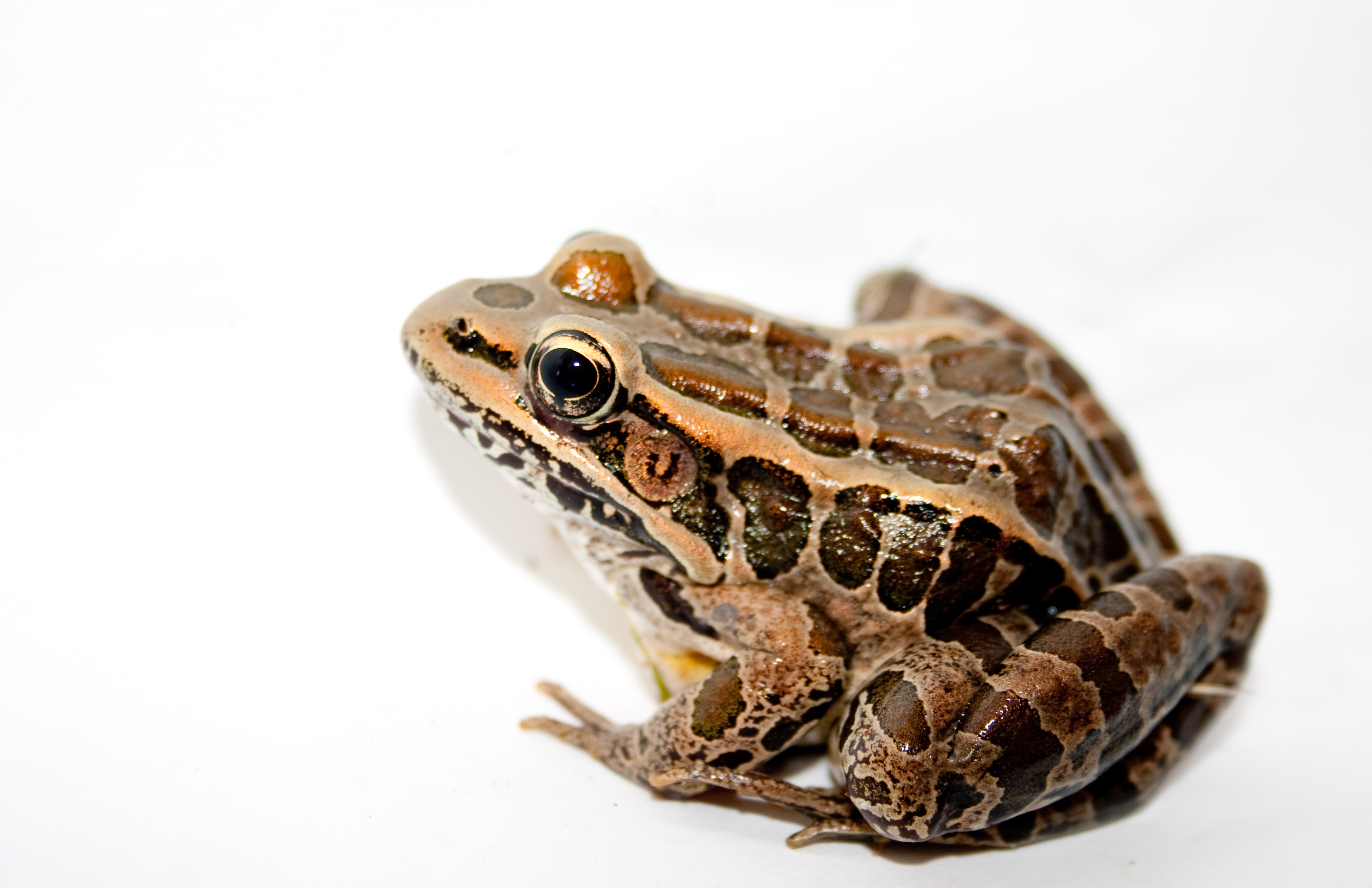
Often confused with leopard frogs but distinguishable by paired square spots and a yellow-orange wash on the inner thighs. Their skin secretions are toxic enough that other frogs caged with them often die.
§ Quick facts
§ Encyclopedia
The pickerel frog is a small North American frog, characterized by the appearance of seemingly "hand-drawn" squares on its dorsal surface.
Source: Wikipedia — Pickerel frog Licensed under CC BY-SA 4.0
§ Identification
Field marks. Medium-sized brown frog with bright yellow-green dorsolateral ridges; large dark brown square or rectangular spots arranged in two rows; bright yellow flanks visible in flight.
Similar species. Northern Leopard Frog (round spots). Plains Leopard Frog (round spots). Wood Frog (no rows of spots, dark mask).
Voice. Snore-like "low rumble" lasting 2–3 seconds.
§ Diet & behavior
Diet. Insects, spiders, small crustaceans, occasional small vertebrates.
Behavior. Inhabits cool streams and ponds across eastern North America. Distinctive prominent square-shaped dark spots and toxic skin secretions distinguish it from related leopard frogs. Skin produces irritating compounds that deter many predators; toxic enough that snake predators must learn to avoid them after first encounter. Population stable across most of range.
§ Range
Eastern US from Maine to Texas
§ Habitat
Cool clean streams, springs, sphagnum bogs
§ Threats
Stream pollution, sediment runoff, pesticides, pH changes from acid mine drainage.
§ Conservation status
According to the IUCN Red List, the pickerel frog is currently classified as Least Concern.
§ What helps
Reduce sediment runoff from construction. Maintain forested stream buffers. Support clean water enforcement.
§ Further reading
- Wikipedia — Pickerel frog
- www.nwf.org — authoritative profile of Lithobates palustris
- IUCN Red List · taxon 58672
- iNaturalist · taxon 66315
- GBIF occurrence records
- Encyclopedia of Life — Lithobates palustris
§ Sources cited
- AmphibiaWeb
- USGS PWRC
- Davidson College Herpetology Lab
- IUCN Red List 2014


