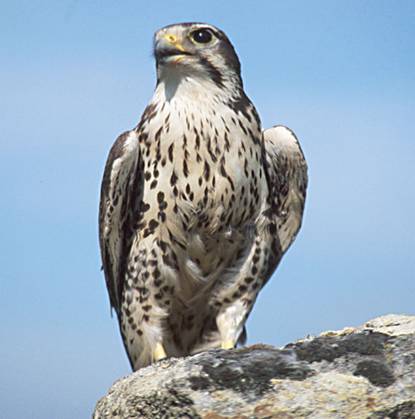
A pale buff falcon of the western open country, distinguished by dark "armpits" visible in flight. Specialized predator of ground squirrels and horned larks.
§ Quick facts
§ Encyclopedia
The prairie falcon is a medium-sized falcon found in Western North America. A separate species from the peregrine falcon, with which it shares some visual similarities, the prairie falcon is, essentially, an arid-climate divergence of earlier peregrine falcon lineage. It is thus able to thrive on a more meager, opportunistic diet compared to that of the peregrine, and is generally lighter in weight than a peregrine of similar wingspan. Having evolved in harsher and desert environments, often with low prey density, the prairie falcon has developed into an aggressive and opportunistic hunter of a wide range of both mammalian and avian prey, as well as occasional reptiles. It will regularly take prey from the size of sparrows or finches to birds approximately its own weight, and occasionally much larger.
Source: Wikipedia — Prairie falcon Licensed under CC BY-SA 4.0
§ Identification
Field marks. Sandy-brown falcon, paler than a Peregrine, with a narrow dark mustache, a pale eyebrow, and (diagnostic in flight) dark 'armpits' and wing linings contrasting with paler underwings.
Similar species. Peregrine Falcon is slate-gray above with a bold dark hood and clean underwings; the Prairie is paler brown with dark axillary patches.
Voice. A harsh, repeated 'kik-kik-kik' alarm near the nest.
§ Diet & behavior
Diet. Small birds, mammals, insects.
Behavior. A pale falcon of arid western open country and badlands; hunts ground squirrels and small birds in fast, low pursuit and nests on cliff ledges.
§ Range
Western North America from southern Canada to Mexico
§ Habitat
Open arid country: grasslands, deserts, sagebrush steppe, cliff escarpments
§ Threats
Sage-steppe conversion to row crops and energy development, wind farm collisions, lead from carrion.
§ Conservation status
According to the IUCN Red List, the prairie falcon is currently classified as Least Concern.
§ What helps
Support sagebrush conservation. Use non-lead ammunition near falcon territory. Donate to prairie-bird groups.
§ Further reading
- Wikipedia — Prairie falcon
- www.allaboutbirds.org — authoritative profile of Falco mexicanus
- IUCN Red List — search for Falco mexicanus
- GBIF occurrence records
- Encyclopedia of Life — Falco mexicanus
§ Sources cited
- Cornell Lab of Ornithology — All About Birds
- National Audubon Society
- iNaturalist
- IUCN Red List


