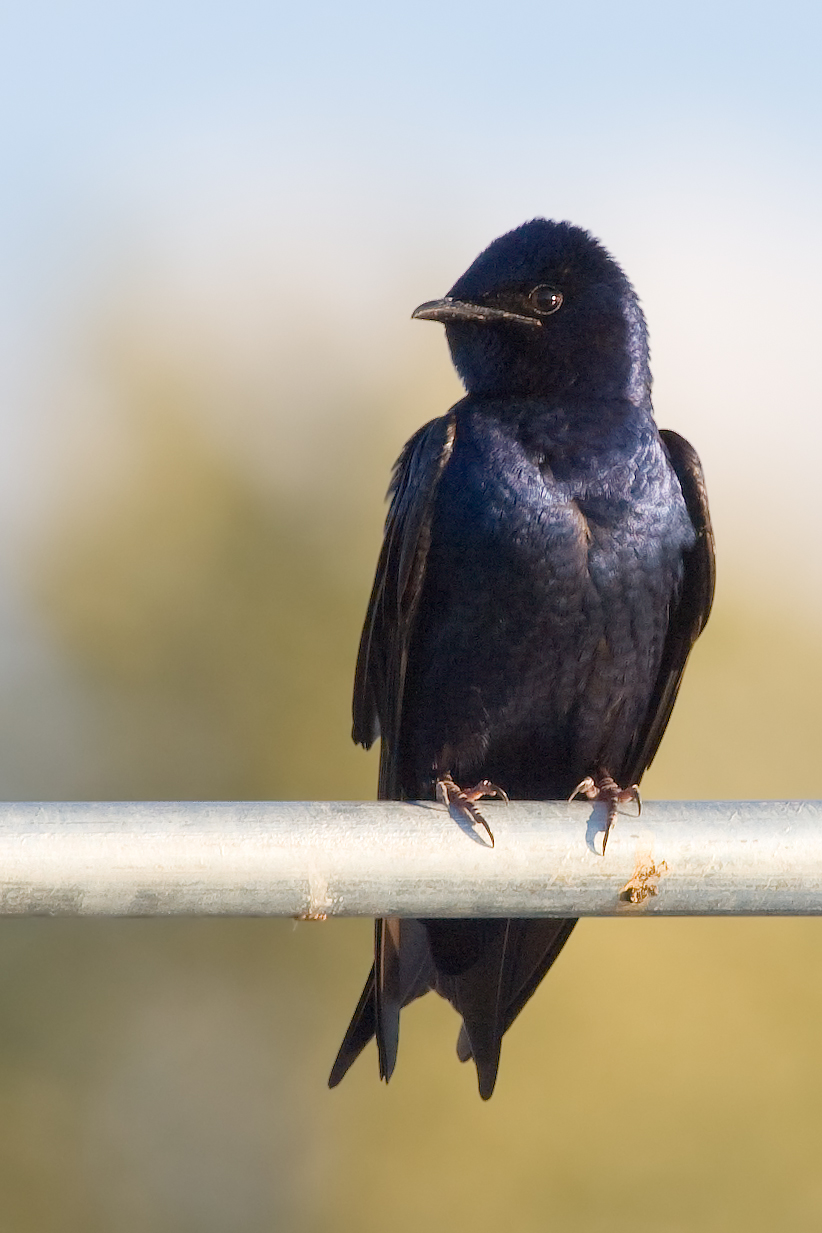
The largest North American swallow — males a deep iridescent purple-blue. Eastern populations now depend almost entirely on human-supplied housing (gourds and apartment-style boxes).
§ Quick facts
§ Encyclopedia
The purple martin is a passerine bird in the swallow family Hirundinidae. It is the largest swallow in North America. Despite its name, the purple martin is not truly purple. The dark blackish-blue feathers have an iridescent sheen caused by the diffraction of incident light giving them a bright blue to navy blue or deep purple appearance. In some light, they may even appear green in color.
Source: Wikipedia — Purple martin Licensed under CC BY-SA 4.0
§ Identification
Field marks. Large swallow. Males: entirely glossy dark blue-purple (only North American swallow with all-dark underparts). Females: gray belly, dark upperparts.
Similar species. European Starling (no swallow body shape, yellow bill in summer). Tree Swallow (much smaller, white belly). Smaller swallows have rusty or pale undersides.
Voice. Liquid gurgling "chur" calls; rich complex morning songs.
§ Diet & behavior
Diet. Flying insects (dragonflies, beetles, flies, moths, true bugs, mosquitoes); rarely consumes ground-dwelling insects.
Behavior. Largest North American swallow. Eastern populations now nest almost exclusively in human-supplied housing (multi-compartment "martin houses" and hollowed gourd clusters) — a tradition that began with Native Americans hanging gourds for martins and continues today. Western populations still mostly nest in natural cavities of trees and saguaro cacti. Migrates 10,000+ km annually between Brazilian winter range and North American breeding range. Among the most-watched migration species via geolocator tracking.
§ Range
Across eastern US and parts of west in summer; winters in Amazon basin
§ Habitat
Open country near water; depends on managed nest housing in the East
§ Threats
Loss of older housing, competition with starlings/house sparrows, pesticide-driven insect declines.
§ Conservation status
According to the IUCN Red List, the purple martin is currently classified as Least Concern.
§ What helps
Maintain a martin house with starling-resistant entrances. Evict invasive house sparrows from boxes. Skip pesticides.
§ Further reading
- Wikipedia — Purple martin
- www.allaboutbirds.org — authoritative profile of Progne subis
- IUCN Red List · taxon 22712098
- iNaturalist · taxon 13107
- eBird · purmar
- GBIF occurrence records
- Encyclopedia of Life — Progne subis
§ Sources cited
- Cornell Lab — All About Birds
- Purple Martin Conservation Association
- National Audubon Society
- IUCN Red List 2018


