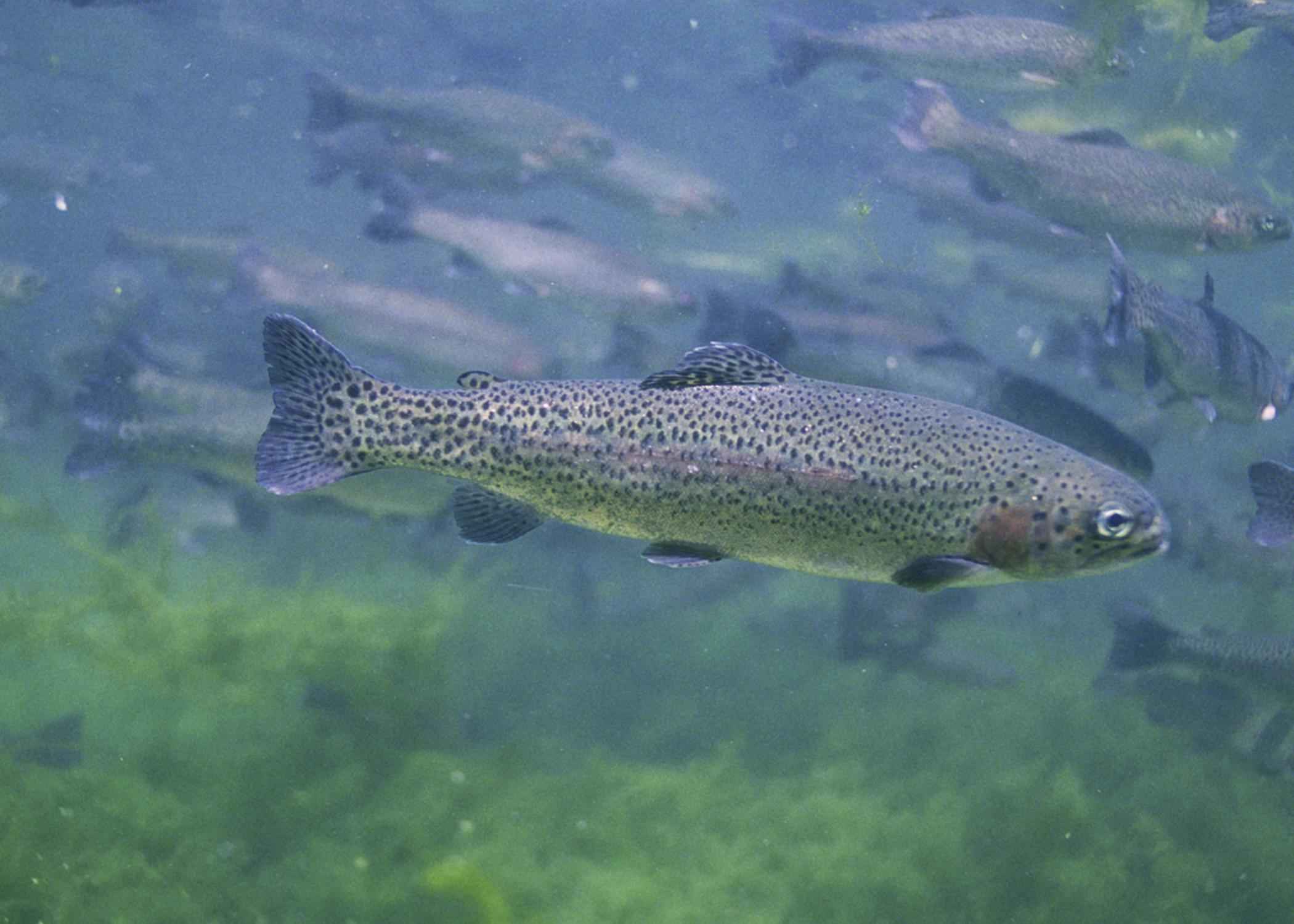
The iconic American trout — silvery with a bright pink stripe down the side. Sea-run rainbows are called "steelhead" and undertake remarkable migrations to spawn in natal streams.
§ Quick facts
§ Encyclopedia
The rainbow trout is a species of trout native to cold-water tributaries of the Pacific Ocean in North America and Asia. The steelhead is an anadromous (sea-run) form of the coastal rainbow trout (O. m. irideus) or Columbia River redband trout (O. m. gairdneri) that usually returns to freshwater to spawn after living two to three years in the ocean.
Source: Wikipedia — Rainbow trout Licensed under CC BY-SA 4.0
§ Identification
Field marks. Silvery body with pink-red lateral stripe and dark spots on back and tail. Steelhead are sleeker and more silvery than resident forms.
Similar species. Cutthroat Trout (red throat slash; spots more concentrated on tail). Brown Trout (light spots on dark, no pink stripe).
Voice. Silent.
§ Diet & behavior
Diet. Aquatic insects, small fish, crustaceans, fish eggs, terrestrial insects falling onto water surface.
Behavior. Sea-run "steelhead" undertake remarkable migrations: smolt out as 2-year-olds, return to natal streams to spawn. Non-anadromous "rainbows" stay in fresh water lifelong.
§ Range
Native to western North America; stocked worldwide
§ Habitat
Cold clear streams, rivers, lakes
§ Threats
Hybridization with native cutthroat, hatchery impacts on wild gene pools, climate-driven warming of trout streams.
§ Conservation status
According to the IUCN Red List, the rainbow trout is currently classified as Least Concern.
§ What helps
Don't release hatchery rainbows into native cutthroat streams. Support cold-water stream restoration. Practice catch-and-release.
§ Further reading
- Wikipedia — Rainbow trout
- www.nwf.org — authoritative profile of Oncorhynchus mykiss
- IUCN Red List · taxon 62214
- iNaturalist · taxon 49675
- GBIF occurrence records
- Encyclopedia of Life — Oncorhynchus mykiss
§ Sources cited
- NOAA Fisheries
- California Department of Fish and Wildlife
- Trout Unlimited
- IUCN Red List 2018


