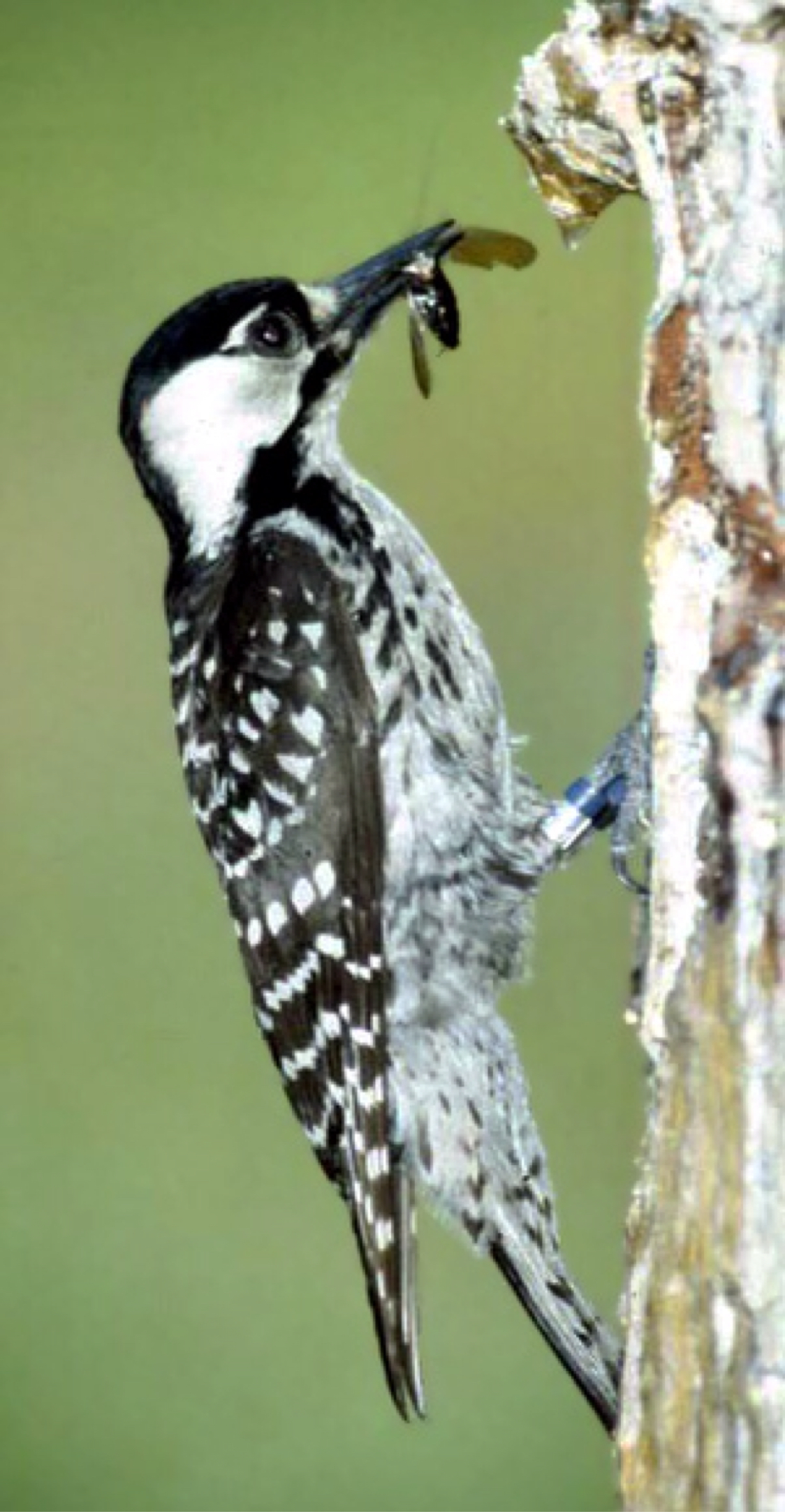
A small black-and-white woodpecker endemic to mature longleaf pine forests of the southeastern US. Federally endangered until 2024 when it was downlisted to threatened thanks to recovery efforts.
§ Quick facts
§ Encyclopedia
The red-cockaded woodpecker is a woodpecker endemic to the southeastern United States. It is a threatened species under the Endangered Species Act of 1973.
Source: Wikipedia — Red-cockaded woodpecker Licensed under CC BY-SA 4.0
§ Identification
Field marks. Black-and-white woodpecker with a large white cheek patch, a black-and-white barred back, and a black cap; the tiny red 'cockade' on the male's head is rarely visible.
Similar species. Downy and Hairy woodpeckers have a white back stripe; the big white cheek patch and barred back of Red-cockaded are distinctive in its pine-savanna habitat.
Voice. A raspy, scolding 'sklit' and churring notes; weak rattle.
§ Diet & behavior
Diet. Insects (especially wood-boring beetle larvae), some fruits and seeds.
Behavior. An endangered cooperative-breeding specialist of old-growth southern pine savanna; the only woodpecker that excavates nest cavities in living pines, drilling resin wells that deter snakes.
§ Range
Southeastern US (longleaf pine ecosystem)
§ Habitat
Mature longleaf pine forests
§ Threats
Loss of longleaf pine ecosystem (95% destroyed since European settlement).
§ Conservation status
According to the IUCN Red List, the red-cockaded woodpecker is currently classified as Near Threatened.
§ What helps
Support longleaf pine restoration. Use prescribed fire. Donate to The Nature Conservancy's pine programs.
§ Further reading
- Wikipedia — Red-cockaded woodpecker
- www.fws.gov — authoritative profile of Picoides borealis
- IUCN Red List — search for Picoides borealis
- GBIF occurrence records
- Encyclopedia of Life — Picoides borealis
§ Sources cited
- Cornell Lab of Ornithology — All About Birds
- National Audubon Society
- iNaturalist
- IUCN Red List


