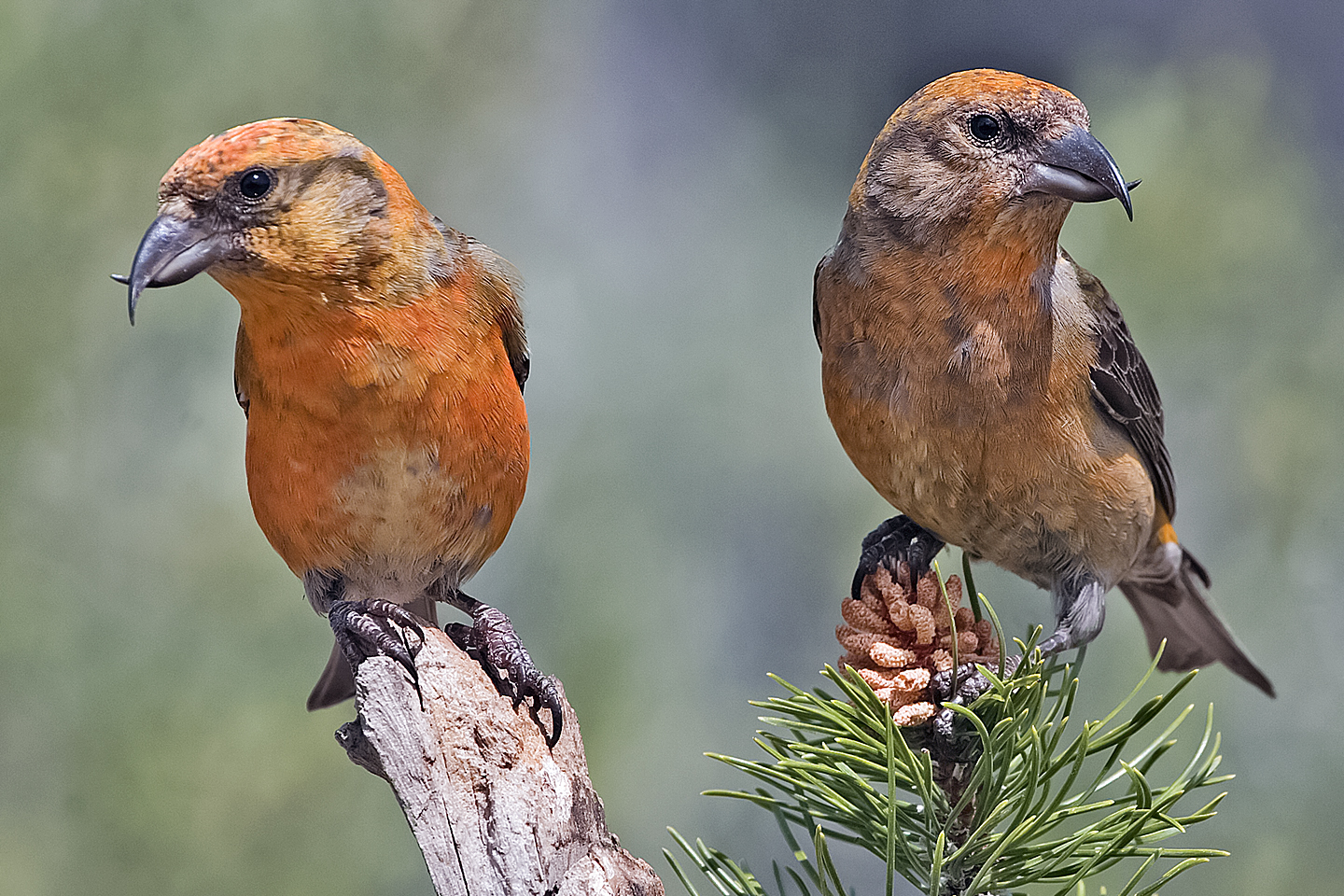
A specialized finch with crossed mandibles for prying open conifer cones. Several genetic "call types" that may represent cryptic species — each specializes on a specific conifer.
§ Quick facts
§ Encyclopedia
The red crossbill or common crossbill is a small passerine bird in the finch family Fringillidae. Crossbills have distinctive mandibles, crossed at the tips, which enable them to extract seeds from conifer cones and other fruits.
Source: Wikipedia — Red crossbill Licensed under CC BY-SA 4.0
§ Identification
Field marks. Stocky finch with a crossed bill; males brick-red to orange, females yellowish-olive to gray, both with dark unmarked wings.
Similar species. White-winged Crossbill has bold white wing bars; Red Crossbill has plain dark wings. Bill size varies among the cryptic call types.
Voice. A hard, repeated 'kip-kip-kip' flight call (varying by call type); song a series of warbles and trills.
§ Diet & behavior
Diet. Seeds (specialized for many species), occasional insects.
Behavior. A conifer specialist with crossed bill tips that pry apart cone scales to extract seeds; nomadic and able to breed any month if cones are abundant. Comprises several 'call types' with distinct bills.
§ Range
Coniferous forests across North America
§ Habitat
Mature coniferous forests, especially spruce, fir, pine
§ Threats
Conifer forest loss, climate change, mountain pine beetle outbreaks.
§ Conservation status
According to the IUCN Red List, the red crossbill is currently classified as Least Concern.
§ What helps
Support boreal and montane conifer protection. Skip pesticides on forest pests.
§ Further reading
- Wikipedia — Red crossbill
- www.allaboutbirds.org — authoritative profile of Loxia curvirostra
- IUCN Red List — search for Loxia curvirostra
- GBIF occurrence records
- Encyclopedia of Life — Loxia curvirostra
§ Sources cited
- Cornell Lab of Ornithology — All About Birds
- National Audubon Society
- iNaturalist
- IUCN Red List


