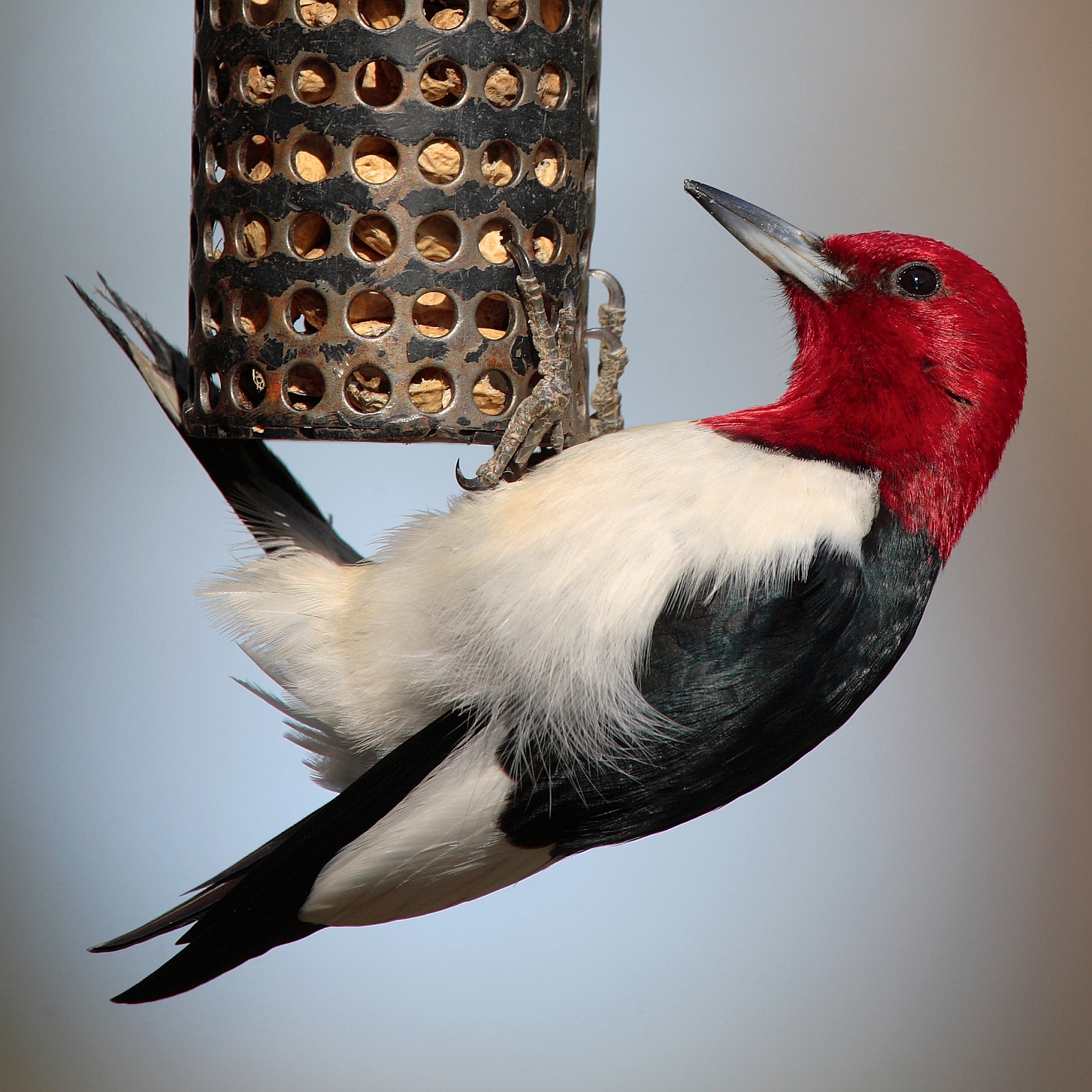
A stunning woodpecker with a brilliantly red head, black back, and white belly. Populations have declined 60% since 1966 due to habitat changes.
§ Quick facts
§ Encyclopedia
The red-headed woodpecker is a mid-sized woodpecker found in temperate North America. Its breeding habitat is open country across southern Canada and the east-central United States. It is rated as least concern on the International Union for Conservation of Nature (IUCN)'s Red List of Endangered species, having been down-listed from near threatened in 2018.
Source: Wikipedia — Red-headed woodpecker Licensed under CC BY-SA 4.0
§ Identification
Field marks. Entirely crimson head, snow-white underparts, and a black back with large white wing patches that flash in flight. Sexes alike; juveniles have brown heads.
Similar species. Red-bellied Woodpecker has only a red cap and a barred back; the all-red head and bold black-and-white blocks are unmistakable in adults.
Voice. A loud, harsh 'queer' or 'churr', higher and sharper than Red-bellied.
§ Diet & behavior
Diet. Insects (especially wood-boring beetle larvae), some fruits and seeds.
Behavior. A striking woodpecker that flycatches, caches nuts, and aggressively defends territory; has declined sharply with loss of open oak woods and dead trees.
§ Range
Central and eastern US
§ Habitat
Open oak woodlands, savannas, recently burned areas
§ Threats
Loss of open oak savanna habitat, fire suppression, dead-tree removal.
§ Conservation status
According to the IUCN Red List, the red-headed woodpecker is currently classified as Near Threatened.
§ What helps
Support prescribed-fire woodland management. Leave dead trees standing where safe.
§ Further reading
- Wikipedia — Red-headed woodpecker
- www.allaboutbirds.org — authoritative profile of Melanerpes erythrocephalus
- IUCN Red List — search for Melanerpes erythrocephalus
- GBIF occurrence records
- Encyclopedia of Life — Melanerpes erythrocephalus
§ Sources cited
- Cornell Lab of Ornithology — All About Birds
- National Audubon Society
- iNaturalist
- IUCN Red List


