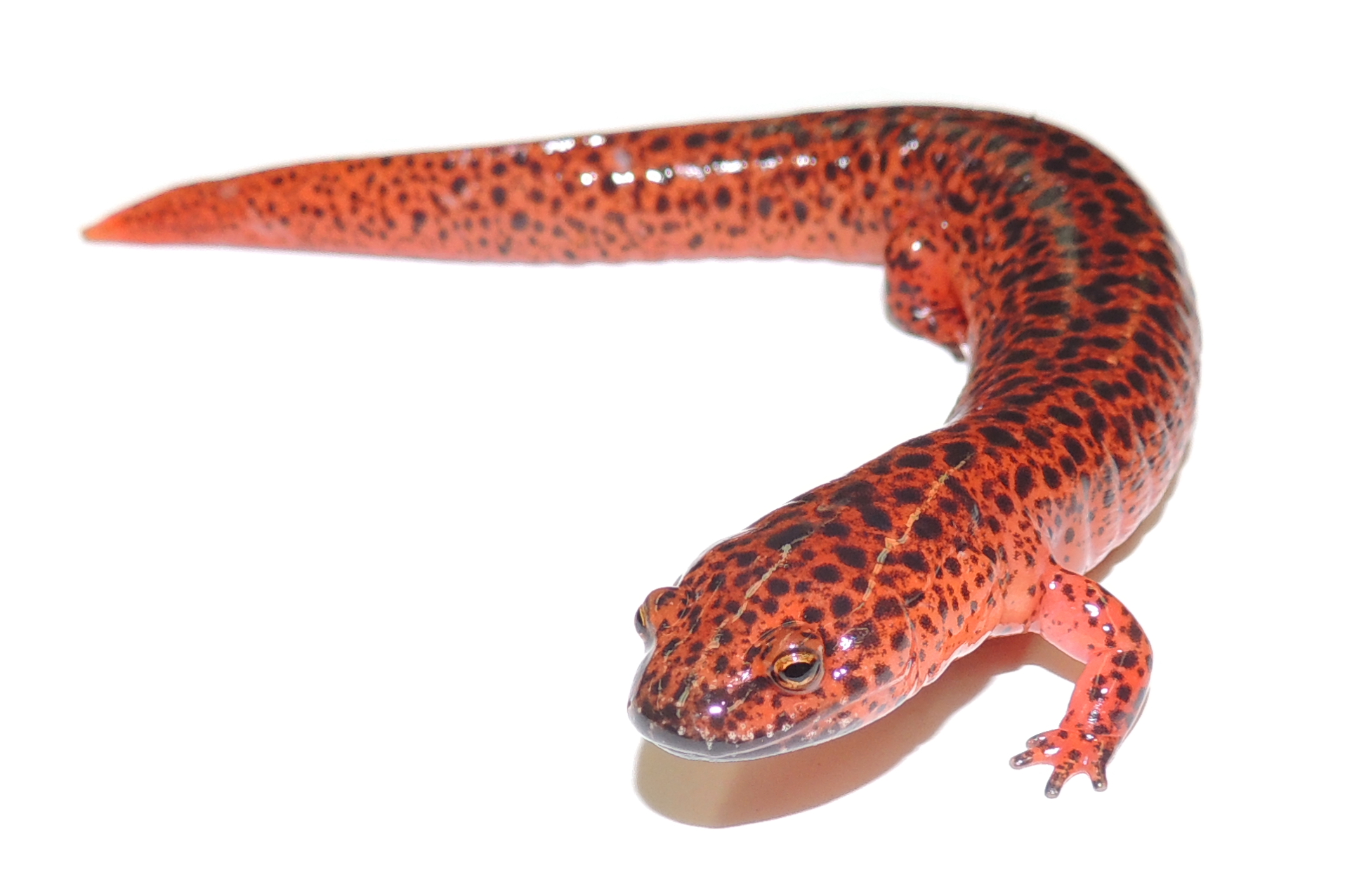
A bright orange-red salamander with scattered black spots and a slightly tubercular body. Among the most photogenic North American amphibians, but also among the most habitat-specific — requires clean cold spring-fed water.
§ Quick facts
§ Encyclopedia
The red salamander is a species of salamander in the family Plethodontidae endemic to the Eastern United States. Its skin is brown, orange or red with random black spots. Semiaquatic adults and aquatic larvae live in temperate forests, small creeks, bogs, ponds, intermittent streams, and freshwater springs. Overall this species is common and widespread, but locally it has declined because of habitat loss and it is considered threatened in Indiana and New York. Red salamanders eat insects, earthworms, spiders, small crustaceans, snails, and smaller salamanders. To eat, they extend their tongue to capture prey on the tip of it and retract it back into their mouths. The red salamander, as a member of the family Plethodontidae lacks lungs and respires through its skin.
Source: Wikipedia — Red salamander Licensed under CC BY-SA 4.0
§ Identification
Field marks. Medium-sized salamander with rich red-orange body marked with prominent rounded black spots; tail relatively short; broad head; legs robust.
Similar species. Mud Salamander (similar but darker). Cave Salamander (similar but longer tail). Spring Salamander (very similar; range overlap; different head shape).
Voice. Silent.
§ Diet & behavior
Diet. Small invertebrates (springtails, mites, small insects, worms).
Behavior. Largely terrestrial salamander of eastern forests. Lungless (like all Plethodontidae) — breathes entirely through skin and mouth lining. Reddish-orange body with black spots is distinctive. Found under rocks, logs, and in leaf litter of moist hardwood forests. Females lay eggs in moist upland soil and guard them until hatching — among the few salamanders with terrestrial egg-laying.
§ Range
Eastern US
§ Habitat
Cold clear springs, seeps, small streams
§ Threats
Spring contamination, headwater stream degradation, mountaintop mining.
§ Conservation status
According to the IUCN Red List, the red salamander is currently classified as Least Concern.
§ What helps
Support clean headwater streams. Don't handle (sensitive skin). Oppose mountaintop coal mining.
§ Further reading
- Wikipedia — Red salamander
- www.nwf.org — authoritative profile of Pseudotriton ruber
- IUCN Red List · taxon 59443
- iNaturalist · taxon 27548
- GBIF occurrence records
- Encyclopedia of Life — Pseudotriton ruber
§ Sources cited
- AmphibiaWeb
- Davidson College Herpetology Lab
- USGS PWRC
- IUCN Red List 2014


