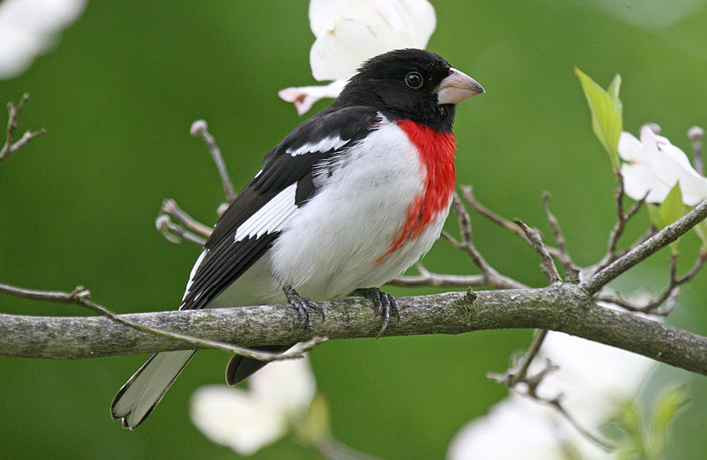
A striking finch — males are crisp black-and-white with a brilliant rose-red triangle on the breast. Females are streaky brown and easily mistaken for large sparrows. Frequent feeder visitors at sunflower seed.
§ Quick facts
§ Encyclopedia
The rose-breasted grosbeak, colloquially called "cut-throat" due to its coloration, is a large, seed-eating grosbeak in the cardinal family (Cardinalidae). It is primarily a foliage gleaner. Males have black heads, wings, backs, and tails, and a bright rose colored patch on their white breast. Males and females exhibit marked sexual dimorphism.
Source: Wikipedia — Rose-breasted grosbeak Licensed under CC BY-SA 4.0
§ Identification
Field marks. Male black-and-white with a brilliant rose-red triangle on the breast and a huge pale bill; female streaky brown with a bold white eyebrow and a heavy bill (rosy wing linings in flight).
Similar species. Black-headed Grosbeak (West) male is orange below; the male Rose-breasted's white belly with a rose bib is diagnostic, and females show crisp streaking.
Voice. A sweet, rich, robin-like warble; call a distinctive sharp, squeaky 'eek' (like a sneaker on a gym floor).
§ Diet & behavior
Diet. Seeds, insects, fruits.
Behavior. A grosbeak of eastern and northern deciduous forest; males sing a rich robin-like warble from the canopy and share incubation. Crushes seeds with a massive bill but also eats insects and fruit.
§ Range
Eastern and central North America in summer; winters in Central and South America
§ Habitat
Deciduous woodlands, forest edges, suburban yards with mature trees
§ Threats
Forest fragmentation, tropical wintering habitat loss, window strikes.
§ Conservation status
According to the IUCN Red List, the rose-breasted grosbeak is currently classified as Least Concern.
§ What helps
Maintain forest cover. Use window decals. Plant native fruit-bearing shrubs.
§ Further reading
- Wikipedia — Rose-breasted grosbeak
- www.allaboutbirds.org — authoritative profile of Pheucticus ludovicianus
- IUCN Red List — search for Pheucticus ludovicianus
- GBIF occurrence records
- Encyclopedia of Life — Pheucticus ludovicianus
§ Sources cited
- Cornell Lab of Ornithology — All About Birds
- National Audubon Society
- iNaturalist
- IUCN Red List


