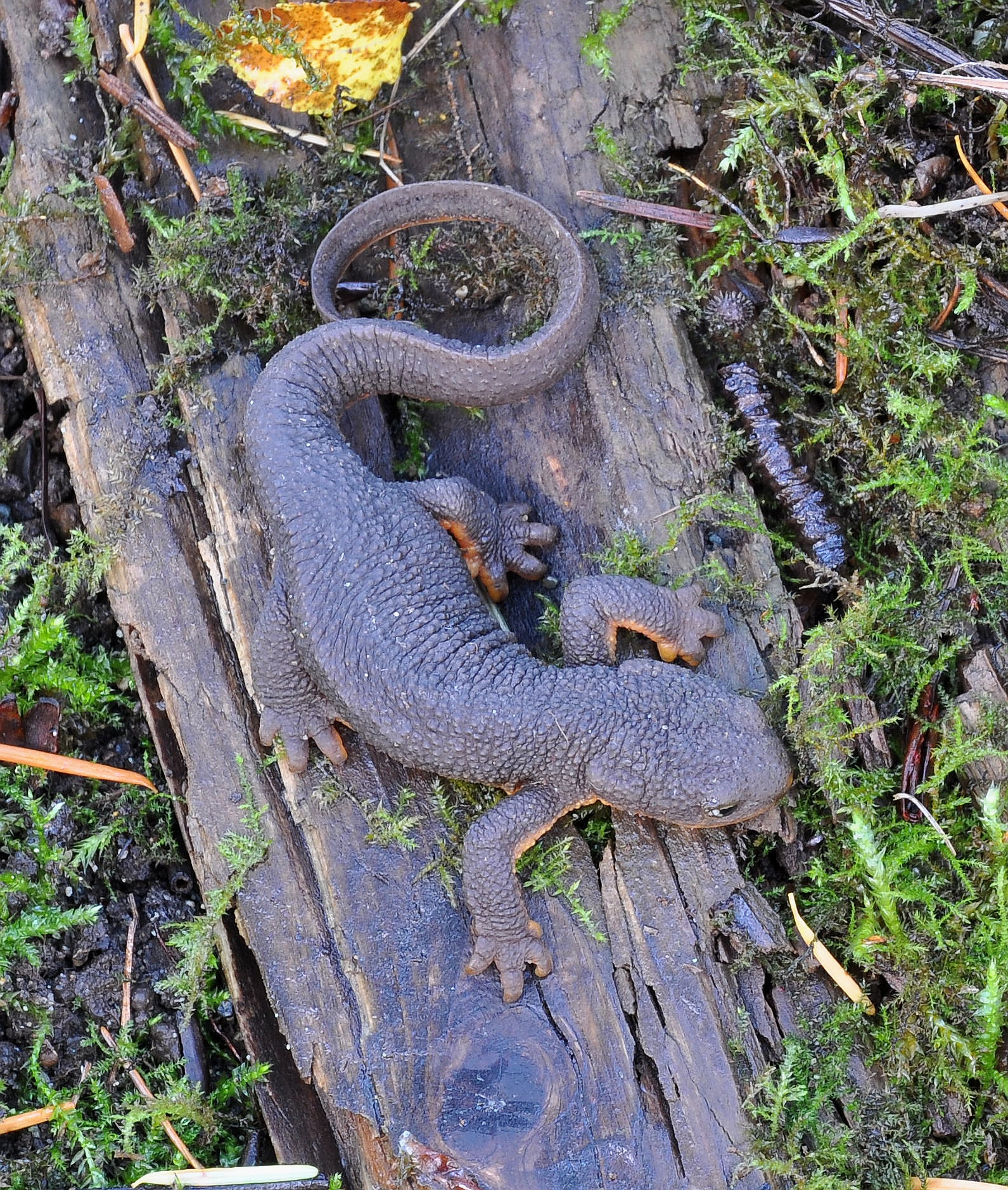
A modest-looking newt that contains the same neurotoxin as a pufferfish — tetrodotoxin. A single rough-skinned newt has enough toxin to kill 10–20 adult humans, and they're evolving stronger doses to keep up with toxin-resistant garter snake predators.
§ Quick facts
§ Encyclopedia
The rough-skinned newt or roughskin newt is a North American newt known for the strong toxin exuded from its skin.
Source: Wikipedia — Rough-skinned newt Licensed under CC BY-SA 4.0
§ Identification
Field marks. Stocky dark brown to nearly black newt with bright orange-yellow belly; rough granular skin (vs. smooth-skinned eastern newts); broad head.
Similar species. Red-bellied Newt (similar but smaller; Mendocino-Sonoma only). Sierra Newt (lower elevation; similar pattern). California Newt (drier-skinned).
Voice. Silent.
§ Diet & behavior
Diet. Insects, snails, small crustaceans, small frog eggs and tadpoles.
Behavior. Among the most toxic vertebrates in North America. Skin produces tetrodotoxin (TTX) — same neurotoxin found in pufferfish — in concentrations high enough to kill many predators. Predator garter snakes (Thamnophis sirtalis) have evolved resistance to the toxin; the evolutionary "arms race" between newt and snake has been studied for decades. Humans should never eat these or any salamander.
§ Range
Pacific Northwest from Alaska to northern California
§ Habitat
Cool moist forests, ponds, slow streams
§ Threats
Habitat loss, road mortality during breeding migrations.
§ Conservation status
According to the IUCN Red List, the rough-skinned newt is currently classified as Least Concern.
§ What helps
Don't handle newts (and absolutely don't put your hand in your mouth after). Support old-growth forest protection.
§ Further reading
- Wikipedia — Rough-skinned newt
- www.nwf.org — authoritative profile of Taricha granulosa
- IUCN Red List · taxon 59477
- iNaturalist · taxon 27563
- GBIF occurrence records
- Encyclopedia of Life — Taricha granulosa
§ Sources cited
- AmphibiaWeb
- Brodie & Brodie newt-snake coevolution research (Utah State)
- Oregon State University
- IUCN Red List 2014


