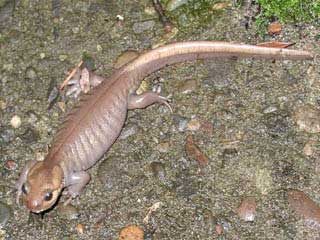
A medium-sized salamander with prominent parotoid glands. Some populations retain larval features into adulthood (neotenic).
§ Quick facts
§ Encyclopedia
The northwestern salamander is a species of mole salamander that inhabits the northwest Pacific coast of North America. These fairly large salamanders grow to 8.7 in (220 mm) in length. It is found from southeastern Alaska on May Island, through Washington and Oregon south to the mouth of the Gualala River, Sonoma County, California. It occurs from sea level to the timberline, but not east of the Cascade Divide. Its range includes Vancouver Island in British Columbia and The San Juan Islands, Cypress, Whidbey, Bainbridge, and Vashon Islands in Washington.
Source: Wikipedia — Northwestern salamander Licensed under CC BY-SA 4.0
§ Identification
Field marks. Stocky dark gray salamander; smooth skin; rounded snout; prominent parotoid glands.
Similar species. Other Ambystoma species. Pacific Giant Salamander (much larger).
Voice. Some neotenic adults squeak.
§ Diet & behavior
Diet. Aquatic invertebrates, small fish, frog eggs.
Behavior. Mole salamander of Pacific Northwest forests. Some populations retain external gills throughout life (neoteny). Lives in cool moist coniferous forests.
§ Range
Pacific Northwest
§ Habitat
Coniferous forests, mountain lakes
§ Threats
Forest loss, climate change.
§ Conservation status
According to the IUCN Red List, the northwestern salamander is currently classified as Least Concern.
§ What helps
Support Pacific Northwest forest conservation.
§ Further reading
- Wikipedia — Northwestern salamander
- www.nwf.org — authoritative profile of Ambystoma gracile
- IUCN Red List · taxon 59092
- iNaturalist · taxon 27551
- GBIF occurrence records
- Encyclopedia of Life — Ambystoma gracile
§ Sources cited
- AmphibiaWeb
- Oregon State University
- IUCN Red List 2014


