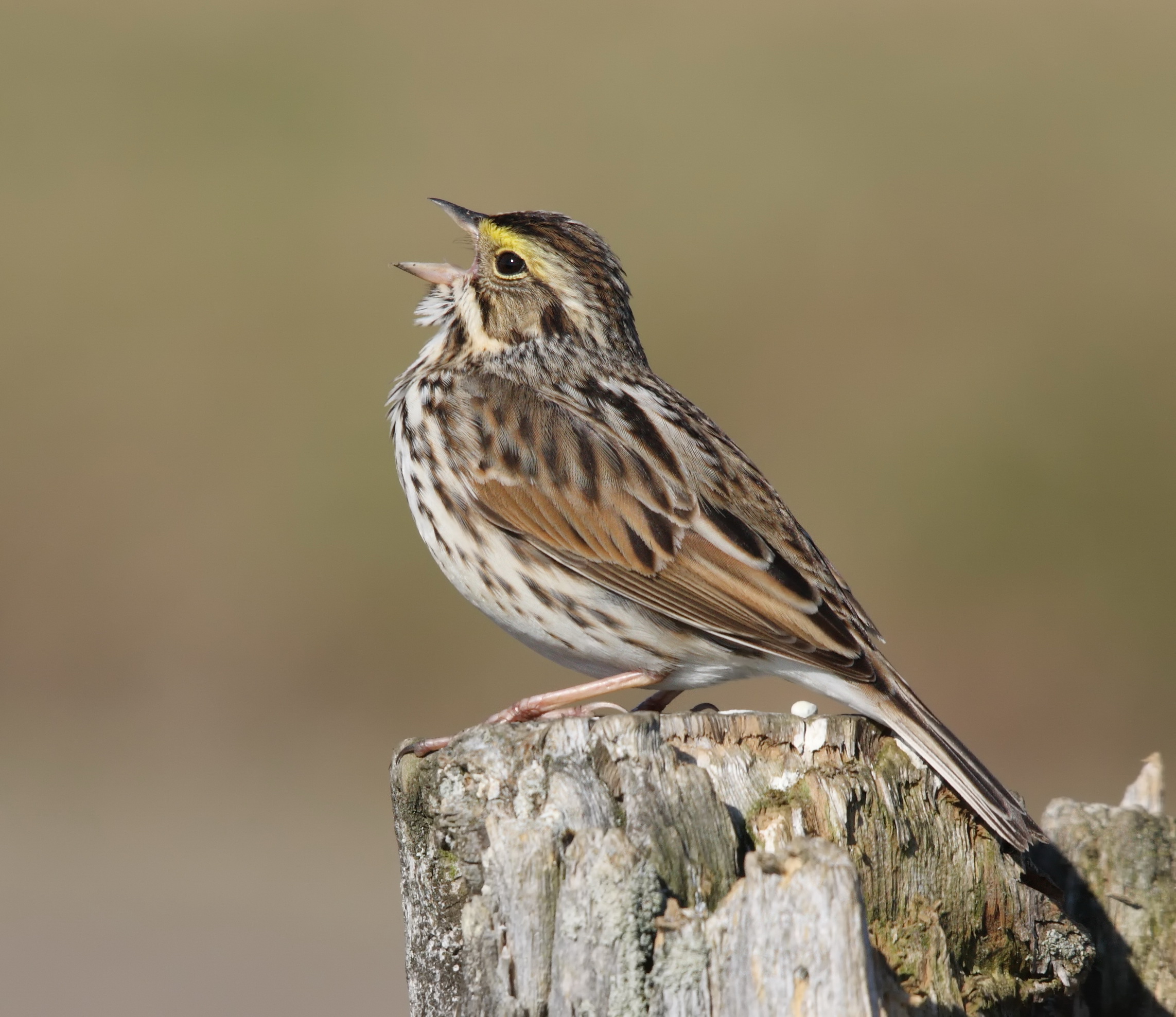
A streaky brown sparrow of open country with a distinctive yellow eyebrow stripe and short notched tail. One of the most abundant grassland birds — yet declining sharply with prairie conversion.
§ Quick facts
§ Encyclopedia
The Savannah sparrow is a small New World sparrow that is the only member of the genus Passerculus. It is a widespread and abundant species that occupies open grassland habitats in North America.
Source: Wikipedia — Savannah sparrow Licensed under CC BY-SA 4.0
§ Identification
Field marks. Streaked brown sparrow with a short notched tail, pink legs, crisp breast streaking, and (usually) a yellow wash on the lores above the eye.
Similar species. Song Sparrow is larger with a longer rounded tail and bolder central breast spot; the yellow lores and short tail point to Savannah.
Voice. A buzzy, insect-like song: 'tsip-tsip-tsip-tseeee-tsaaay', the last notes dropping.
§ Diet & behavior
Diet. Seeds (primary), insects (especially during breeding).
Behavior. An abundant sparrow of open grasslands, fields, and shorelines; forages on the ground and runs through grass. Highly variable across its huge range.
§ Range
Across most of North America
§ Habitat
Open grasslands, fields, salt marshes, alpine tundra
§ Threats
Grassland conversion, early haying, pesticide drift.
§ Conservation status
According to the IUCN Red List, the savannah sparrow is currently classified as Least Concern.
§ What helps
Delay haying until after August 1. Support grassland conservation. Skip lawn pesticides.
§ Further reading
- Wikipedia — Savannah sparrow
- www.allaboutbirds.org — authoritative profile of Passerculus sandwichensis
- IUCN Red List — search for Passerculus sandwichensis
- GBIF occurrence records
- Encyclopedia of Life — Passerculus sandwichensis
§ Sources cited
- Cornell Lab of Ornithology — All About Birds
- National Audubon Society
- iNaturalist
- IUCN Red List


