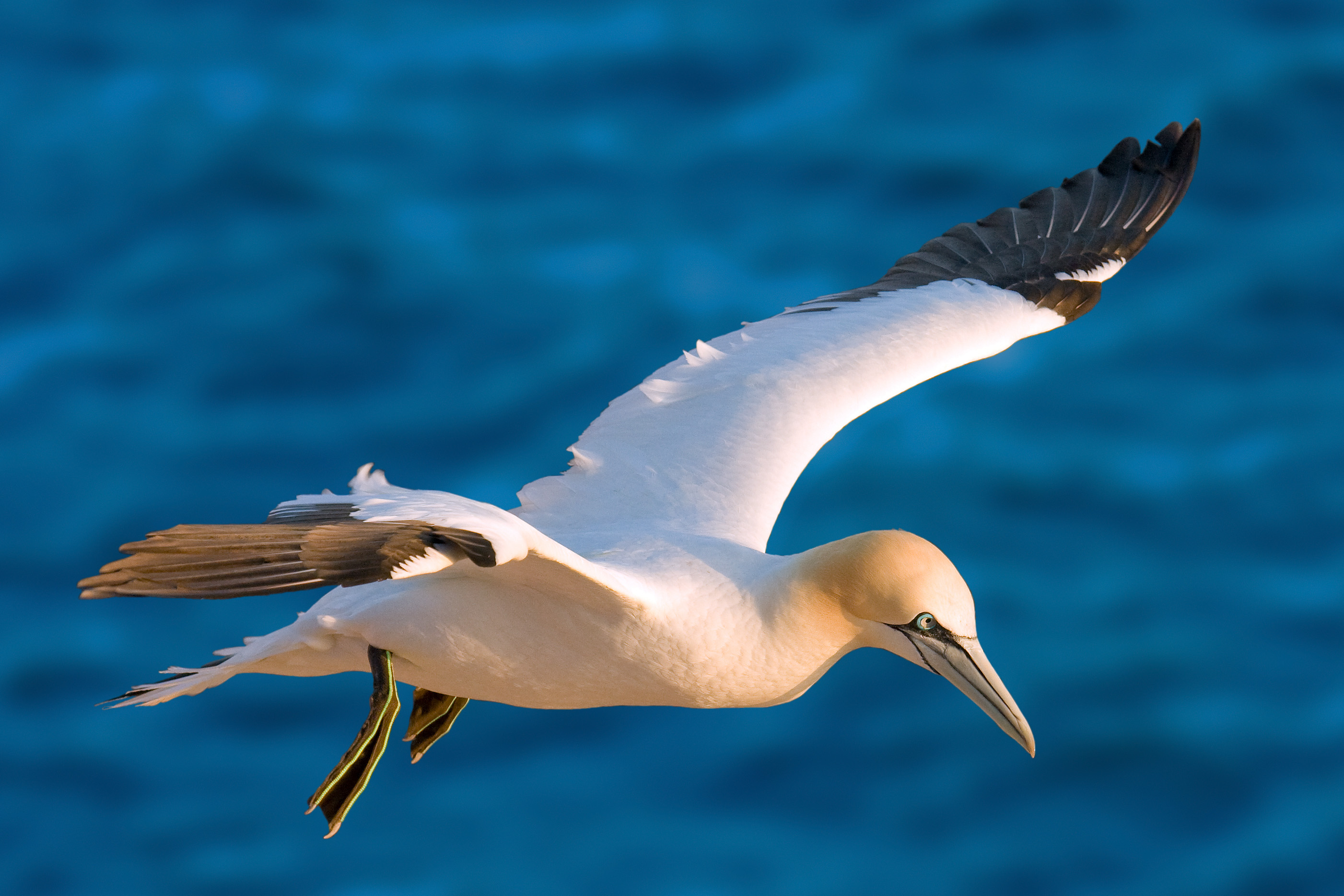
A large white seabird with black wingtips.
§ Quick facts
§ Encyclopedia
The Northern gannet is a seabird, the largest species of the gannet family, Sulidae. It is native to the coasts of the North Atlantic Ocean, breeding in Western Europe and Northeastern North America. It is the largest seabird in the northern Atlantic. The sexes are similar in appearance. The adult northern gannet has a mainly white streamlined body with a long neck, and long and slender wings. It is 87–100 cm long with a 170–180 cm (67–71 in) wingspan. The head and nape have a buff tinge that is more prominent in breeding season, and the wings are edged with dark brown-black feathers. The long, pointed bill is blue-grey, contrasting with black, bare skin around the mouth and eyes. Juveniles are mostly grey-brown, becoming increasingly white in the five years it takes them to reach maturity.
Source: Wikipedia — Northern gannet Licensed under CC BY-SA 4.0
§ Identification
Field marks. Large, cigar-shaped white seabird with long black-tipped wings, a buffy-yellow wash on the head, and a long pointed bill and tail; immatures dark and speckled, whitening over several years.
Similar species. Gulls are smaller with broader wings and lack the pointed-at-both-ends shape; the gannet's size, black wingtips, and dramatic plunge-diving are distinctive.
Voice. Harsh, grating 'rah-rah-rah' at the colony; silent at sea.
§ Diet & behavior
Diet. Fish caught at surface; some species steal from other seabirds.
Behavior. A spectacular plunge-diver of the North Atlantic that folds its wings and hits the water from up to 30 m to catch fish, with air sacs cushioning the impact; nests in vast, dense cliff colonies.
§ Range
North Atlantic
§ Habitat
Coastal waters
§ Threats
Habitat loss, climate change.
§ Conservation status
According to the IUCN Red List, the northern gannet is currently classified as Least Concern.
§ What helps
Support coastal conservation.
§ Further reading
- Wikipedia — Northern gannet
- www.allaboutbirds.org — authoritative profile of Morus bassanus
- IUCN Red List — search for Morus bassanus
- GBIF occurrence records
- Encyclopedia of Life — Morus bassanus
§ Sources cited
- Cornell Lab of Ornithology — All About Birds
- National Audubon Society
- iNaturalist
- IUCN Red List


