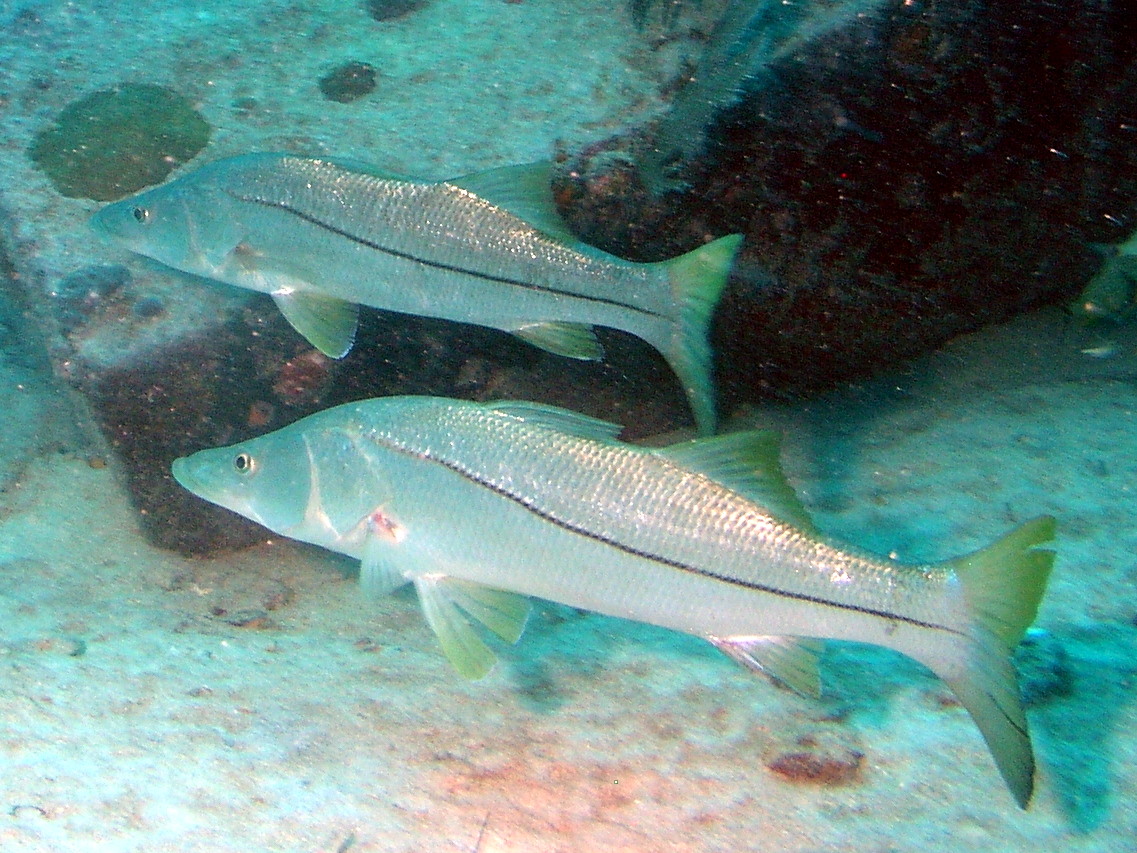
A sleek silvery gamefish with a distinctive black lateral line. Highly prized by Florida anglers — they're cold-sensitive and major freezes (2010) can kill enormous numbers.
§ Quick facts
§ Encyclopedia
The common snook is a species of marine fish in the family Centropomidae of the order Perciformes. The common snook is also known as the sergeant fish or robalo. It was originally assigned to the sciaenid genus Sciaena; Sciaena undecimradiatus and Centropomus undecimradiatus are obsolete synonyms for the species.
Source: Wikipedia — Common snook Licensed under CC BY-SA 4.0
§ Identification
Field marks. Streamlined silvery-yellow fish with distinctive prominent black lateral line running from gill cover to tail; deeply forked tail; underslung lower jaw projecting beyond upper.
Similar species. Other Centropomus species (different ranges). Tarpon (much larger; different scales). Striped Bass (different range; different tail).
Voice. Silent.
§ Diet & behavior
Diet. Smaller fish (mullet, sardines, anchovies), shrimp, crabs.
Behavior. Tropical fish at northern limit of range in southern Florida; cannot tolerate water below ~55°F (13°C). Major 2010 cold snap killed estimated millions of Florida snook. Sex changes from male to female with age — typical fish under 5 lbs are male; over 8 lbs are female (protandrous hermaphroditism). Mostly caught and released by anglers; recreational regulations include slot limits and seasonal closures.
§ Range
Coastal southern Florida, Gulf of Mexico, Caribbean
§ Habitat
Mangroves, beaches, estuaries, even into fresh water
§ Threats
Cold-snap mortality, coastal development, water-quality decline, overfishing.
§ Conservation status
According to the IUCN Red List, the common snook is currently classified as Least Concern.
§ What helps
Support mangrove protection. Practice strict catch-and-release in cold periods. Follow size and bag limits.
§ Further reading
- Wikipedia — Common snook
- www.nwf.org — authoritative profile of Centropomus undecimalis
- IUCN Red List · taxon 190996
- iNaturalist · taxon 49619
- GBIF occurrence records
- Encyclopedia of Life — Centropomus undecimalis
§ Sources cited
- NOAA Fisheries
- Florida FWC
- Mote Marine Laboratory
- Snook & Gamefish Foundation
- IUCN Red List 2018


