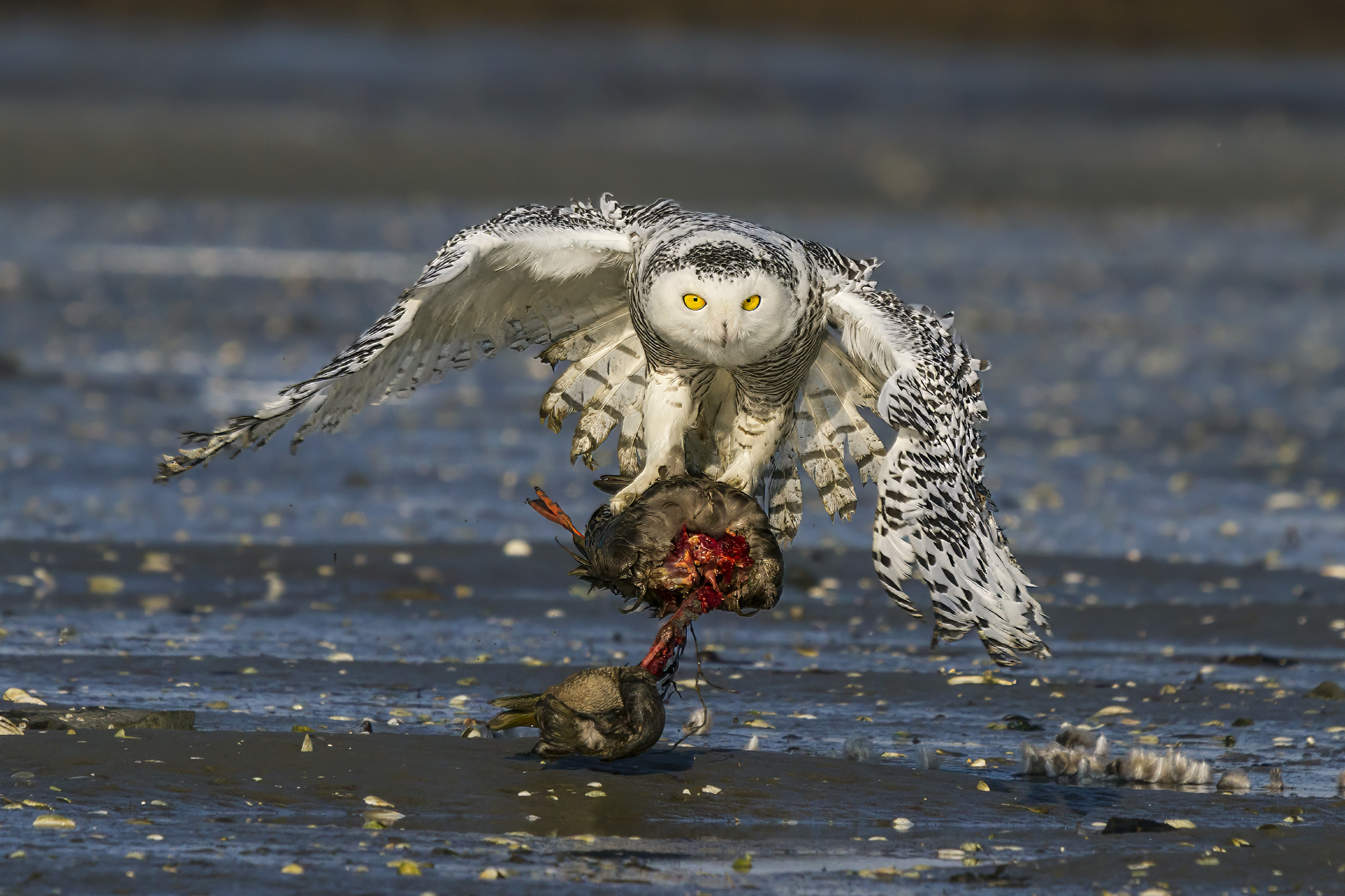
Massive white owls that hunt by day and rely on rodent populations to determine breeding success and migration patterns.
§ Quick facts
§ Encyclopedia
The snowy owl, also known as the polar owl, the white owl and the Arctic owl, is a large, white owl of the true owl family. Snowy owls are native to the Arctic regions of both North America and the Palearctic, breeding mostly on the tundra. It has a number of unique adaptations to its habitat and lifestyle, which are quite distinct from other extant owls. One of the largest species of owl, it is the only owl with mainly white plumage. Males tend to be a purer white overall while females tend to have more extensive flecks of dark brown. Juvenile male snowy owls have dark markings and may appear similar to females until maturity, at which point they typically turn whiter. The composition of brown markings about the wing, although not foolproof, is the most reliable technique for aging and sexing individual snowy owls.
Source: Wikipedia — Snowy owl Licensed under CC BY-SA 4.0
§ Identification
Field marks. Massive white owl with variable black or brown markings. Males approach pure white with age; females remain heavily barred. Round head with yellow eyes; no ear tufts.
Similar species. None really — but partial-albino Great Horned Owls have caused confusion. Always check for the smooth head (no tufts).
Voice. Generally silent in winter range. On breeding grounds, deep booming "krooh-krooh" hoots.
§ Diet & behavior
Diet. Mainly small mammals (voles, lemmings, hares); also waterfowl, gulls, and other birds when irrupting south.
Behavior. Highly nomadic, following prey cycles. Hunts day and night during summer's 24-hour Arctic daylight. Often perches on the ground or low posts.
§ Range
Arctic Circle in summer; irregular winter irruptions south to mid-US
§ Habitat
Treeless tundra, open fields, dunes, and airfields during winter
§ Threats
Climate change altering Arctic prey cycles, vehicle collisions during winter irruptions, lead poisoning.
§ Conservation status
According to the IUCN Red List, the snowy owl is currently classified as Vulnerable.
§ What helps
Avoid disturbing roosting owls. Report sightings to citizen-science platforms like eBird. Support Arctic conservation.
§ Further reading
- Wikipedia — Snowy owl
- www.allaboutbirds.org — authoritative profile of Bubo scandiacus
- IUCN Red List · taxon 22689055
- iNaturalist · taxon 19350
- eBird · snoowl
- GBIF occurrence records
- Encyclopedia of Life — Bubo scandiacus
§ Sources cited
- Cornell Lab — All About Birds
- Project SNOWstorm
- IUCN Red List 2020
- Owl Research Institute


