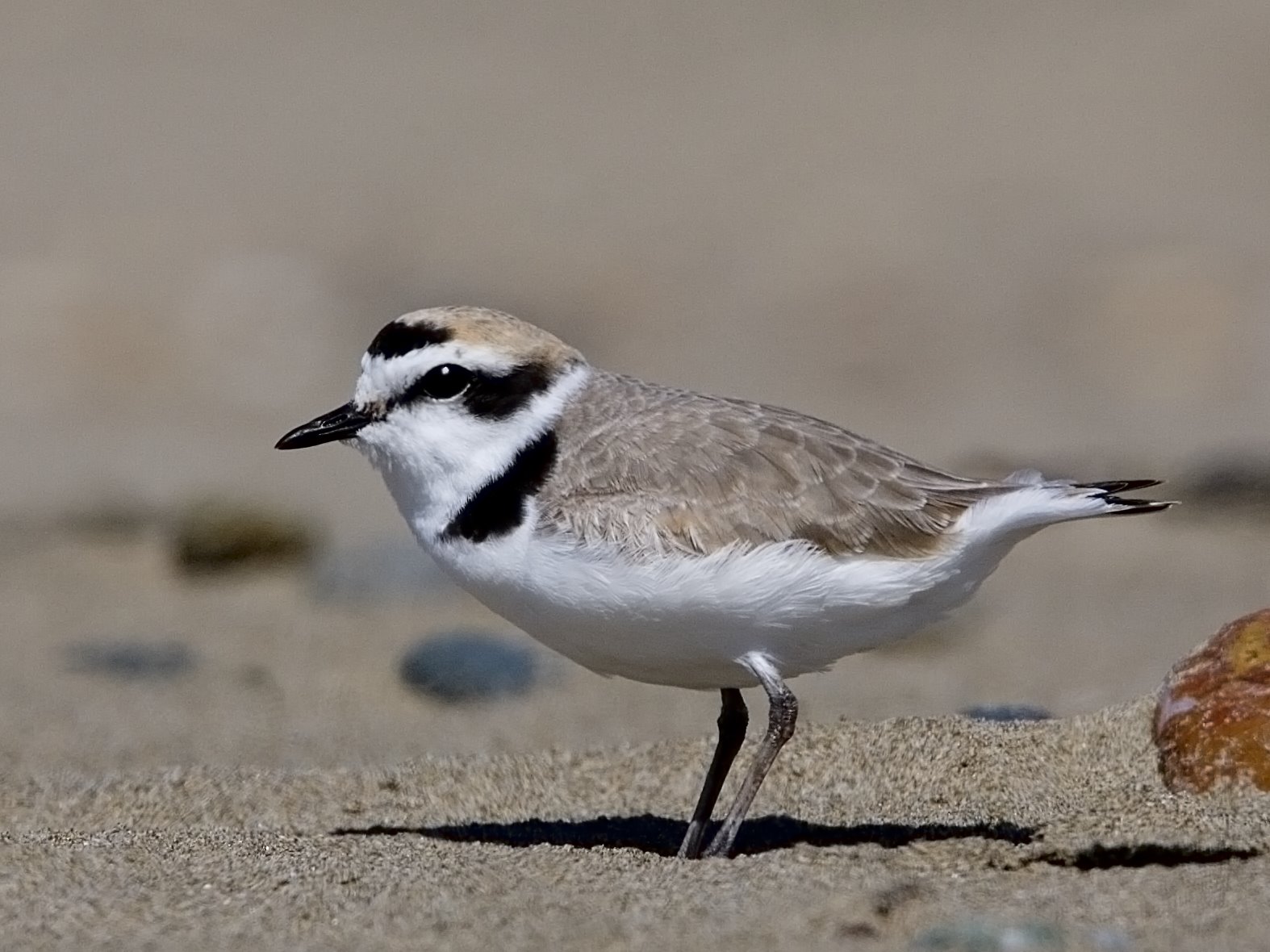
A tiny pale shorebird, even smaller and paler than piping plover. Pacific coast populations are federally threatened due to beach development and disturbance.
§ Quick facts
§ Encyclopedia
The snowy plover is a small shorebird found in the Americas. It is a member of the bird family Charadriidae, which includes the plovers, dotterels, and lapwings. The snowy plover was originally described by John Cassin in 1858, but was classified as a subspecies of the Kentish plover in 1922. Since 2011, the snowy plover has been recognized as a distinct species based on genetic and anatomical differences from the Kentish plover. Two or three subspecies are recognized, distributed along the Pacific coast of North America, Ecuador, Peru, and Chile, in several inland areas of the US and Mexico, along the Gulf Coast, and on Caribbean islands. The coastal populations consist of both residential and migratory birds, whereas the inland populations are mostly migratory. It is one of the best studied endemic shorebirds of the Americas, and one of the rarest.
Source: Wikipedia — Snowy plover Licensed under CC BY-SA 4.0
§ Identification
Field marks. Tiny, pale sandy-gray plover with a thin black bill, dark (often incomplete) shoulder patches rather than a full breast band, and grayish legs.
Similar species. Piping Plover has orange legs and a stubby orange-and-black bill; Snowy is paler with dark legs and a thin all-dark bill.
Voice. A soft, low whistled 'tu-wheet' and a purring trill.
§ Diet & behavior
Diet. Insects, small invertebrates from shoreline or open ground.
Behavior. A pale, threatened plover of sandy beaches, alkaline flats, and salt pans; nests in shallow scrapes on open sand, making it highly vulnerable to disturbance and predators.
§ Range
Pacific and Gulf coasts; inland alkaline flats
§ Habitat
Sandy beaches, salt flats, alkali playas
§ Threats
Coastal beach loss to development, dune destabilization from foot traffic, off-leash dogs.
§ Conservation status
According to the IUCN Red List, the snowy plover is currently classified as Near Threatened.
§ What helps
Respect beach closures. Stay off dunes. Support coastal preserves and snowy plover predator management.
§ Further reading
- Wikipedia — Snowy plover
- www.fws.gov — authoritative profile of Charadrius nivosus
- IUCN Red List — search for Charadrius nivosus
- GBIF occurrence records
- Encyclopedia of Life — Charadrius nivosus
§ Sources cited
- Cornell Lab of Ornithology — All About Birds
- National Audubon Society
- iNaturalist
- IUCN Red List


