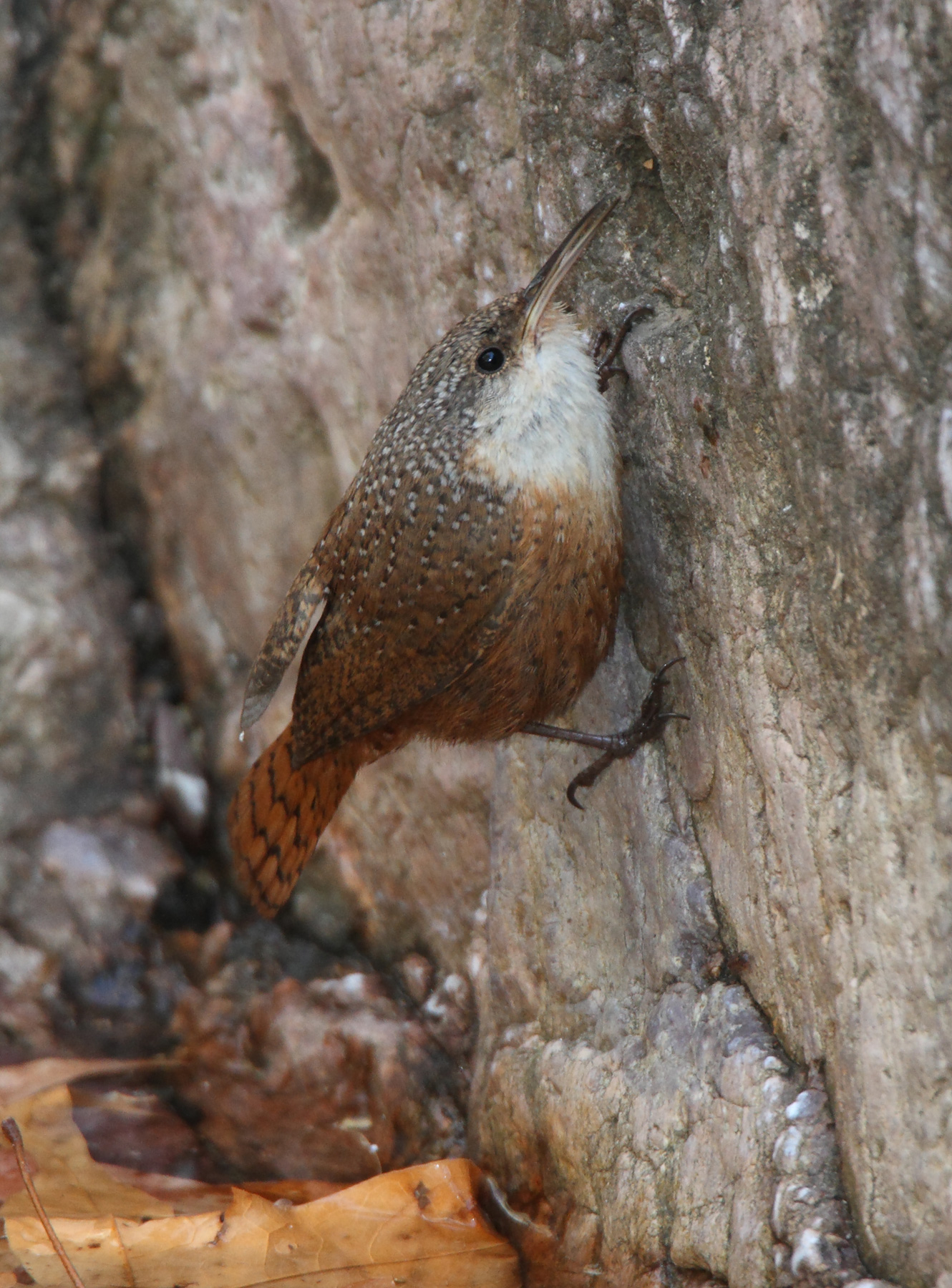
A small canyon-dwelling wren with extraordinarily long bill.
§ Quick facts
§ Encyclopedia
The canyon wren is a small North American songbird of the wren family Troglodytidae. A non-migratory species, these birds are found throughout western North America in dry, rocky environments such as cliffs, outcrops, and canyons. It is a small bird that is hard to see on its rocky habitat, and is often located by its loud distinctive song. It is currently in a monotypic taxon and is the only species in the genus Catherpes.
Source: Wikipedia — Canyon wren Licensed under CC BY-SA 4.0
§ Identification
Field marks. Rusty-brown wren with a contrasting bright white throat and breast, a long decurved bill, and a flattened head that helps it squeeze into rock cracks.
Similar species. Rock Wren is grayer with a buff (not white) breast; the Canyon Wren's white bib and rusty belly are diagnostic.
Voice. A beautiful cascading series of clear, sweet whistles tumbling down the scale and slowing at the end.
§ Diet & behavior
Diet. Insects and spiders gleaned from vegetation.
Behavior. A wren of steep rock faces, canyons, and cliffs that creeps over vertical rock and into crevices probing for insects; its cascading song is an iconic sound of the western canyonlands.
§ Range
Western US canyons
§ Habitat
Canyons and cliffs
§ Threats
Habitat loss.
§ Conservation status
According to the IUCN Red List, the canyon wren is currently classified as Least Concern.
§ What helps
Support western canyon conservation.
§ Further reading
- Wikipedia — Canyon wren
- www.allaboutbirds.org — authoritative profile of Catherpes mexicanus
- IUCN Red List — search for Catherpes mexicanus
- GBIF occurrence records
- Encyclopedia of Life — Catherpes mexicanus
§ Sources cited
- Cornell Lab of Ornithology — All About Birds
- National Audubon Society
- iNaturalist
- IUCN Red List


