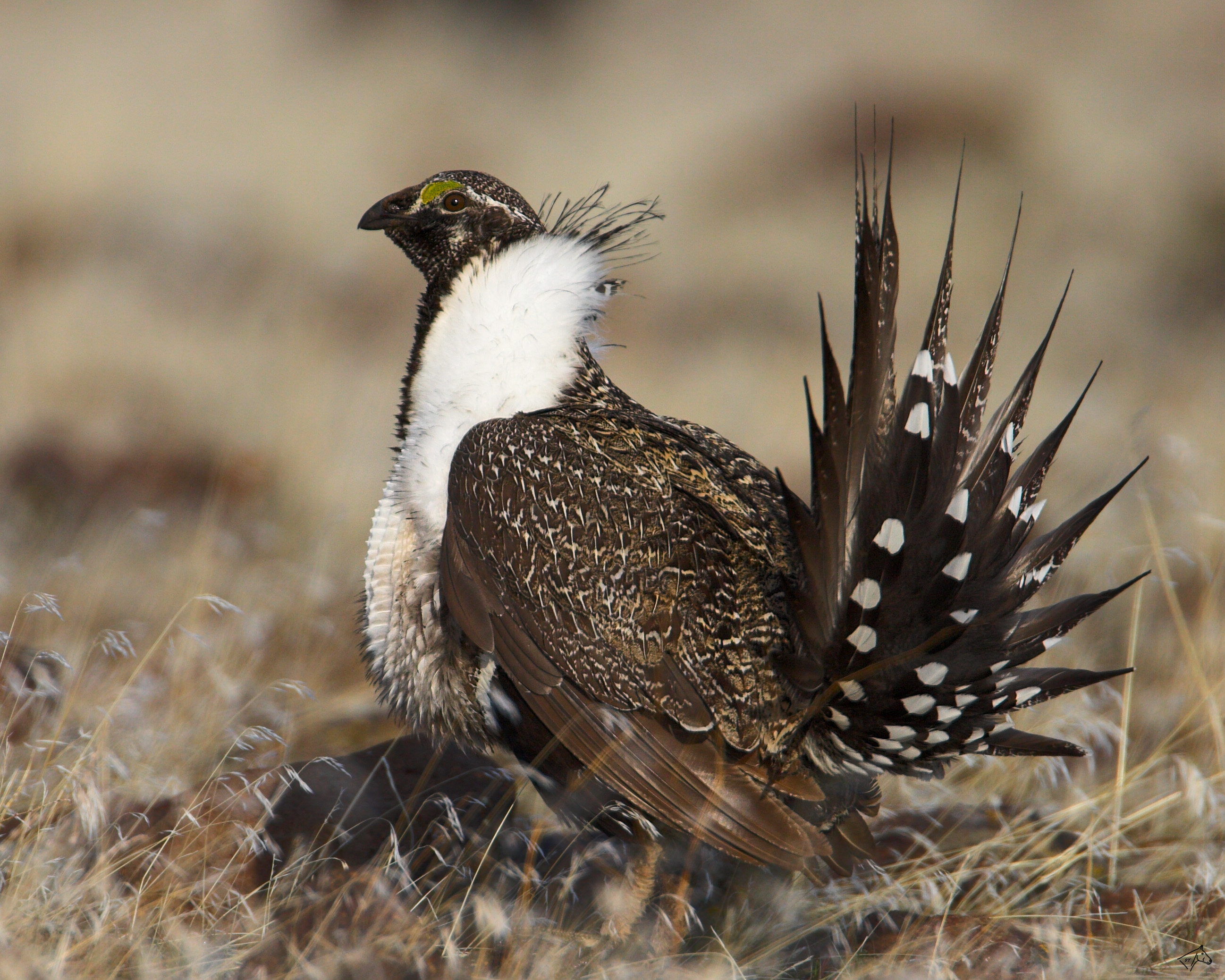
Large iconic sage-steppe grouse with elaborate breeding displays.
§ Quick facts
§ Encyclopedia
The greater sage-grouse, also known as the sagehen, is the largest grouse in North America. Its range is sagebrush country in the western United States and southern Alberta and Saskatchewan, Canada. It was known as simply the sage grouse until the Gunnison sage-grouse was recognized as a separate species in 2000. The Mono Basin population of sage grouse may also be distinct.
Source: Wikipedia — Greater sage-grouse Licensed under CC BY-SA 4.0
§ Identification
Field marks. Massive grouse with long pointed tail; males have white breast and large yellow neck sacs; females mottled gray-brown.
Similar species. Gunnison Sage-Grouse (smaller, split as separate species 2000). Sharp-tailed Grouse (white outer tail feathers; different lek display).
Voice. Males produce eerie "swish-coo" and popping sounds during lek display.
§ Diet & behavior
Diet. Adults: sagebrush leaves (especially in winter — sagebrush is ~90% of winter diet), other forbs, insects. Chicks: insects.
Behavior. Sagebrush-obligate species — cannot survive without intact sagebrush ecosystems. Males gather at communal "leks" each spring to perform spectacular strutting displays with inflated yellow air sacs producing a low-frequency popping sound. Same leks used for generations. Range has contracted 50% since 1800s; populations down 80%+ since 1965.
§ Range
Western sagebrush steppe
§ Habitat
Sagebrush habitats
§ Threats
Sagebrush loss.
§ Conservation status
According to the IUCN Red List, the sage grouse (greater) is currently classified as Near Threatened.
§ What helps
Support sagebrush conservation.
§ Further reading
- Wikipedia — Greater sage-grouse
- www.fws.gov — authoritative profile of Centrocercus urophasianus
- IUCN Red List · taxon 22679503
- iNaturalist · taxon 896
- eBird · grsgro
- GBIF occurrence records
- Encyclopedia of Life — Centrocercus urophasianus
§ Sources cited
- USFWS Sage-Grouse Conservation
- Bureau of Land Management
- Western Watersheds Project
- IUCN Red List 2016


