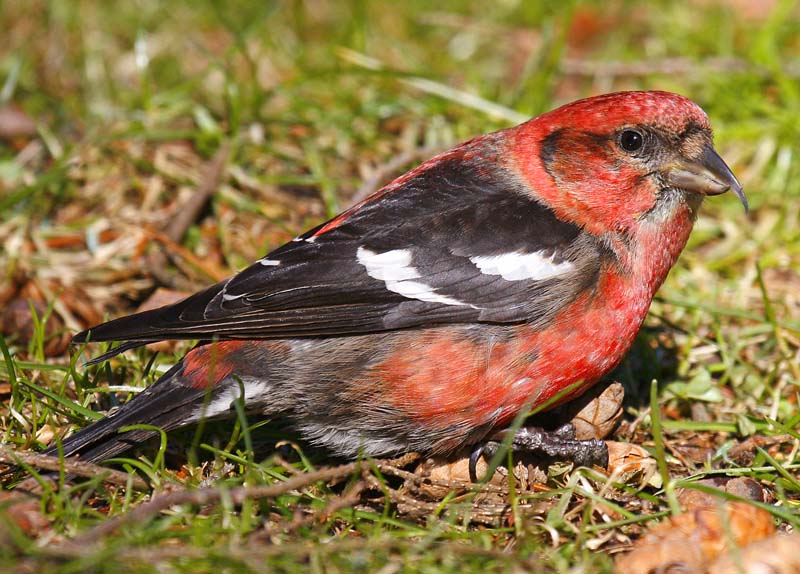
A small finch with crossed mandibles for prying open conifer cones. Distinct white wing bars.
§ Quick facts
§ Encyclopedia
The two-barred crossbill or white-winged crossbill is a small passerine bird in the finch family Fringillidae. It breeds in the coniferous forests of North America and the Palearctic.
Source: Wikipedia — Two-barred crossbill Licensed under CC BY-SA 4.0
§ Identification
Field marks. Crossed-bill finch with two bold white wing bars on black wings; males rosy-pink, females yellowish-olive and streaked.
Similar species. Red Crossbill has plain dark wings without wing bars; the bold white wing bars are diagnostic for White-winged.
Voice. A dry, rattling trill and liquid 'chif-chif' flight calls; song a series of mechanical trills.
§ Diet & behavior
Diet. Seeds (specialized for many species), occasional insects.
Behavior. A nomadic crossbill of northern spruce and larch forest; specializes on smaller, softer cones than the Red Crossbill and wanders widely tracking cone crops.
§ Range
Boreal Canada and Alaska
§ Habitat
Coniferous forests
§ Threats
Forest loss, climate change.
§ Conservation status
According to the IUCN Red List, the white-winged crossbill is currently classified as Least Concern.
§ What helps
Support boreal forest conservation.
§ Further reading
- Wikipedia — Two-barred crossbill
- www.allaboutbirds.org — authoritative profile of Loxia leucoptera
- IUCN Red List — search for Loxia leucoptera
- GBIF occurrence records
- Encyclopedia of Life — Loxia leucoptera
§ Sources cited
- Cornell Lab of Ornithology — All About Birds
- National Audubon Society
- iNaturalist
- IUCN Red List


