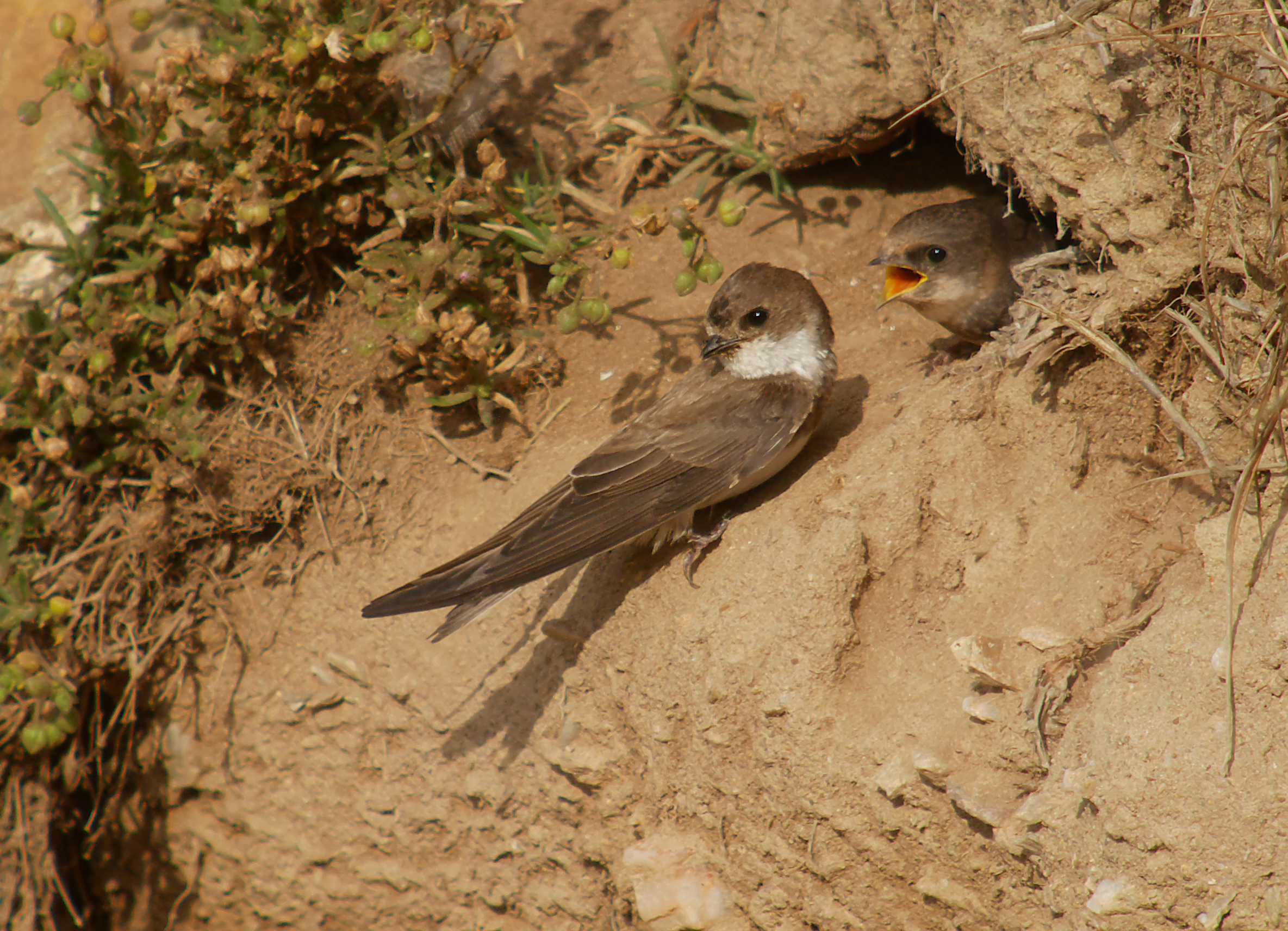
A small brown swallow that nests in burrows in river banks.
§ Quick facts
§ Encyclopedia
The sand martin, also known as the collared sand martin or common sand martin, and in the Americas as the bank swallow, is a migratory passerine bird in the swallow family Hirundinidae. It has a wide range in summer, embracing practically the whole Holarctic area, from Europe, across Asia to the Pacific Ocean, and throughout North America. It winters in eastern and southern Africa, southern Asia, and South America.
Source: Wikipedia — Sand martin Licensed under CC BY-SA 4.0
§ Identification
Field marks. Small brown-and-white swallow with distinct dark brown breast band (other US swallows lack this); pale chin and throat; slightly forked tail.
Similar species. Northern Rough-winged Swallow (warmer brown, no breast band). Tree Swallow (iridescent, no breast band). Cliff Swallow (square tail).
Voice. Soft buzzy "brrtt" twitter from colonies.
§ Diet & behavior
Diet. Flying insects caught in mid-air over water, fields, and marshes.
Behavior. Smallest swallow in North America. Nests in colonies of dozens to thousands of pairs by excavating horizontal burrows 60–90 cm deep into vertical sand or gravel banks. Critically dependent on natural river-bank erosion — bank stabilization, sand and gravel mining, and reservoir flooding have eliminated traditional colonies. Some populations have adapted to gravel-pit walls.
§ Range
Across North America
§ Habitat
River banks, gravel pits
§ Threats
Habitat loss to river-bank stabilization.
§ Conservation status
According to the IUCN Red List, the bank swallow is currently classified as Least Concern.
§ What helps
Support natural river-bank dynamics.
§ Further reading
- Wikipedia — Sand martin
- www.allaboutbirds.org — authoritative profile of Riparia riparia
- IUCN Red List · taxon 22712192
- iNaturalist · taxon 14857
- eBird · banswa
- GBIF occurrence records
- Encyclopedia of Life — Riparia riparia
§ Sources cited
- Cornell Lab — All About Birds
- National Audubon Society
- IUCN Red List 2018


