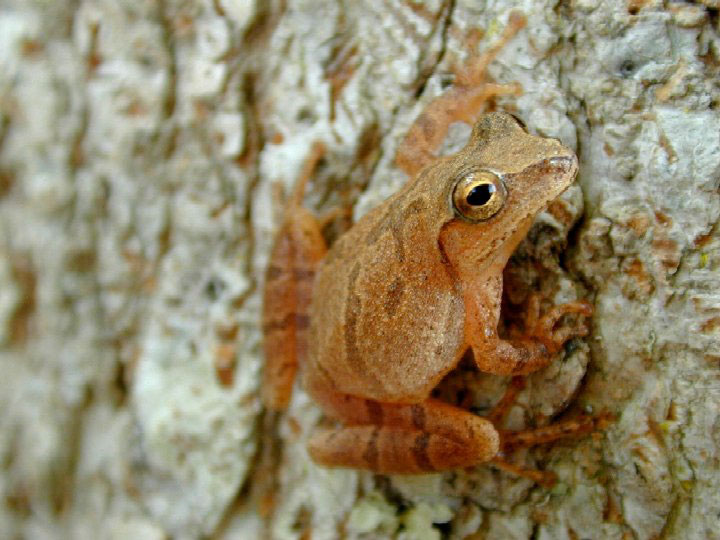
A tiny chorus frog (1 inch long) whose distinctive "peep, peep, peep" male advertisement call announces spring across eastern North America. A single chorus can include thousands of males calling at 100+ decibels at close range.
§ Quick facts
§ Encyclopedia
The spring peeper is a small chorus frog widespread throughout the eastern United States and eastern Canada. It prefers permanent ponds due to its advantage in avoiding predation; however, it is very adaptable with respect to the habitat it can live in. In northern regions, the frog is able to endure below freezing temperatures due to the capacity of its liver to exude and flush the bloodstream with a glucose cryoprotectant which acts both as an anti-freeze in its blood, and allows organs like the heart to enter into a state of protected dormancy. The peeper earned its name from its chirping call, which marks the beginning of spring. Crucifer is derived from the Latin root meaning "cross-bearing", a reference to the cross-like pattern on the spring peeper's dorsal side.
Source: Wikipedia — Spring peeper Licensed under CC BY-SA 4.0
§ Identification
Field marks. Tiny smooth-skinned tree frog with brown to tan body; distinctive dark X-shaped mark on back; small adhesive toe pads.
Similar species. Other small Hylids (different X pattern or no X). Other small frogs lack the adhesive toe pads.
Voice. High piercing whistled "peep peep peep" — male chorus is among the loudest natural sounds in eastern North America.
§ Diet & behavior
Diet. Small insects (gnats, midges, mites, springtails), small spiders.
Behavior. Iconic herald of spring across eastern North America — male choruses begin in late winter (sometimes through thin ice) and can be heard from over 1 km. Despite minute body, can produce calls reaching 90 decibels. Survives partial freezing of body fluids in winter by elevating blood glucose (a natural antifreeze) — among the most freeze-tolerant frogs known.
§ Range
Eastern North America from Canada to Florida
§ Habitat
Wooded wetlands and vernal pools
§ Threats
Vernal pool destruction, road mortality on rainy spring nights, pesticides, climate-driven phenology mismatches.
§ Conservation status
According to the IUCN Red List, the spring peeper is currently classified as Least Concern.
§ What helps
Maintain forested wetland buffers. Drive carefully on warm rainy spring evenings. Volunteer for FrogWatch USA monitoring.
§ Further reading
- Wikipedia — Spring peeper
- www.nwf.org — authoritative profile of Pseudacris crucifer
- IUCN Red List · taxon 55892
- iNaturalist · taxon 25564
- GBIF occurrence records
- Encyclopedia of Life — Pseudacris crucifer
§ Sources cited
- AmphibiaWeb
- USGS PWRC Amphibian Research and Monitoring Initiative
- National Park Service
- IUCN Red List 2014


