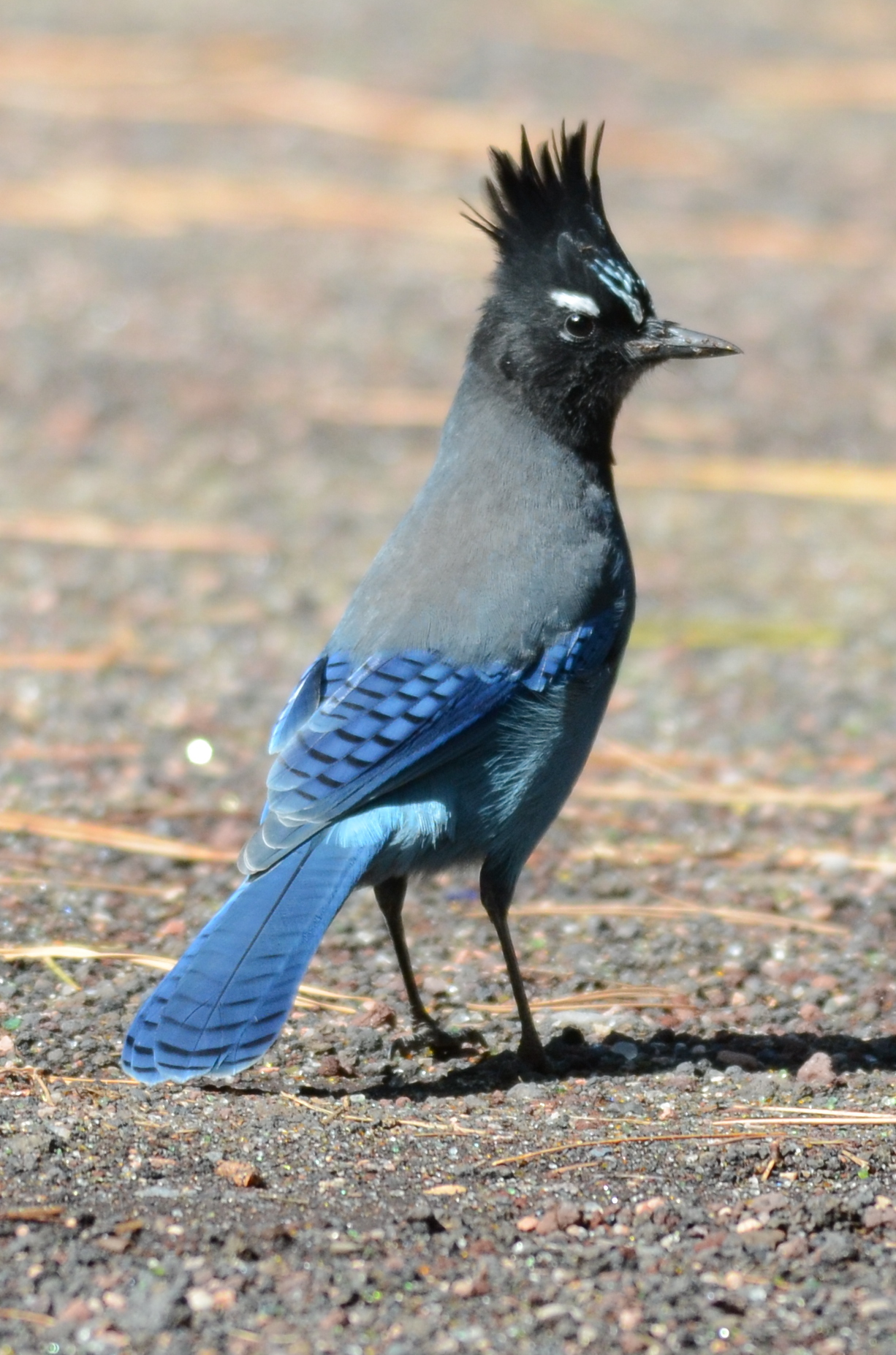
A stunning dark blue jay with a black crest and head — western counterpart to the blue jay. Bold and curious; frequent at campsites and high-elevation trails.
§ Quick facts
§ Encyclopedia
Steller's jay is a bird native to western North America and the mountains of Central America, closely related to the blue jay found in eastern North America. It is the only crested jay west of the Rocky Mountains. It is also sometimes colloquially called a "blue jay" in the Pacific Northwest, but is distinct from the blue jay of eastern North America. The species inhabits pine-oak and coniferous forests.
Source: Wikipedia — Steller's jay Licensed under CC BY-SA 4.0
§ Identification
Field marks. Charcoal-and-deep-blue jay with a tall blackish crest, a sooty head and breast, and a deep-blue body and tail with fine black barring.
Similar species. Blue Jay (eastern) is pale blue and white with a white face; Steller's is much darker with a black head and crest. Ranges barely overlap.
Voice. A harsh, descending 'shaack-shaack-shaack' and excellent imitations of Red-tailed Hawk.
§ Diet & behavior
Diet. Omnivorous: nuts, seeds, insects, eggs, carrion, small vertebrates.
Behavior. The dark, crested jay of western conifer and pine-oak forest; bold around campgrounds, it caches seeds, mimics hawks, and is the only North American jay with a tall crest.
§ Range
Western North American mountains
§ Habitat
Coniferous and mixed mountain forests
§ Threats
Western forest loss, increased predation pressure on songbirds.
§ Conservation status
According to the IUCN Red List, the steller's jay is currently classified as Least Concern.
§ What helps
Support mountain forest conservation. Don't feed at campsites.
§ Further reading
- Wikipedia — Steller's jay
- www.allaboutbirds.org — authoritative profile of Cyanocitta stelleri
- IUCN Red List — search for Cyanocitta stelleri
- GBIF occurrence records
- Encyclopedia of Life — Cyanocitta stelleri
§ Sources cited
- Cornell Lab of Ornithology — All About Birds
- National Audubon Society
- iNaturalist
- IUCN Red List


