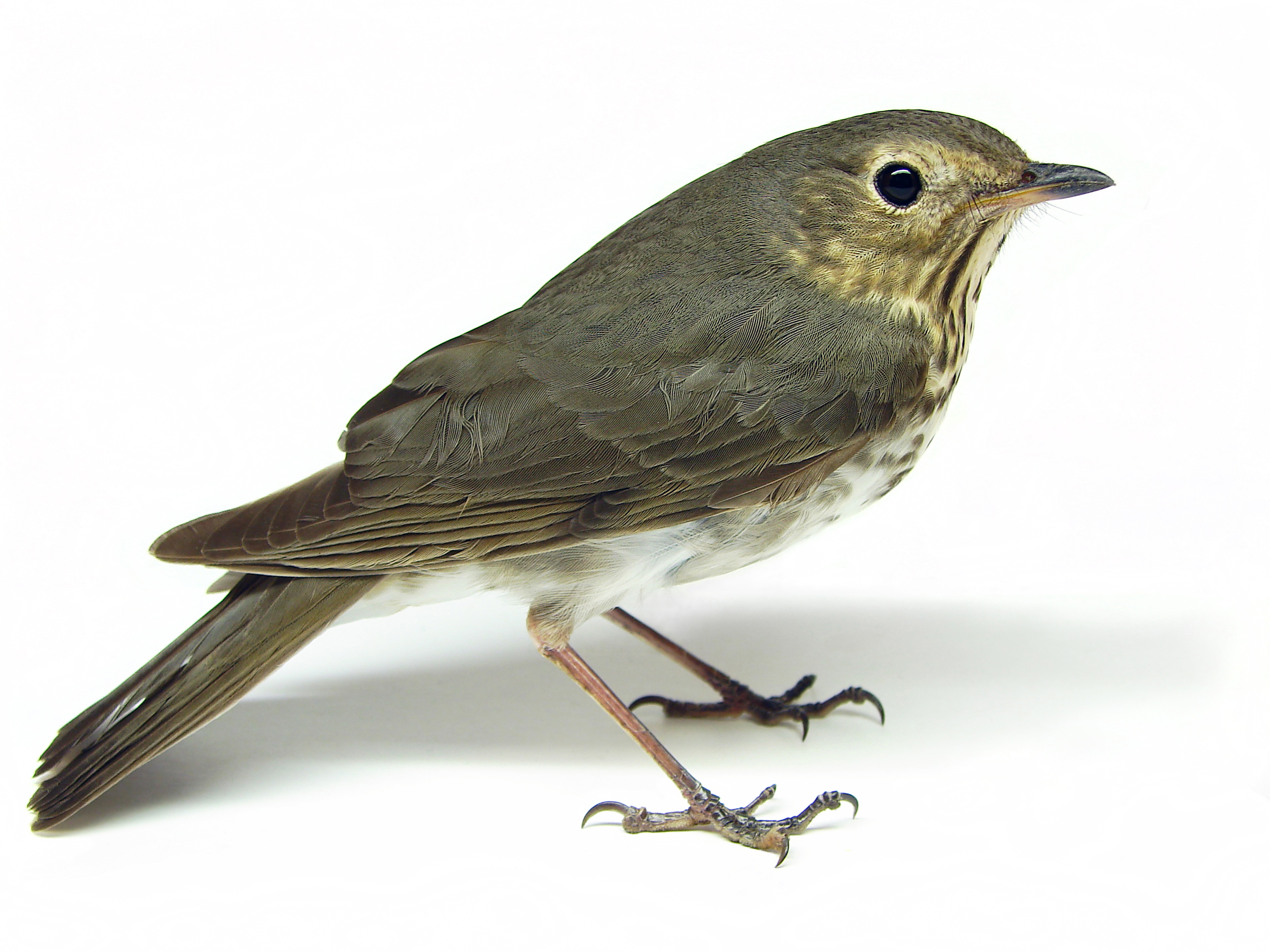
A medium-sized brown thrush with spotted breast. Sings spiraling flute-like song. Migrates 8,000+ km between Canada and South America.
§ Quick facts
§ Encyclopedia
Swainson's thrush, also called olive-backed thrush, russet-backed thrush, and salmonberry bird is a medium-sized thrush. It is a member of genus Catharus and is typical of it in terms of its subdued coloration and beautiful, ascending flute-like voice. Swainson's thrush was named after William Swainson, an English ornithologist.
Source: Wikipedia — Swainson's thrush Licensed under CC BY-SA 4.0
§ Identification
Field marks. Warm olive-brown above with a bold buffy eye ring and buffy cheeks ('spectacled' look) and a buff-washed, spotted breast.
Similar species. Gray-cheeked Thrush lacks the buffy spectacles; Hermit Thrush has a rusty tail; Veery is more uniformly cinnamon with faint spots.
Voice. A rising, spiraling series of flute-like phrases that ascend in pitch; call a liquid 'whit' or (night flight) a spring-peeper-like 'queep'.
§ Diet & behavior
Diet. Insects, worms, fruits.
Behavior. A common but retiring forest thrush and nocturnal migrant; its upward-spiraling song rises through northern and montane woods at dusk.
§ Range
Boreal Canada in summer; winters in South America
§ Habitat
Boreal coniferous and mixed forests
§ Threats
Boreal forest loss, climate change.
§ Conservation status
According to the IUCN Red List, the swainson's thrush is currently classified as Least Concern.
§ What helps
Support boreal forest conservation.
§ Further reading
- Wikipedia — Swainson's thrush
- www.allaboutbirds.org — authoritative profile of Catharus ustulatus
- IUCN Red List — search for Catharus ustulatus
- GBIF occurrence records
- Encyclopedia of Life — Catharus ustulatus
§ Sources cited
- Cornell Lab of Ornithology — All About Birds
- National Audubon Society
- iNaturalist
- IUCN Red List


