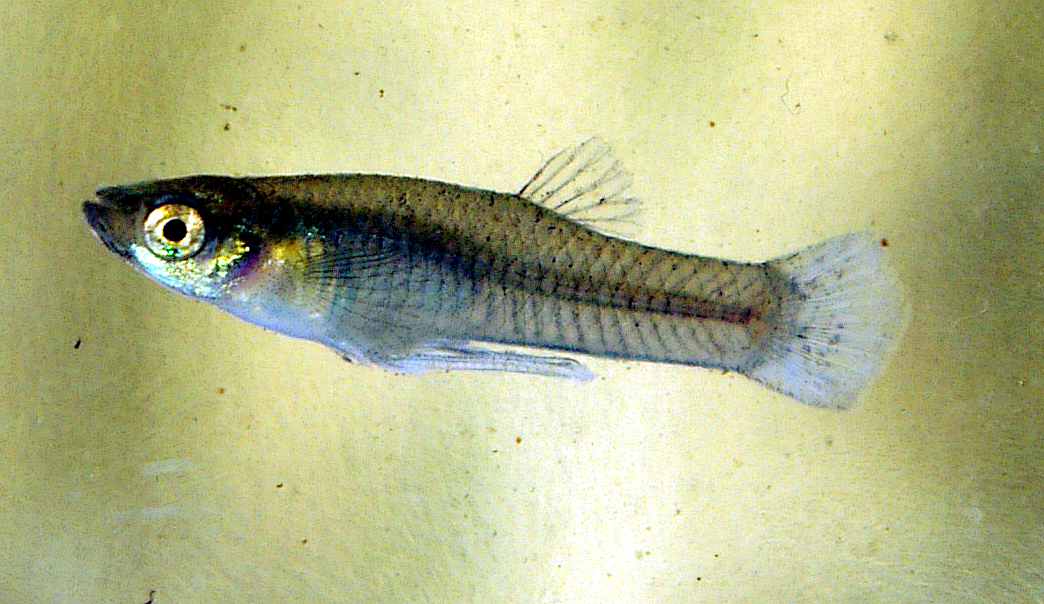
A tiny live-bearing native fish much-used worldwide for mosquito control. Despite their reputation, they're often less effective than native fish at controlling mosquitoes and aggressively displace native fauna.
§ Quick facts
§ Encyclopedia
The western mosquitofish is a North American freshwater poeciliid fish, also known commonly, if ambiguously, as simply mosquitofish or by its generic name, Gambusia, or by the common name gambezi. Its sister species, the eastern mosquitofish is also referred to by these names.
Source: Wikipedia — Mosquitofish Licensed under CC BY-SA 4.0
§ Identification
Field marks. Small slender fish with single dorsal fin; rounded tail; pale olive coloration with darker back; females larger than males.
Similar species. Eastern Mosquitofish (G. holbrooki — native to East Coast). Other Gambusia species. Native topminnows (Fundulidae; different fin pattern).
Voice. Silent.
§ Diet & behavior
Diet. Small aquatic invertebrates, especially mosquito larvae and pupae; also algae, fish eggs.
Behavior. Native to US Southeast but widely introduced worldwide for mosquito control. Highly effective at consuming mosquito larvae but also voracious predator of native fish eggs, other aquatic insects, and small native fish — making it harmful to native ecosystems wherever introduced outside historical range. Live-bearing (a key character of poeciliid family); females can store sperm and produce broods every 3–4 weeks.
§ Range
Native to central US; introduced globally for mosquito control
§ Habitat
Slow waters, marshes, ditches, ponds
§ Threats
In native range: habitat loss, water-quality decline. In introduced range: they ARE the threat.
§ Conservation status
According to the IUCN Red List, the western mosquitofish is currently classified as Least Concern.
§ What helps
In west: don't release mosquitofish. Plant native plants to control mosquitoes. Encourage dragonfly habitat.
§ Further reading
- Wikipedia — Mosquitofish
- www.nwf.org — authoritative profile of Gambusia affinis
- IUCN Red List · taxon 202386
- iNaturalist · taxon 49619
- GBIF occurrence records
- Encyclopedia of Life — Gambusia affinis
§ Sources cited
- American Fisheries Society
- American Mosquito Control Association
- IUCN Red List 2013


