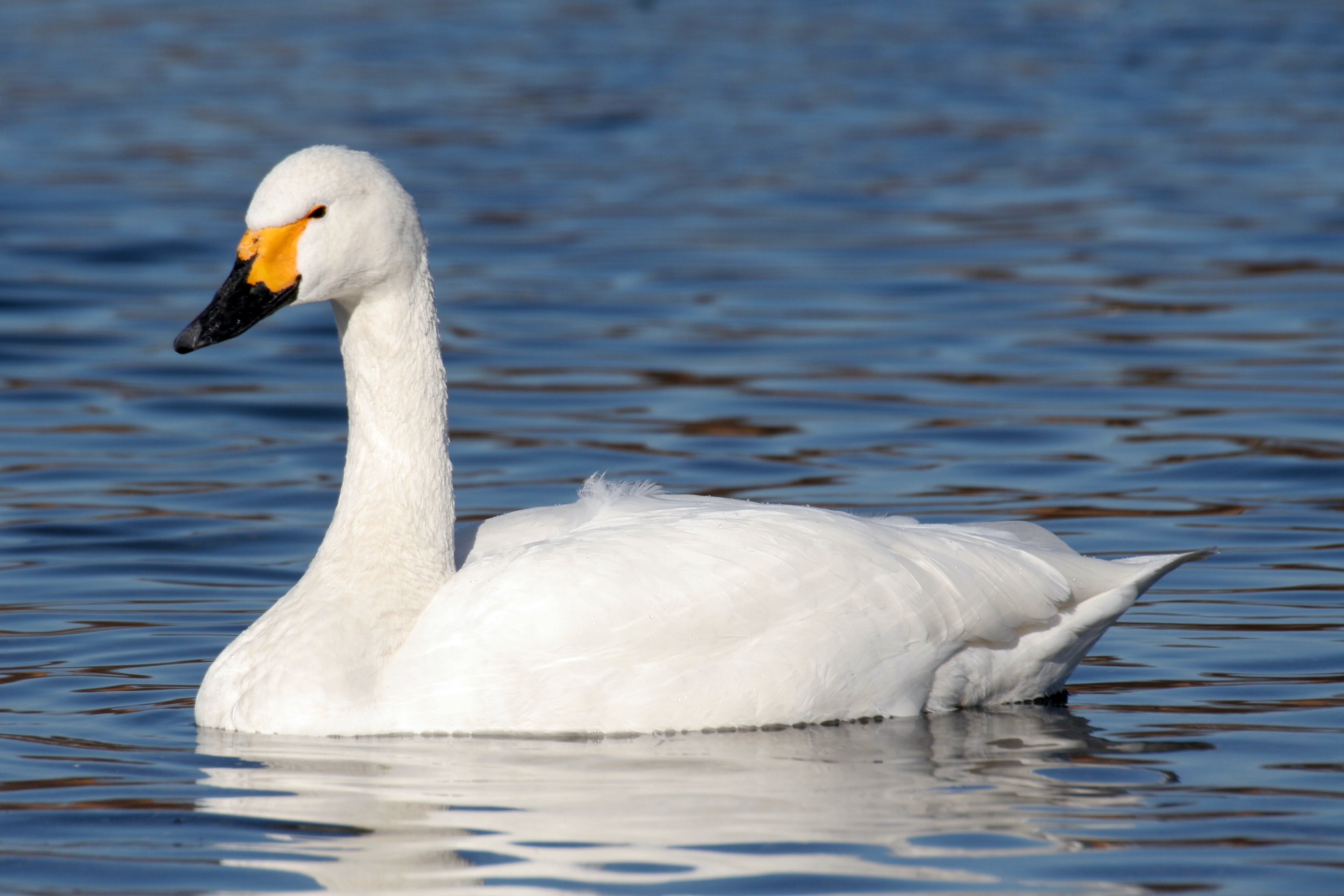
A medium-sized white swan with black bill (usually with yellow spot). Migrates 6,000+ km between Arctic breeding grounds and US wintering grounds.
§ Quick facts
§ Encyclopedia
The tundra swan is a species of swan of the Holarctic.
Source: Wikipedia — Tundra swan Licensed under CC BY-SA 4.0
§ Identification
Field marks. Large all-white swan with a black bill, usually showing a small yellow spot before the eye; holds the neck straight. Smaller than Trumpeter Swan.
Similar species. Trumpeter Swan is larger with an all-black bill and a deeper, trumpeting call; Mute Swan has an orange bill. The small yellow lore spot, when present, confirms Tundra.
Voice. A mellow, high, quavering 'whoo-hoo-hoo' — more musical and higher than the Trumpeter.
§ Diet & behavior
Diet. Aquatic plants, grasses, grain.
Behavior. A long-distance migrant swan that breeds on arctic tundra and winters on coastal bays and flooded fields; migrates in long lines and V's, calling musically.
§ Range
Arctic North America in summer; winters US Atlantic coast, Great Salt Lake
§ Habitat
Tundra lakes in summer; coastal estuaries in winter
§ Threats
Lead poisoning from old shot in wetlands, habitat loss, climate-driven Arctic changes.
§ Conservation status
According to the IUCN Red List, the tundra swan is currently classified as Least Concern.
§ What helps
Support wetland protection. Use non-toxic shot. Reduce wetland contamination.
§ Further reading
- Wikipedia — Tundra swan
- www.allaboutbirds.org — authoritative profile of Cygnus columbianus
- IUCN Red List — search for Cygnus columbianus
- GBIF occurrence records
- Encyclopedia of Life — Cygnus columbianus
§ Sources cited
- Cornell Lab of Ornithology — All About Birds
- National Audubon Society
- iNaturalist
- IUCN Red List


