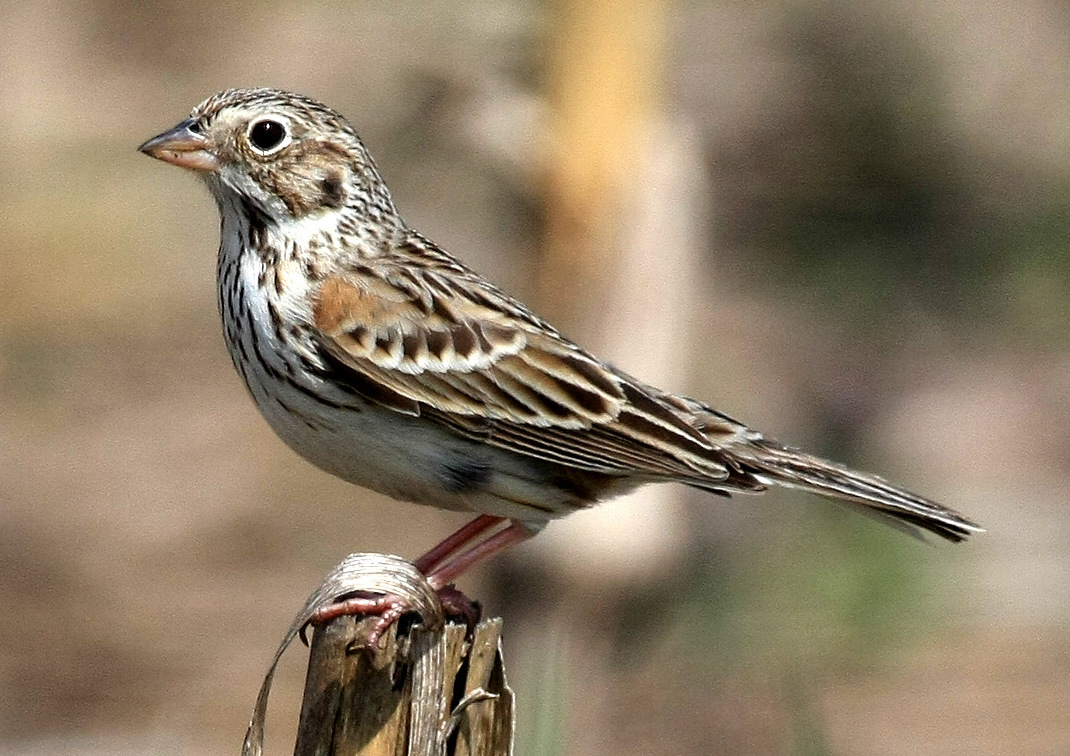
A streaky brown grassland sparrow with white outer tail feathers visible in flight and a distinctive chestnut shoulder patch. Beloved by farmers for their sweet evening songs ("vesper").
§ Quick facts
§ Encyclopedia
The vesper sparrow is a medium-sized New World sparrow. The only member of the genus Pooecetes, it is a pale sparrow with brown streaks that breeds across the grasslands of northern North America. It migrates to winter in the southern United States and Mexico.
Source: Wikipedia — Vesper sparrow Licensed under CC BY-SA 4.0
§ Identification
Field marks. Streaked brown sparrow with a thin white eye ring, chestnut shoulder patch (often hidden), and conspicuous white outer tail feathers.
Similar species. Savannah Sparrow lacks white outer tail feathers and the bold eye ring; the white tail edges and eye ring are key Vesper marks.
Voice. A rich, musical song of two long slurred notes followed by descending trills — sweeter than a Song Sparrow.
§ Diet & behavior
Diet. Seeds (primary), insects (especially during breeding).
Behavior. A grassland sparrow named for its evening song; takes dust baths on dirt roads and flashes white outer tail feathers in flight.
§ Range
Across northern and central North America in summer
§ Habitat
Open shortgrass fields, pastures, alkali flats
§ Threats
Conversion of fields to row crops, pesticide drift, fire suppression.
§ Conservation status
According to the IUCN Red List, the vesper sparrow is currently classified as Least Concern.
§ What helps
Maintain shortgrass field corners. Skip pesticide drift. Use prescribed fire in restoration areas.
§ Further reading
- Wikipedia — Vesper sparrow
- www.allaboutbirds.org — authoritative profile of Pooecetes gramineus
- IUCN Red List — search for Pooecetes gramineus
- GBIF occurrence records
- Encyclopedia of Life — Pooecetes gramineus
§ Sources cited
- Cornell Lab of Ornithology — All About Birds
- National Audubon Society
- iNaturalist
- IUCN Red List


