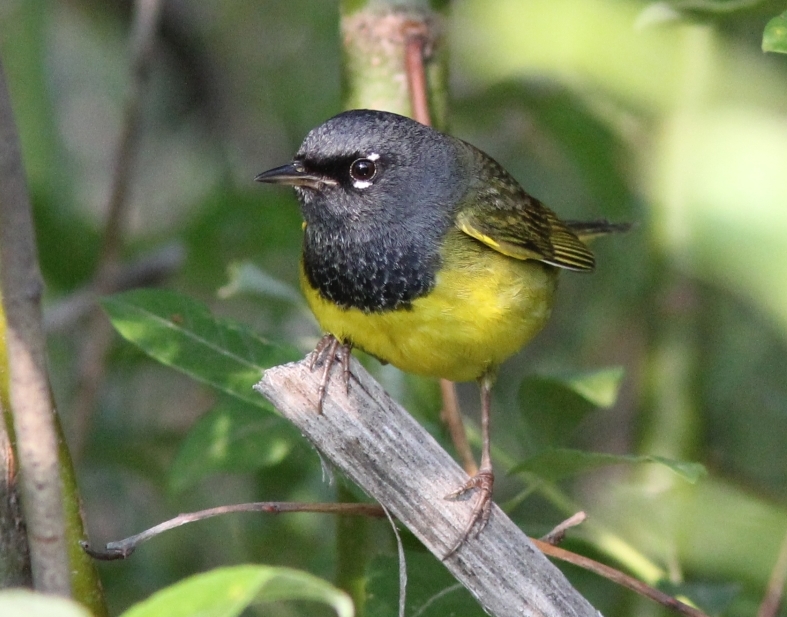
A western counterpart to Mourning Warbler.
§ Quick facts
§ Encyclopedia
MacGillivray's warbler is a species of New World warbler. These birds are sluggish and heavy warblers, preferring to spend most of their time on, or near the ground, except when singing.
Source: Wikipedia — MacGillivray's warbler Licensed under CC BY-SA 4.0
§ Identification
Field marks. Gray hood, olive back, yellow belly, and bold white crescents (eye-arcs) above and below the eye broken front and back. Males show a blackish wash on the lower throat.
Similar species. Mourning Warbler is the eastern look-alike and usually lacks bold eye-arcs; Connecticut has a complete eye ring and walks.
Voice. A buzzy, two-parted 'churry-churry-churry-sweet-sweet' dropping at the end.
§ Diet & behavior
Diet. Insects (caterpillars primary), spiders, occasional berries on migration.
Behavior. A skulking western counterpart of the Mourning Warbler; forages low in dense shrubby thickets and regenerating burns, often near water.
§ Range
Western North America
§ Habitat
Mountain shrub habitats
§ Threats
Habitat loss.
§ Conservation status
According to the IUCN Red List, the macgillivray's warbler is currently classified as Least Concern.
§ What helps
Support western shrub habitat conservation.
§ Further reading
- Wikipedia — MacGillivray's warbler
- www.allaboutbirds.org — authoritative profile of Geothlypis tolmiei
- IUCN Red List — search for Geothlypis tolmiei
- GBIF occurrence records
- Encyclopedia of Life — Geothlypis tolmiei
§ Sources cited
- Cornell Lab of Ornithology — All About Birds
- National Audubon Society
- iNaturalist
- IUCN Red List


