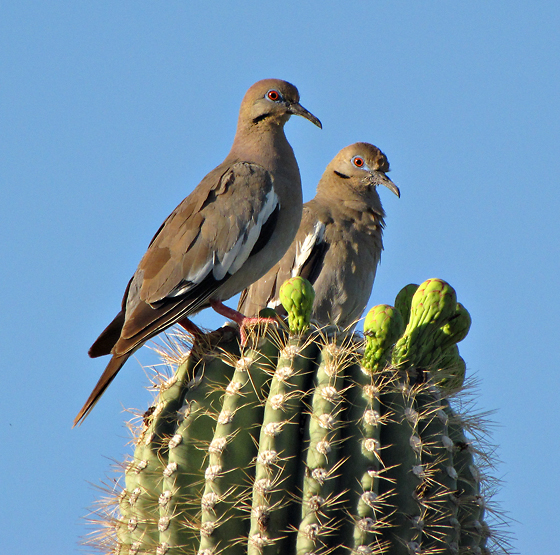
A medium-sized dove with bright white wing patches. Native to southwestern US; expanding range eastward and northward.
§ Quick facts
§ Encyclopedia
The white-winged dove is a dove whose native range extends from the Southwestern United States through Mexico, Central America, and the Caribbean. They are large for doves, and can be distinguished from similar doves by the distinctive white edge on their wings. They have a blue eyering, and red eyes. The plumage is brownish-gray to gray. Juveniles are duller in color, and have brown eyes. The call is likened to English phrase "who cooks for you". There are three subspecies. It was first described by George Edwards in 1743, and given its binomial name by Linnaeus in 1756. It was moved into the genus Zenaida in 1838.
Source: Wikipedia — White-winged dove Licensed under CC BY-SA 4.0
§ Identification
Field marks. Plump gray-brown dove with a bold white wing stripe (forming a white crescent at rest), a rounded white-tipped tail, a blue eye-ring, and an orange-red eye.
Similar species. Mourning Dove lacks the white wing stripe and has a long pointed tail; the bold white wing edge is diagnostic for White-winged.
Voice. A drawn-out, hooting 'who-cooks-for-you' phrasing, lower and more rhythmic than other doves.
§ Diet & behavior
Diet. Seeds, grains, fruits.
Behavior. A dove of the desert Southwest and southern brushlands, important as a pollinator and seed-disperser of saguaro cactus; has expanded northward and into cities.
§ Range
Southern US, Mexico
§ Habitat
Desert areas, suburbs, riparian areas
§ Threats
Habitat loss to development, climate change.
§ Conservation status
According to the IUCN Red List, the white-winged dove is currently classified as Least Concern.
§ What helps
Maintain native plantings. Support desert habitat conservation.
§ Further reading
- Wikipedia — White-winged dove
- www.allaboutbirds.org — authoritative profile of Zenaida asiatica
- IUCN Red List — search for Zenaida asiatica
- GBIF occurrence records
- Encyclopedia of Life — Zenaida asiatica
§ Sources cited
- Cornell Lab of Ornithology — All About Birds
- National Audubon Society
- iNaturalist
- IUCN Red List


