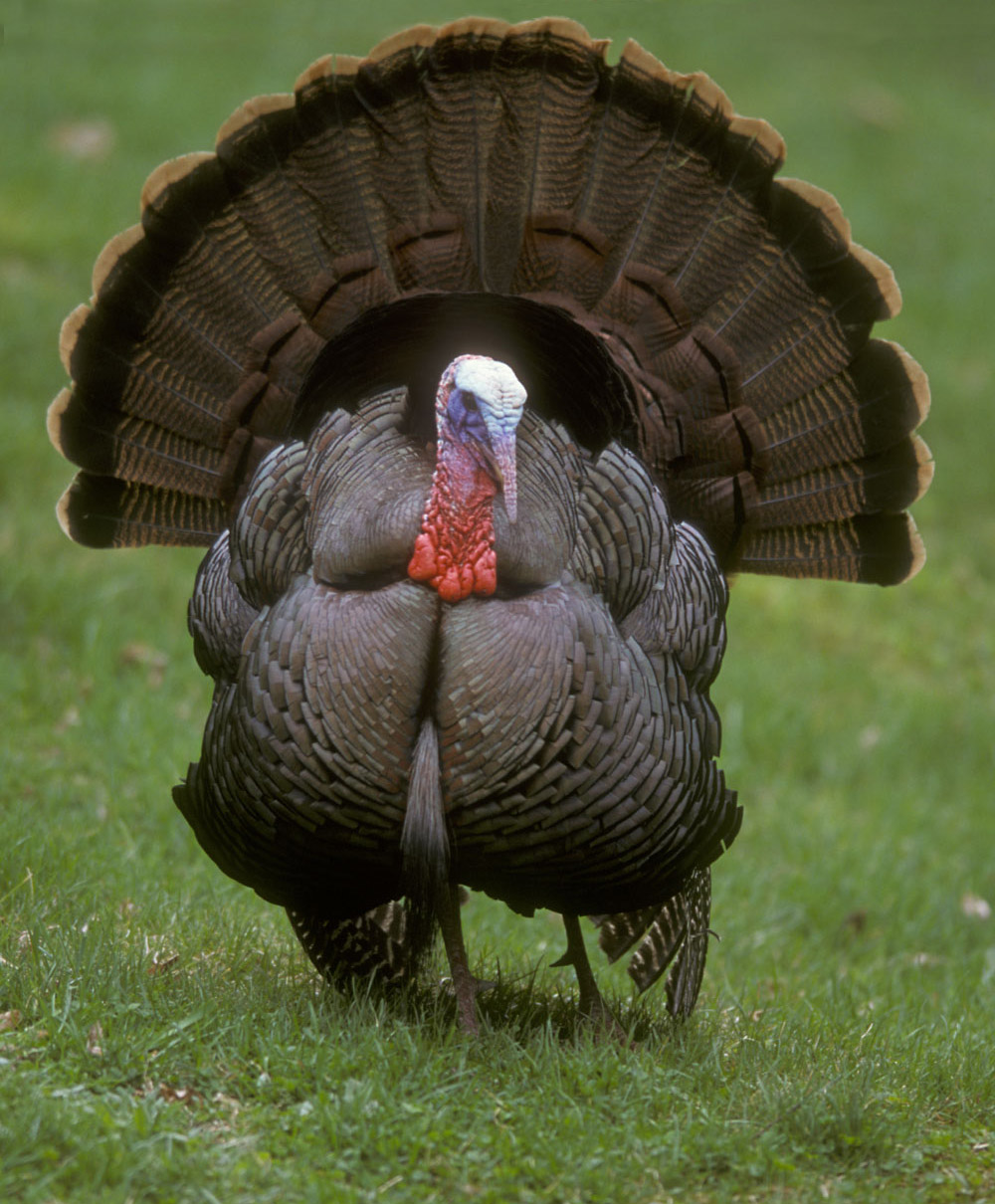
The continent's largest gallinaceous bird — once nearly extirpated by 1900 (down to ~30,000), now thriving at over 7 million thanks to a model trap-and-transplant restoration. Benjamin Franklin's preferred national bird.
§ Quick facts
§ Encyclopedia
The wild turkey is an upland game bird native to North America, one of two extant species of turkey and the heaviest member of the order Galliformes. It is the ancestor to the domestic turkey, which was originally derived from a southern Mexican subspecies of wild turkey.
Source: Wikipedia — Wild turkey Licensed under CC BY-SA 4.0
§ Identification
Field marks. Medium-sized chicken-like bird with gray body and distinctive black-and-white head.
Similar species. Wild Turkey (much larger).
Voice. Loud distinctive guinea calls.
§ Diet & behavior
Diet. Insects, worms, seeds.
Behavior. Highly social; forms large flocks. Loud and conspicuous.
§ Range
Throughout most of the US, parts of Canada and Mexico
§ Habitat
Hardwood and mixed forests with open clearings; agricultural edges
§ Threats
Generally well-recovered, but local declines linked to wet springs harming poults, habitat fragmentation, and disease.
§ Conservation status
According to the IUCN Red List, the wild turkey is currently classified as Least Concern.
§ What helps
Maintain mast-producing hardwoods (oak, hickory). Support state wildlife agency funding. Avoid mowing fields during nesting season (May–June).
§ Further reading
- Wikipedia — Wild turkey
- www.allaboutbirds.org — authoritative profile of Meleagris gallopavo
- IUCN Red List · taxon 22679525
- iNaturalist · taxon 950
- eBird · hegui1
- GBIF occurrence records
- Encyclopedia of Life — Meleagris gallopavo
§ Sources cited
- Cornell Lab — All About Birds
- iNaturalist


