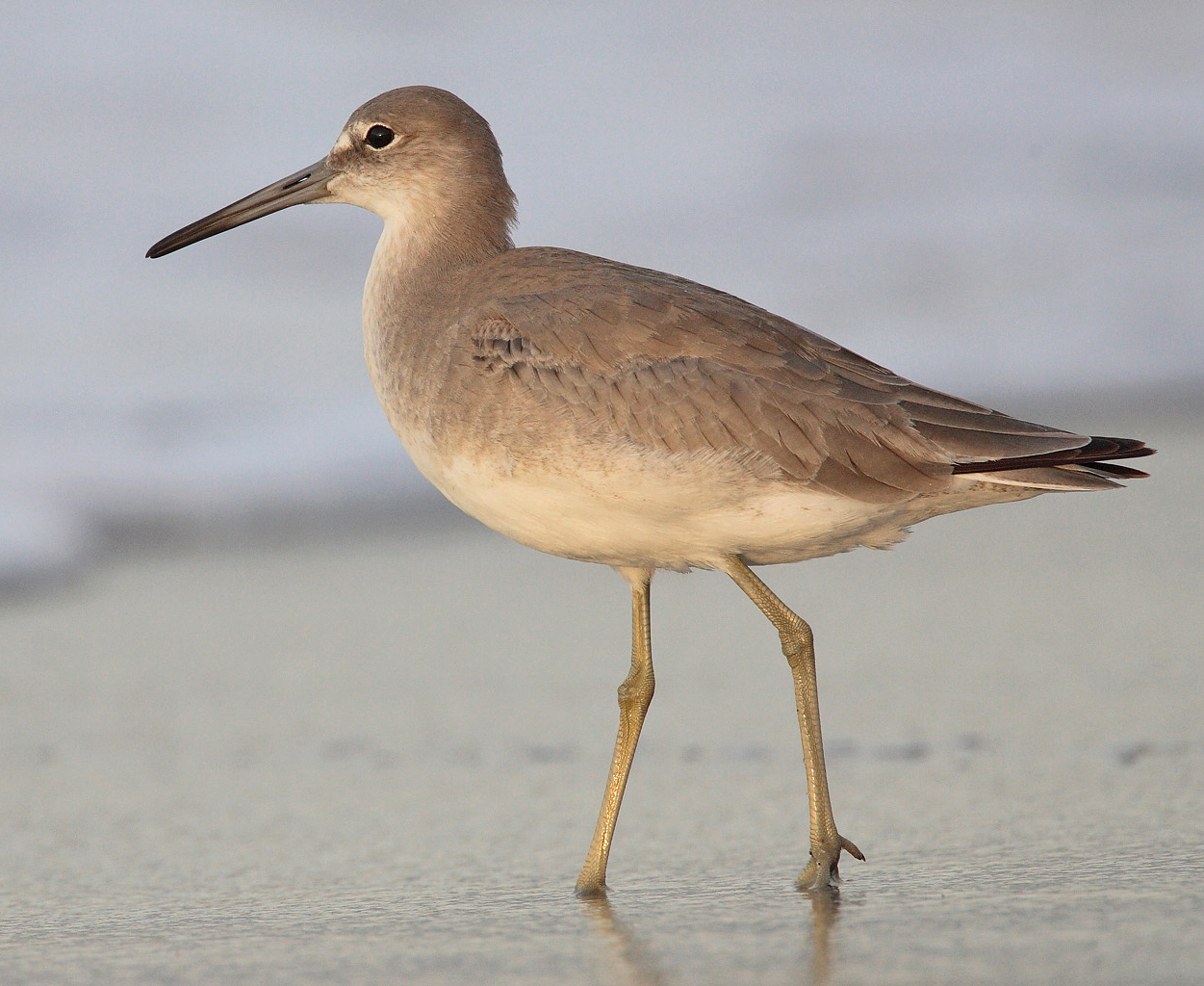
A medium gray-brown shorebird with bold black-and-white wing pattern revealed in flight. Loud "will-WILLET" call gives it the name.
§ Quick facts
§ Encyclopedia
The willet is a large shorebird in the family Scolopacidae. It is a relatively large and robust sandpiper and is the largest of the species called "shanks" in the genus Tringa. Its closest relative is the lesser yellowlegs, a much smaller bird with a very different appearance apart from the fine, clear, and dense pattern of the neck, which both species show in breeding plumage. It breeds in North America and the West Indies and winters in southern North America, Central America, the West Indies and South America.
Source: Wikipedia — Willet Licensed under CC BY-SA 4.0
§ Identification
Field marks. Big gray shorebird with long bluish-gray legs and a straight, stout bill; in flight shows a bold black-and-white wing stripe that transforms its appearance.
Similar species. Greater Yellowlegs has yellow legs and is slimmer; the Willet's gray legs, stout bill, and striking wing pattern are diagnostic.
Voice. A ringing, repeated 'pill-will-willet' on the breeding grounds; loud 'kip' and 'kleep' calls.
§ Diet & behavior
Diet. Invertebrates probed from mud, sand, or shallow water.
Behavior. A large, plain-looking shorebird that explodes into a flashy black-and-white wing pattern in flight; defends marsh and beach territories noisily. Two subspecies (Eastern and Western).
§ Range
Eastern + Gulf Coasts and western North America
§ Habitat
Coastal beaches, salt marshes; western prairie wetlands
§ Threats
Coastal habitat loss, climate change, beach disturbance.
§ Conservation status
According to the IUCN Red List, the willet is currently classified as Least Concern.
§ What helps
Support coastal beach protection. Respect nesting areas.
§ Further reading
- Wikipedia — Willet
- www.allaboutbirds.org — authoritative profile of Tringa semipalmata
- IUCN Red List — search for Tringa semipalmata
- GBIF occurrence records
- Encyclopedia of Life — Tringa semipalmata
§ Sources cited
- Cornell Lab of Ornithology — All About Birds
- National Audubon Society
- iNaturalist
- IUCN Red List


