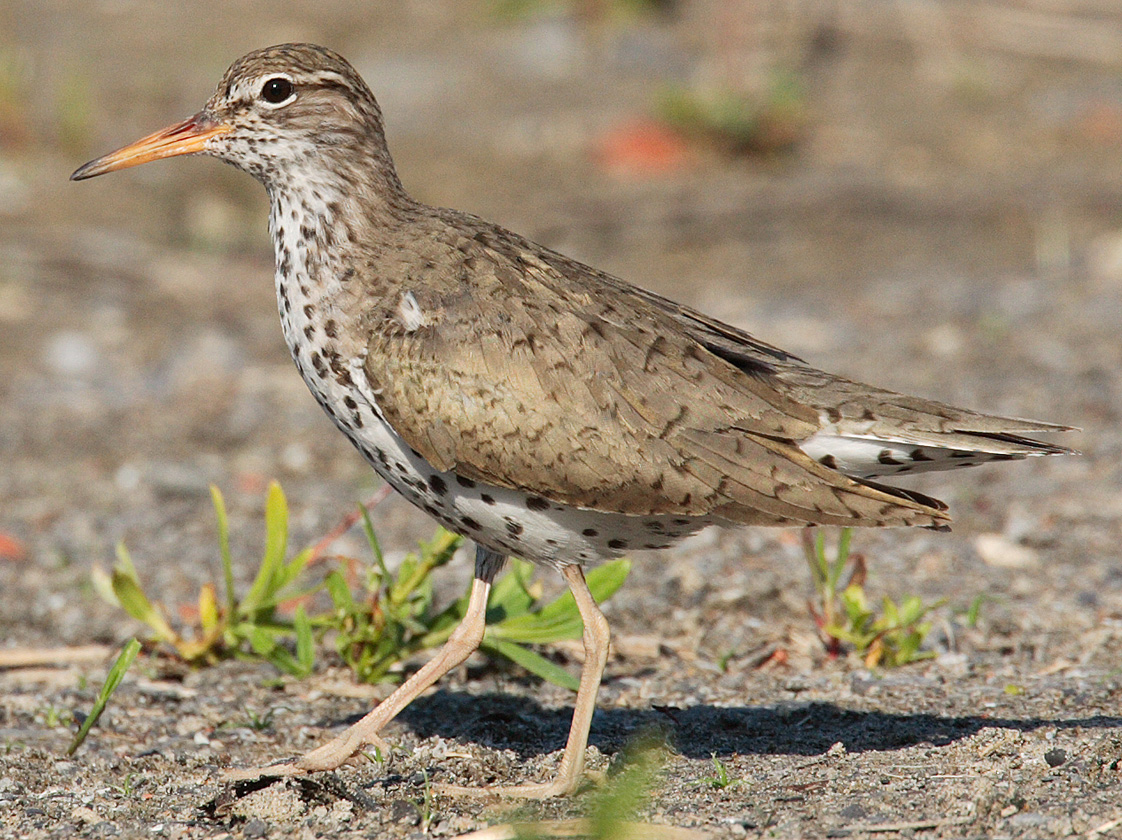
A small sandpiper with distinctive teetering gait. Among the most widespread shorebirds. Females have the unusual mating system of polyandry — males raise the young.
§ Quick facts
§ Encyclopedia
The spotted sandpiper is a small shorebird. Together with its sister species the common sandpiper, it makes up the genus Actitis. They replace each other geographically; stray birds may settle down with breeders of the other species and hybridize.
Source: Wikipedia — Spotted sandpiper Licensed under CC BY-SA 4.0
§ Identification
Field marks. Small sandpiper with bold round black spots on white underparts (breeding), an orange bill, and pinkish legs. Winter birds plain brown above, clean white below with a brown shoulder smudge.
Similar species. Solitary Sandpiper has a bold eye ring and dark wings; the constant teetering and (breeding) spotted breast mark the Spotted.
Voice. A clear, whistled 'peet-weet' or rapid 'weet-weet-weet'.
§ Diet & behavior
Diet. Invertebrates probed from mud, sand, or shallow water.
Behavior. The most widespread sandpiper in the Americas; teeters its rear end constantly and flies low over water on stiff, fluttering wingbeats. Females are the larger, dominant sex and may mate with several males.
§ Range
Across North America
§ Habitat
Streamsides, lake shores, ponds
§ Threats
Streamside habitat loss, climate change.
§ Conservation status
According to the IUCN Red List, the spotted sandpiper is currently classified as Least Concern.
§ What helps
Support stream-side habitat conservation. Don't mow shorelines.
§ Further reading
- Wikipedia — Spotted sandpiper
- www.allaboutbirds.org — authoritative profile of Actitis macularius
- IUCN Red List — search for Actitis macularius
- GBIF occurrence records
- Encyclopedia of Life — Actitis macularius
§ Sources cited
- Cornell Lab of Ornithology — All About Birds
- National Audubon Society
- iNaturalist
- IUCN Red List


