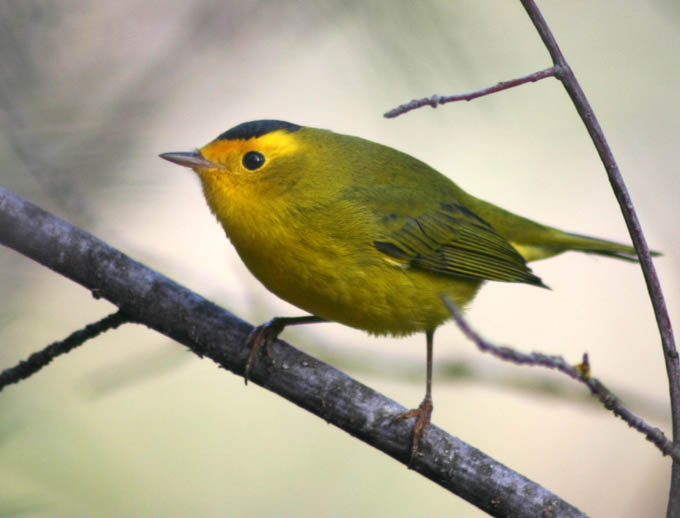
A small bright yellow warbler with distinctive black cap on males. Active feeder; flycatches insects mid-air.
§ Quick facts
§ Encyclopedia
Wilson's warbler is a small New World warbler. It is greenish above and yellow below, with rounded wings and a long, slim tail. The male has a black crown patch; depending on the subspecies, that mark is reduced or absent in the female. It breeds across Canada and south through the western United States, and winters from Mexico south through much of Central America. It is a very rare vagrant to western Europe.
Source: Wikipedia — Wilson's warbler Licensed under CC BY-SA 4.0
§ Identification
Field marks. Bright yellow face and underparts, olive upperparts, beady black eye, and (males) a neat round black cap. Females may show a reduced or absent cap.
Similar species. Hooded Warbler male has a full black hood and white tail flashes; Yellow Warbler lacks any cap and has yellow tail spots.
Voice. A rapid, chattering series that drops in pitch at the end: 'chi-chi-chi-chi-chet-chet'.
§ Diet & behavior
Diet. Insects (caterpillars primary), spiders, occasional berries on migration.
Behavior. A hyperactive low forager in willow and alder thickets and bog edges; constantly flicks and twirls its tail while sallying for insects.
§ Range
Across North America in summer; winters Mexico, Central America
§ Habitat
Brushy edges, willow thickets, riparian areas
§ Threats
Habitat loss, climate change.
§ Conservation status
According to the IUCN Red List, the wilson's warbler is currently classified as Least Concern.
§ What helps
Maintain native willow thickets. Skip pesticides.
§ Further reading
- Wikipedia — Wilson's warbler
- www.allaboutbirds.org — authoritative profile of Cardellina pusilla
- IUCN Red List — search for Cardellina pusilla
- GBIF occurrence records
- Encyclopedia of Life — Cardellina pusilla
§ Sources cited
- Cornell Lab of Ornithology — All About Birds
- National Audubon Society
- iNaturalist
- IUCN Red List


