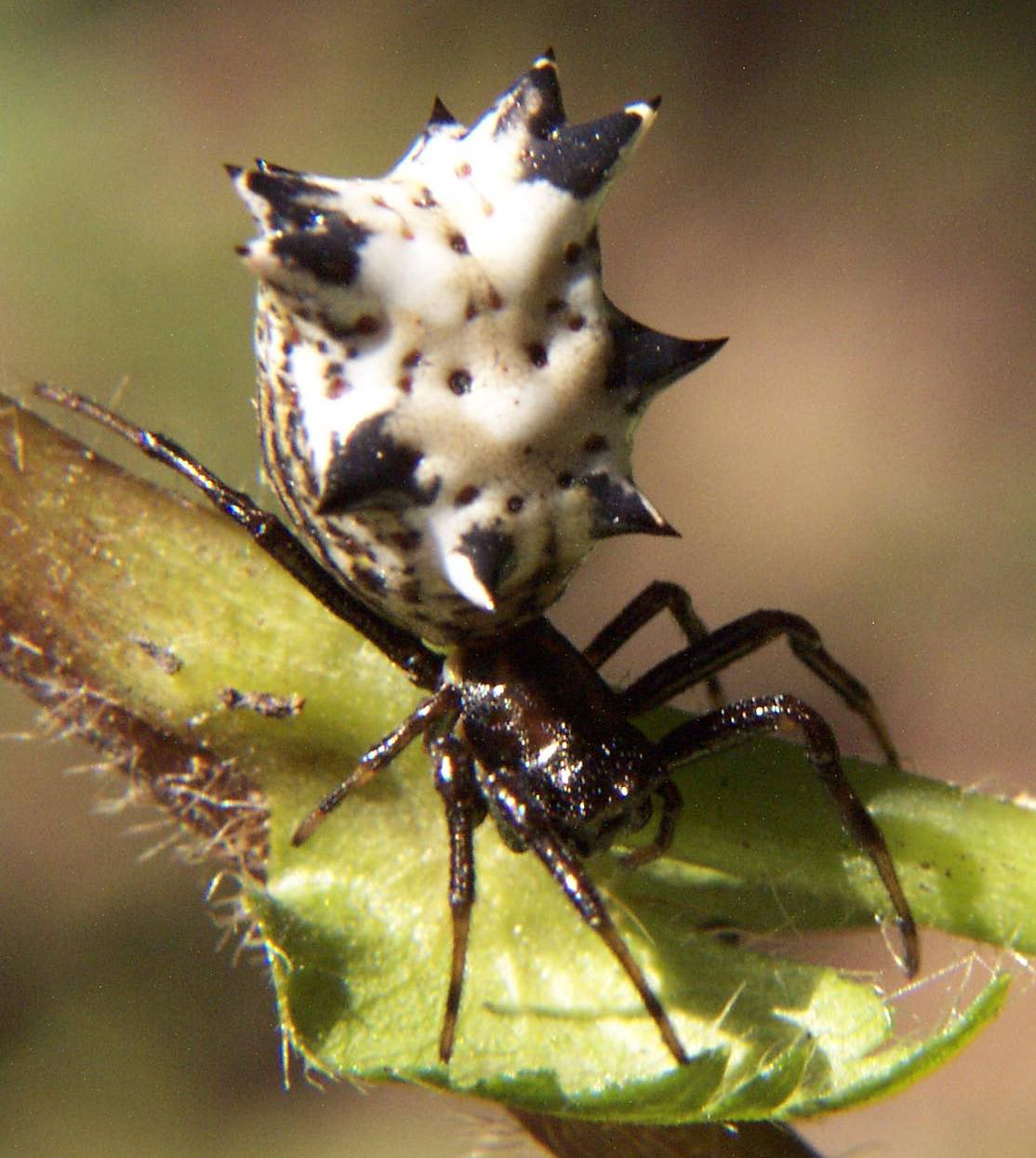
A medium spider with distinctive spiny body shape.
§ Quick facts
§ Encyclopedia
Micrathena gracilis is a spider in the family Araneidae (orb-weavers), commonly known as the spined micrathena or castleback orbweaver. This spider spins a moderately large and very tightly coiled web. The spiders themselves are small and can be found to be anywhere from 4.2 mm to 10.8 mm long. Its venom is harmless to humans. M. gracilis is unique in appearance due to its large spiky abdomen and black and white bodies. Certain spiders of this species can also display a yellow color on the sides of their bodies. These spiders can be seen most active during the end of the summer and beginning of fall. M. gracilis is diurnal and are rarely ever seen active at night.
Source: Wikipedia — Spined micrathena Licensed under CC BY-SA 4.0
§ Identification
Field marks. Small spider with white-and-black abdomen bearing five distinctive sharp dark spines; black legs; cone-shaped or angular abdomen.
Similar species. Spined Micrathena (M. gracilis — fewer spines, more elongated body). Other spiny orb weavers (different shapes).
Voice. N/A
§ Diet & behavior
Diet. Small flying insects (flies, leafhoppers, gnats, mosquitoes) caught in orb web.
Behavior. Small but distinctive orb-weaving spider of eastern North American forests. Females build vertical orb webs in clearings and along paths and trails — often at face height, leading to surprised hikers. Female builds new orb web nearly every day; consumes the old silk to recycle protein. The spiny body shape is believed to deter bird predation.
§ Range
Eastern North America
§ Habitat
Forests, edges
§ Threats
Habitat loss.
§ Conservation status
According to the IUCN Red List, the spiny garden orbweaver is currently classified as Least Concern.
§ What helps
Skip pesticides.
§ Further reading
- Wikipedia — Spined micrathena
- www.nwf.org — authoritative profile of Micrathena gracilis
- iNaturalist · taxon 49284
- IUCN Red List — search for Micrathena gracilis
- GBIF occurrence records
- Encyclopedia of Life — Micrathena gracilis
§ Sources cited
- American Arachnological Society
- BugGuide
- University of Wisconsin–Madison Entomology


