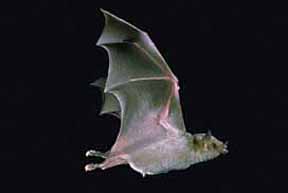
A medium-sized nectar-feeding bat critical for pollination of agave and saguaro cacti. Federally endangered.
§ Quick facts
§ Encyclopedia
The greater long-nosed bat or Mexican long-nosed bat is a species of bat in the family Phyllostomidae. It is found in Mexico and the United States. It chiefly consumes pollen and nectar, particularly from agave plants and cacti. Its habitat includes desert scrub and open woodlands, however, it is threatened by habitat loss.
Source: Wikipedia — Greater long-nosed bat Licensed under CC BY-SA 4.0
§ Identification
Field marks. Medium brown bat with elongated rostrum and long tongue.
Similar species. Lesser Long-nosed Bat (very similar; sister species).
Voice. Ultrasonic echolocation.
§ Diet & behavior
Diet. Nectar and pollen of agave and columnar cacti.
Behavior. Critical pollinator of agave plants. Federally endangered. Migrates between southwestern US and Mexico.
§ Range
Southwestern US, Mexico
§ Habitat
Desert riparian areas, oak-pine forests
§ Threats
Habitat loss, agave overharvest for tequila, climate change.
§ Conservation status
According to the IUCN Red List, the mexican long-nosed bat is currently classified as Endangered.
§ What helps
Buy bat-friendly tequila. Support desert riparian conservation.
§ Further reading
- Wikipedia — Greater long-nosed bat
- www.fws.gov — authoritative profile of Leptonycteris nivalis
- IUCN Red List · taxon 11697
- iNaturalist · taxon 40157
- GBIF occurrence records
- Encyclopedia of Life — Leptonycteris nivalis
§ Sources cited
- USFWS Mexican Long-nosed Bat Recovery
- Bat Conservation International
- IUCN Red List 2018


