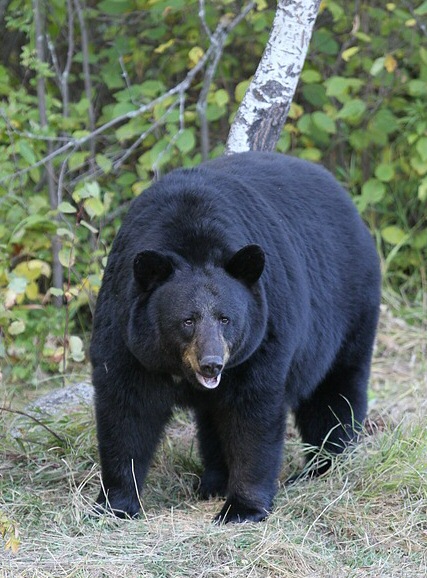
California subspecies of American black bear. Multiple subspecies exist across North America with subtle variations.
§ Quick facts
§ Encyclopedia
The American black bear, or simply black bear, is a species of medium-sized bear which is endemic to North America. It is the continent's smallest and most widely distributed bear species. It is an omnivore, with a diet varying greatly depending on season and location. It typically lives in largely forested areas; it will leave forests in search of food and is sometimes attracted to human communities due to the immediate availability of food.
Source: Wikipedia — American black bear Licensed under CC BY-SA 4.0
§ Identification
Field marks. Medium-large bear in black, blue-gray, cinnamon, or brown color phases.
Similar species. Other black bear subspecies. Brown bear (grizzly; shoulder hump).
Voice. Huffs; cubs squeal.
§ Diet & behavior
Diet. Omnivorous: berries, nuts, insects, fish, occasional carrion.
Behavior. Pacific Coast subspecies of black bear. Some "blue bear" (glacier bear) populations in Alaska are this subspecies; cinnamon and brown color phases also occur.
§ Range
California
§ Habitat
California forests
§ Threats
Vehicle strikes, conflict with humans.
§ Conservation status
According to the IUCN Red List, the black bear (west coast) is currently classified as Least Concern.
§ What helps
Don't leave food accessible. Support California habitat conservation.
§ Further reading
- Wikipedia — American black bear
- www.nwf.org — authoritative profile of Ursus americanus californiensis
- IUCN Red List · taxon 41687
- iNaturalist · taxon 41636
- GBIF occurrence records
- Encyclopedia of Life — Ursus americanus californiensis
§ Sources cited
- USFWS Pacific Region
- Alaska Department of Fish and Game
- IUCN Red List 2017


