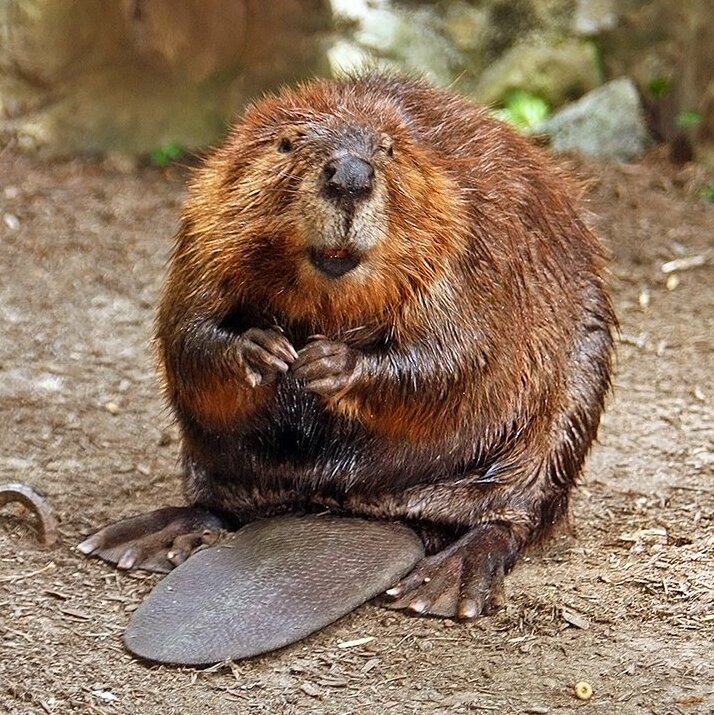
Nature's ecosystem engineers, beavers create wetland habitats that benefit hundreds of other species and store water across landscapes.
§ Quick facts
§ Encyclopedia
The North American beaver is one of two extant beaver species, along with the Eurasian beaver. It is native to North America and has been introduced in South America (Patagonia) and Europe. The North American beaver is one of the national symbols of Canada and the official state mammal of Oregon and New York. North American (Canadian) beavers are widespread across the continental United States, Canada, southern Alaska, and some parts of northern Mexico.
Source: Wikipedia — North American beaver Licensed under CC BY-SA 4.0
§ Identification
Field marks. Largest North American rodent. Dark brown waterproof fur, broad scaled flat paddle tail, webbed hind feet. Constant continuous front teeth (orange-tinted from iron).
Similar species. Muskrat (much smaller, thin tapered tail). Nutria (introduced; round tail, white whiskers).
Voice. Tail slap on water (warning); whines, hisses, grunts; juveniles whine for attention.
§ Diet & behavior
Diet. Bark, twigs, leaves of deciduous trees (especially aspen, willow, cottonwood); aquatic plants in summer.
Behavior. Strict herbivore and master engineer — builds dams of sticks and mud creating ponds that benefit dozens of other species. Lives in family colonies in lodges with underwater entrances.
§ Range
Across North America wherever streams and wetlands exist
§ Habitat
Streams, ponds, lakes, and wetlands they actively engineer
§ Threats
Historical over-trapping reduced populations 99%. Today: human conflict, habitat loss, vehicle strikes.
§ Conservation status
According to the IUCN Red List, the north american beaver is currently classified as Least Concern.
§ What helps
Support beaver coexistence tools (culvert protectors, pond levelers). Advocate for "process-based" stream restoration.
§ Further reading
- Wikipedia — North American beaver
- www.nwf.org — authoritative profile of Castor canadensis
- IUCN Red List · taxon 4003
- iNaturalist · taxon 43794
- GBIF occurrence records
- Encyclopedia of Life — Castor canadensis
§ Sources cited
- Beaver Institute
- Wildlife Conservation Society
- USDA Forest Service
- IUCN Red List 2016


