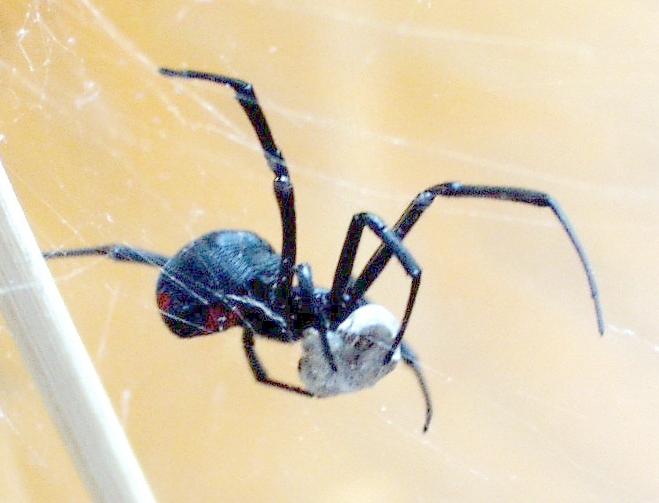
A glossy black spider with the iconic red hourglass on the underside. Females have potent neurotoxic venom but rarely bite unless trapped against skin. Bites are painful but rarely fatal — no US deaths in decades.
§ Quick facts
§ Encyclopedia
Latrodectus mactans, known as southern black widow or simply black widow, and the shoe-button spider, is a venomous species of spider in the genus Latrodectus. The females are well known for their distinctive black and red coloring and for the fact that they will occasionally eat their mates after reproduction. The species is native to North America. The venom can cause pain and other symptoms, but is rarely fatal to healthy humans.
Source: Wikipedia — Latrodectus mactans Licensed under CC BY-SA 4.0
§ Identification
Field marks. Females: glossy jet-black with iconic red hourglass on underside of abdomen. Males: brown with reddish markings, much smaller, no hourglass.
Similar species. Northern Black Widow (L. variolus) — broken hourglass. Brown Widow (L. geometricus) — tan with hourglass; introduced.
Voice. N/A
§ Diet & behavior
Diet. Insects caught in tangled cobweb: flies, beetles, mosquitoes, occasionally larger prey like crickets and small lizards.
Behavior. Builds three-dimensional irregular cobweb in dark sheltered locations. Hangs upside-down at center. Bites only defensively when pressed against skin.
§ Range
Southeastern and southern US
§ Habitat
Sheltered dark corners: woodpiles, sheds, debris piles, outdoor toilets
§ Threats
Pesticide spraying, fear-driven killing, habitat loss.
§ Conservation status
According to the IUCN Red List, the southern black widow is currently classified as Least Concern.
§ What helps
Shake out gloves and shoes left outdoors. Skip pesticides. Don't kill spiders that aren't threatening.
§ Further reading
- Wikipedia — Latrodectus mactans
- www.nwf.org — authoritative profile of Latrodectus mactans
- iNaturalist · taxon 49273
- IUCN Red List — search for Latrodectus mactans
- GBIF occurrence records
- Encyclopedia of Life — Latrodectus mactans
§ Sources cited
- University of Florida IFAS Extension
- American Arachnological Society
- CDC Venomous Spider Bites
- BugGuide


