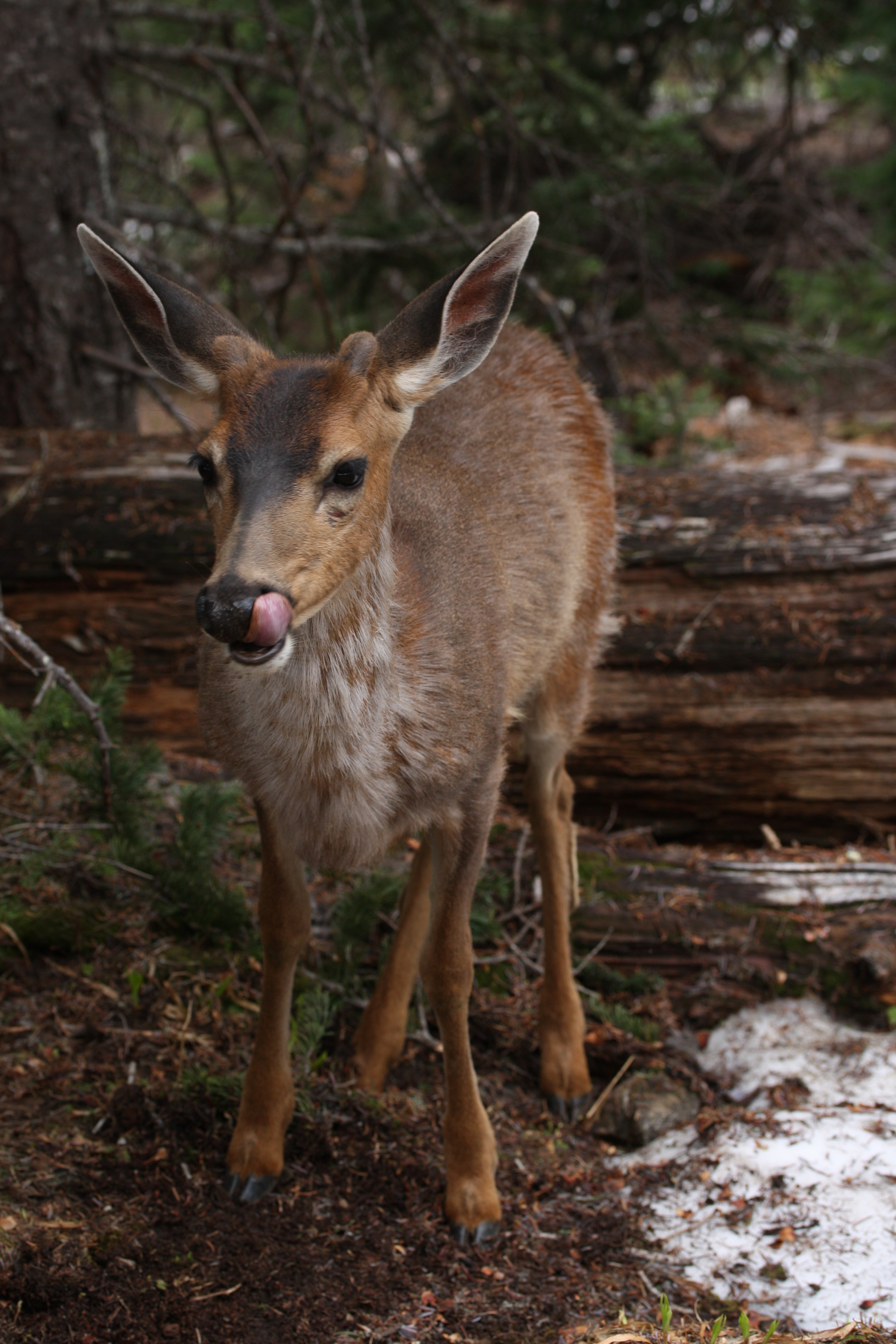
A small subspecies of mule deer adapted to the wet Pacific Northwest forests. Their tail is solid black on top (mule deer have white with a black tip).
§ Quick facts
§ Encyclopedia
Black-tailed deer or blacktail deer occupy coastal regions of western North America. There are two subspecies, the Columbian black-tailed deer which ranges from the Pacific Northwest of the United States and coastal British Columbia in Canada to Santa Barbara County in Southern California, and a second subspecies known as the Sitka deer which is geographically disjunct occupying from mid-coastal British Columbia up through southeast Alaska, and southcentral Alaska. The black-tailed deer subspecies are about half the size of the inland mule deer subspecies, the latter ranging further east in the western United States.
Source: Wikipedia — Black-tailed deer Licensed under CC BY-SA 4.0
§ Identification
Field marks. Medium deer with chocolate-brown back, white belly, distinctive black tail with white underside.
Similar species. Mule Deer (larger, gray-brown). White-tailed Deer (white tail flag).
Voice. Snorts; bleats.
§ Diet & behavior
Diet. Browse: shrubs, twigs, forbs.
Behavior. Pacific Northwest deer subspecies. Distinguished from white-tailed deer by black tail with white underside; different antler structure.
§ Range
Pacific coast from Alaska to California
§ Habitat
Coniferous forests, riparian areas, suburban edges
§ Threats
Forest fragmentation, vehicle strikes, hair loss syndrome (chronic louse infestation), chronic wasting disease.
§ Conservation status
According to the IUCN Red List, the black-tailed deer is currently classified as Least Concern.
§ What helps
Support old-growth forest. Drive slowly on rural roads. Don't feed wild deer.
§ Further reading
- Wikipedia — Black-tailed deer
- www.nwf.org — authoritative profile of Odocoileus hemionus columbianus
- IUCN Red List · taxon 42393
- iNaturalist · taxon 42164
- GBIF occurrence records
- Encyclopedia of Life — Odocoileus hemionus columbianus
§ Sources cited
- Oregon Department of Fish and Wildlife
- National Park Service
- IUCN Red List 2016


