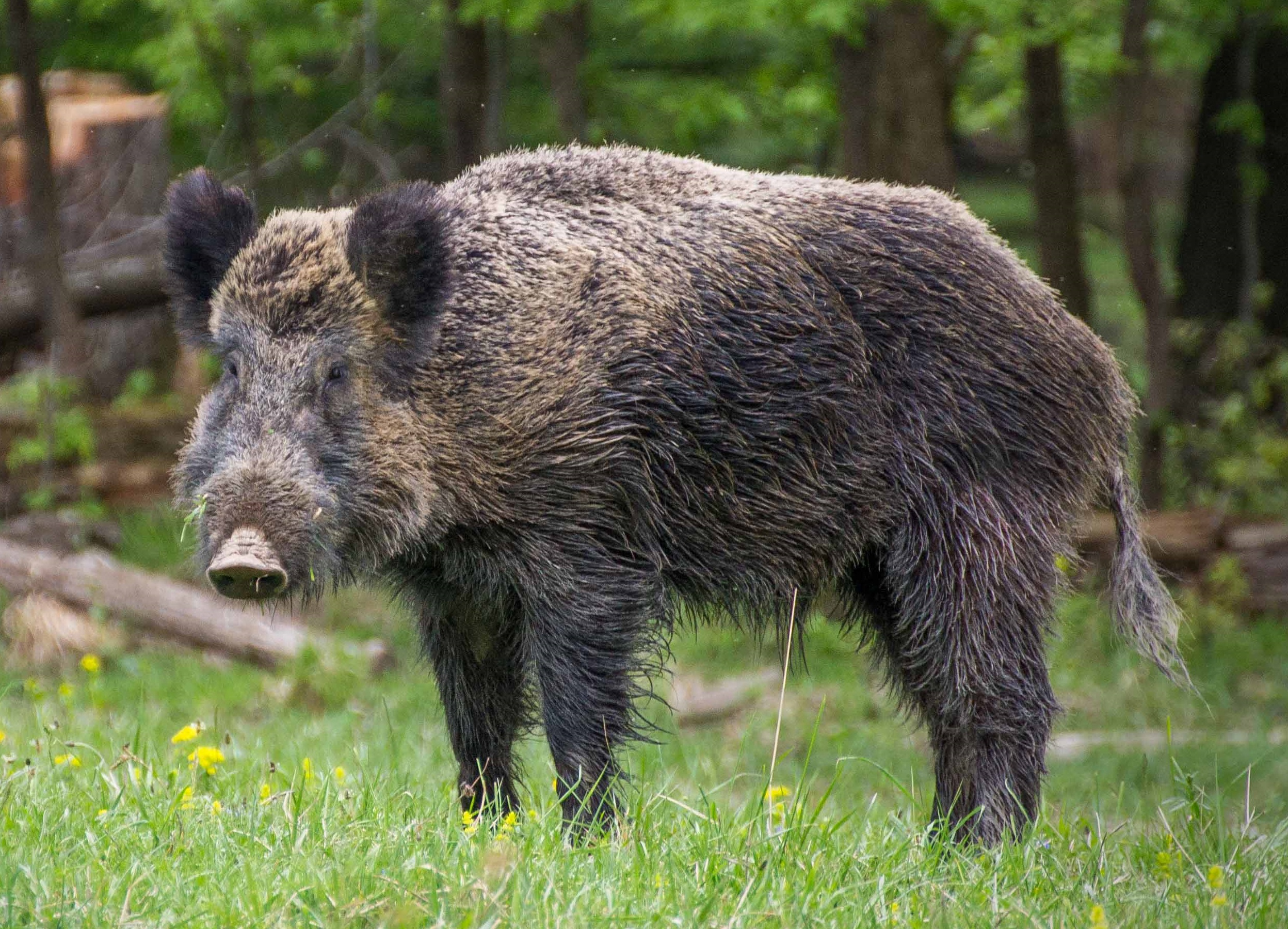
Introduced from Europe for hunting; now invasive across much of the US. Highly destructive to crops, native wildlife habitats.
§ Quick facts
§ Encyclopedia
The wild boar, also known as the wild swine, common wild pig, Eurasian wild pig, or simply wild pig, is a suid native to much of Eurasia and North Africa, and has been introduced to the Americas and Oceania. The species is now one of the widest-ranging mammals in the world, as well as the most widespread suiform. It has been assessed as least concern on the IUCN Red List due to its wide range, high numbers, and adaptability to a diversity of habitats. It has become an invasive species in part of its introduced range. Wild boars probably originated in Southeast Asia during the Early Pleistocene and outcompeted other suid species as they spread throughout the Old World.
Source: Wikipedia — Wild boar Licensed under CC BY-SA 4.0
§ Identification
Field marks. Massive boar with dark coat; large tusks in males; heavy build.
Similar species. Domestic Pig (related; different shape). Javelina (smaller; collared; different family).
Voice. Grunts; squeals.
§ Diet & behavior
Diet. Omnivorous: roots, tubers, fruits, small vertebrates, carrion, agricultural crops.
Behavior. Native to Eurasia; introduced to North America for hunting in early 1900s and escaped/hybridized with feral pigs. Now widespread invasive species causing massive ecological damage. Among the most-feared US invasive species.
§ Range
Native to Eurasia; invasive across the US
§ Habitat
Diverse: forests, grasslands, suburbs
§ Threats
In US: they're the threat. Habitat destruction, agricultural damage.
§ Conservation status
According to the IUCN Red List, the wild boar (invasive) is currently classified as Least Concern.
§ What helps
In US: support hunting and removal programs. Don't introduce or expand populations.
§ Further reading
- Wikipedia — Wild boar
- www.nwf.org — authoritative profile of Sus scrofa
- IUCN Red List · taxon 41775
- iNaturalist · taxon 42313
- GBIF occurrence records
- Encyclopedia of Life — Sus scrofa
§ Sources cited
- USDA Wildlife Services Feral Swine Damage Management
- IUCN Red List 2017


