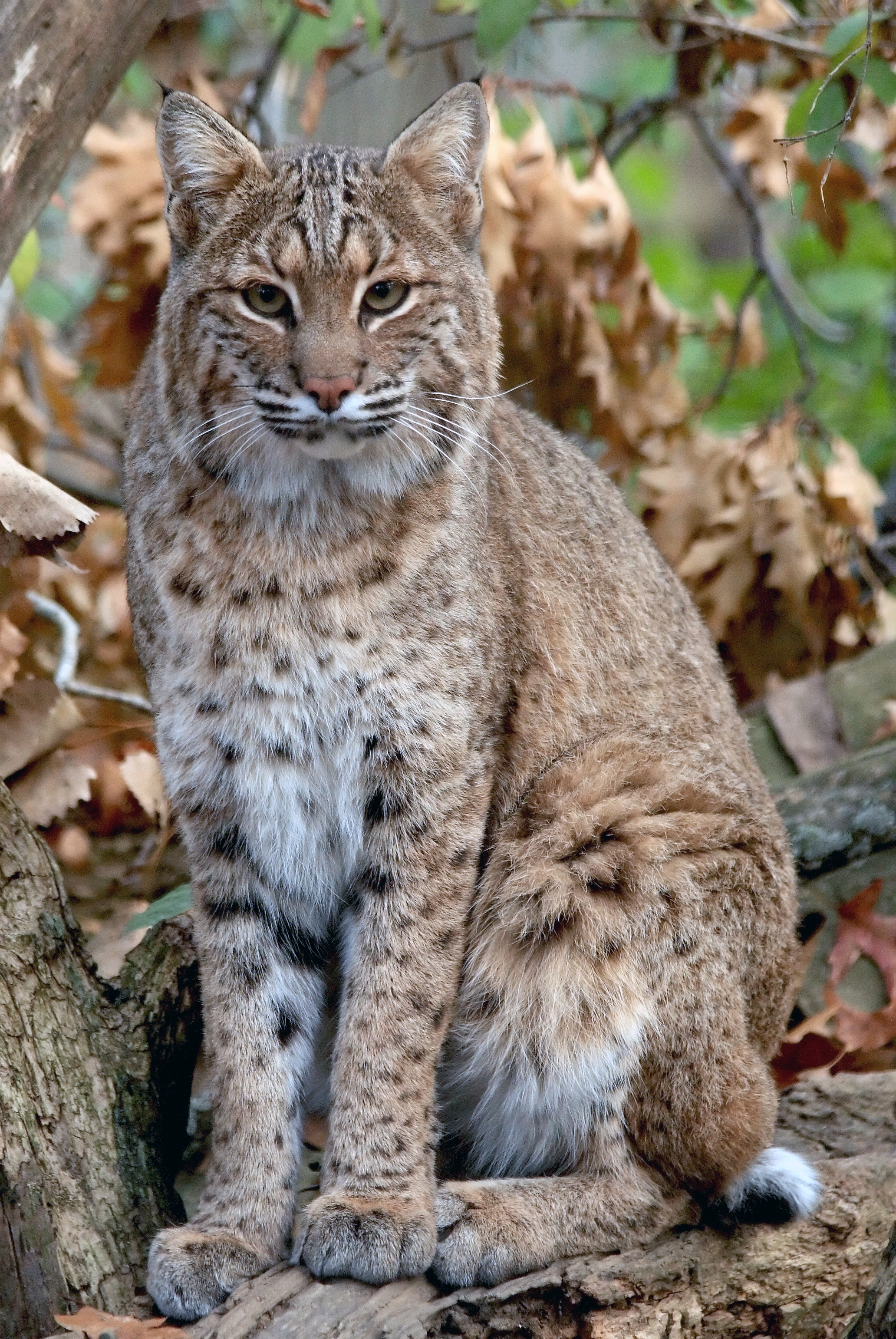
North America's most widespread wild cat — about twice the size of a housecat with a short "bobbed" tail and tufted ears. Despite their range, bobcats are so secretive that most people who live near them never see one.
§ Quick facts
§ Encyclopedia
The bobcat, also known as the wildcat, bay lynx, or red lynx, is one of the four extant species within the medium-sized wild cat genus Lynx. Native to North America, it ranges from southern Canada through most of the contiguous United States to Oaxaca in Mexico. It is listed as Least Concern on the IUCN Red List since 2002, due to its wide distribution and large population. Although it has been hunted extensively both for sport and fur, populations have proven stable, though declining in some areas.
Source: Wikipedia — Bobcat Licensed under CC BY-SA 4.0
§ Identification
Field marks. Medium-sized spotted cat with prominent ear tufts and short "bobbed" tail with white underside.
Similar species. Canada Lynx (longer legs, larger feet, gray coat). Mountain Lion (no spots, much larger).
Voice. Yowls and screams during mating season.
§ Diet & behavior
Diet. Cottontails, ground squirrels, deer, livestock, birds. Highly opportunistic.
Behavior. Crepuscular and adapted to suburbia. Maintains territories of 5–20 km². Excellent climber.
§ Range
Throughout most of the contiguous US, southern Canada, Mexico
§ Habitat
Diverse: forests, swamps, deserts, suburban edges
§ Threats
Rodenticide poisoning (secondary), vehicle strikes, mange outbreaks, illegal trapping.
§ Conservation status
According to the IUCN Red List, the bobcat is currently classified as Least Concern.
§ What helps
Use only first-generation rodenticides if any. Drive slowly at dawn/dusk on rural roads. Report mange cases to state wildlife agencies.
§ Further reading
- Wikipedia — Bobcat
- www.nwf.org — authoritative profile of Lynx rufus
- IUCN Red List · taxon 12521
- iNaturalist · taxon 41961
- GBIF occurrence records
- Encyclopedia of Life — Lynx rufus
§ Sources cited
- Cornell Lab — Wildlife Guide
- USFWS species profile
- IUCN Red List 2015


