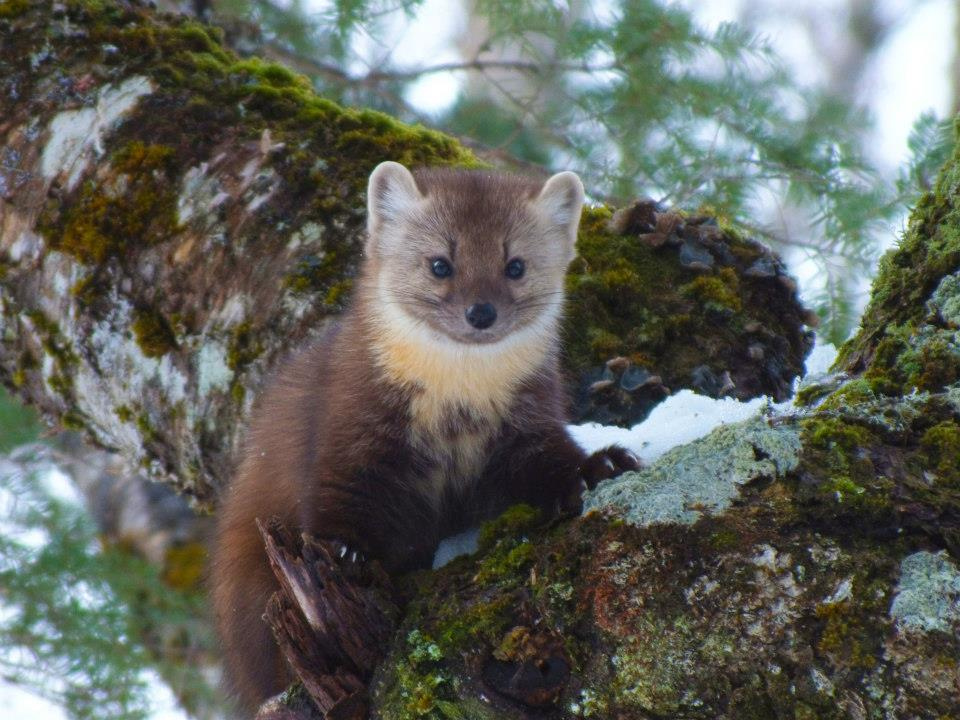
A slender weasel relative the size of a small house cat, with a luxurious brown coat and pale orange throat patch. Arboreal acrobats that hunt red squirrels through the canopy.
§ Quick facts
§ Encyclopedia
The American marten, also known as the American pine marten, is a species of North American mammal, a member of the family Mustelidae. The species is sometimes referred to as simply the pine marten. The name "pine marten" is derived from the common name of the related but distinct Eurasian species, Martes martes. Martes americana is found throughout Canada and parts of the northern United States including Alaska. It is a long, slender-bodied marten, with fur ranging from yellowish to brown to near black. It may be confused with the fisher, but the marten is lighter in color and smaller. Identification of the marten is further eased by a characteristic bib that is a distinctly different color from the body. Sexual dimorphism is pronounced, with males being much larger.
Source: Wikipedia — American marten Licensed under CC BY-SA 4.0
§ Identification
Field marks. Long sleek dark brown body with paler throat.
Similar species. Other weasels. Ermine (black-tipped tail).
Voice. Various chitters and hisses.
§ Diet & behavior
Diet. Carnivorous: rabbits, squirrels, mice.
Behavior. Solitary, mostly nocturnal. Excellent climber.
§ Range
Canada, Alaska, northern Rockies, Great Lakes, northern New England
§ Habitat
Mature coniferous and mixed forests with significant down wood
§ Threats
Logging of mature coniferous forest, fur trapping in some regions, climate-driven range contraction.
§ Conservation status
According to the IUCN Red List, the american marten is currently classified as Least Concern.
§ What helps
Support old-growth and mature forest protection. Support sustainable forestry. Donate to boreal conservation.
§ Further reading
- Wikipedia — American marten
- www.nwf.org — authoritative profile of Martes americana
- IUCN Red List · taxon 41648
- iNaturalist · taxon 41760
- GBIF occurrence records
- Encyclopedia of Life — Martes americana
§ Sources cited
- NWF Wildlife Guide
- iNaturalist
- IUCN Red List 2016


