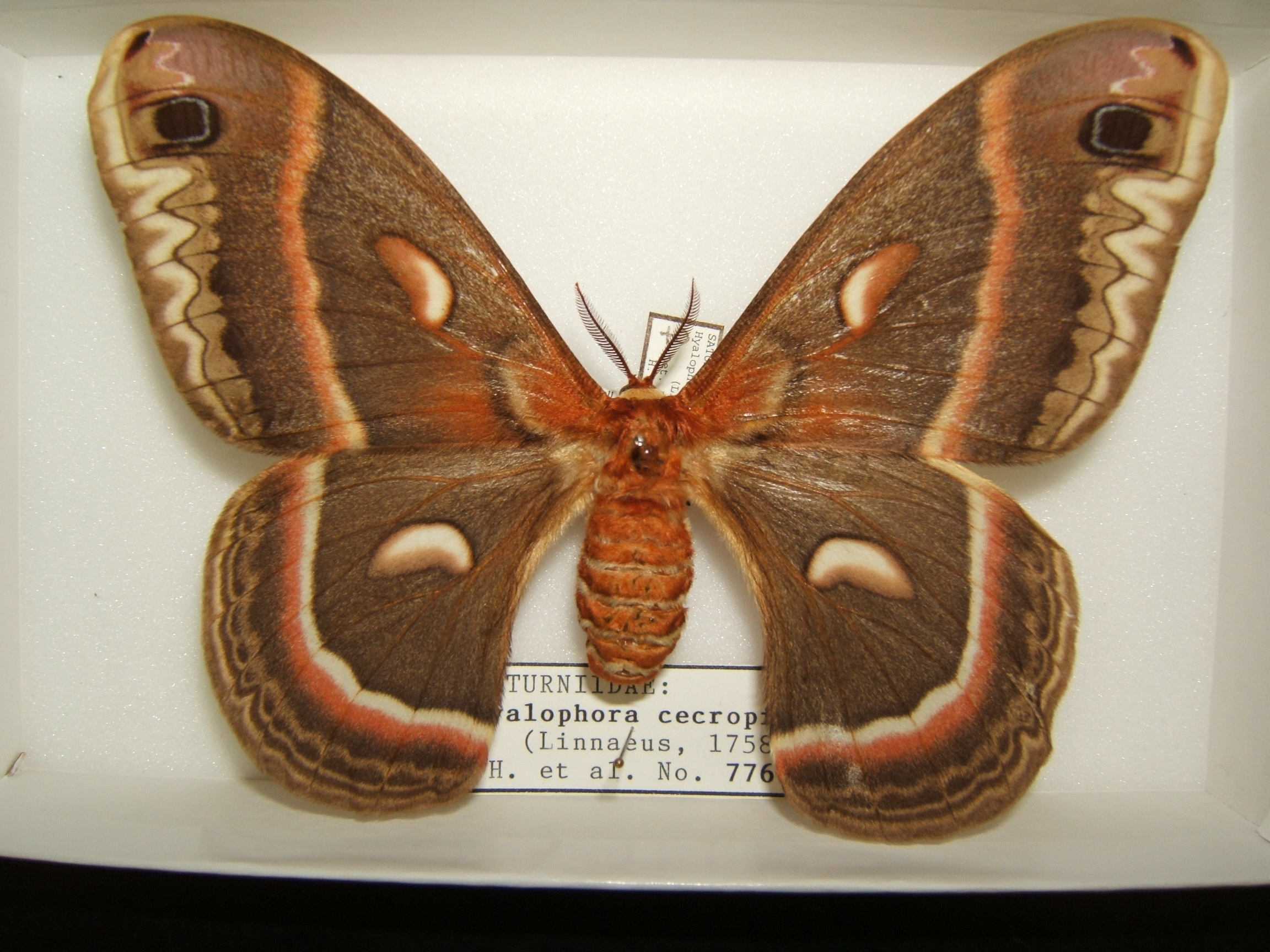
North America's largest native moth — wingspan up to 6 inches. Stunning crimson-red bodies with white eyespots on broad brown wings. Adults have no functional mouths and live only a few days to mate.
§ Quick facts
§ Encyclopedia
Hyalophora cecropia, the cecropia moth, is North America's largest native moth. It is a member of the family Saturniidae, or giant silk moths. Females have been documented with a wingspan of five to seven inches or more. These moths can be found predominantly across eastern North America, with occurrences as far west as Washington and north into the majority of Canadian provinces. Cecropia moth larvae are most commonly found on maple trees, but they have also been found on cherry and birch trees, among many others. The species was first described by Carl Linnaeus in his 1758 10th edition of Systema Naturae.
Source: Wikipedia — Hyalophora cecropia Licensed under CC BY-SA 4.0
§ Identification
Field marks. Massive moth — body deep red, wings reddish-brown with crescent white eyespots and red-and-tan banding.
Similar species. Polyphemus Moth (tan, smaller). Promethea Moth (smaller, no white eyespots).
Voice. Silent flight; caterpillars click mandibles when disturbed.
§ Diet & behavior
Diet. Adults: do not eat. Caterpillars: maple, birch, willow, cherry, oak, hawthorn.
Behavior. Adults emerge in early summer, mate, lay eggs, and die. Pheromone-driven mating — males detect females from miles away with feathered antennae.
§ Range
Eastern North America
§ Habitat
Deciduous forests, suburban yards with diverse trees
§ Threats
Forest loss, light pollution disrupting mate-finding, parasitoid flies introduced for gypsy moth control.
§ Conservation status
According to the IUCN Red List, the cecropia moth is currently classified as Least Concern.
§ What helps
Reduce outdoor lighting. Maintain native trees. Support efforts to control invasive parasitoids.
§ Further reading
- Wikipedia — Hyalophora cecropia
- www.nwf.org — authoritative profile of Hyalophora cecropia
- iNaturalist · taxon 49254
- IUCN Red List — search for Hyalophora cecropia
- GBIF occurrence records
- Encyclopedia of Life — Hyalophora cecropia
§ Sources cited
- Butterflies and Moths of North America
- Xerces Society
- BugGuide
- iNaturalist


