
Field guide · Species directory
Insects

American Bumble Bee
Bombus pensylvanicus
Once one of the most common bumble bees across the eastern US, the American bumble bee has declined nearly 89% over the past 20 years and is…

Cecropia Moth
Hyalophora cecropia
North America's largest native moth — wingspan up to 6 inches. Stunning crimson-red bodies with white eyespots on broad brown wings. Adults …

Eastern Tiger Swallowtail
Papilio glaucus
A large yellow-and-black butterfly that's often considered the eastern US's most familiar swallowtail. Females come in two color forms — yel…

Hine's Emerald Dragonfly
Somatochlora hineana
A federally endangered dragonfly restricted to spring-fed dolomite prairie wetlands. Down to a few sites in the Midwest. Among the most habi…

Miami Blue Butterfly
Cyclargus thomasi bethunebakeri
A tiny butterfly federally listed as endangered. Down to a few hundred individuals. Devastated by habitat loss, hurricanes, and possibly inv…

Monarch Butterfly
Danaus plexippus
Famous for one of the longest insect migrations on Earth, traveling up to 3,000 miles from Canada to central Mexico each fall.

Periodical Cicada (17-year)
Magicicada septendecim
One of the most extreme life-history strategies on Earth: nymphs spend exactly 17 years underground, then emerge as adults synchronously by …

Pipevine Swallowtail
Battus philenor
An iridescent blue-green butterfly whose toxic caterpillars feed on pipevine (Aristolochia spp.) — the toxins make adults inedible to birds.…

Poweshiek Skipperling
Oarisma poweshiek
A small federally endangered skipper down to a few hundred individuals at perhaps 5 sites. Among the most endangered insects in North Americ…

Regal Fritillary
Argynnis idalia
A spectacular large butterfly — black hindwings spotted in white and brilliant orange forewings. Specialist of native tallgrass prairie. Onc…

Rusty Patched Bumble Bee
Bombus affinis
The first bumble bee species listed under the U.S. Endangered Species Act, with populations down 87% since the late 1990s.

Zebra Longwing
Heliconius charithonia
A long-winged black-and-yellow striped butterfly that's the state butterfly of Florida. Unusually long-lived for a butterfly (6+ months as a…

American Lady
Vanessa virginiensis
A medium-sized butterfly closely related to painted lady. American lady has two large blue eyespots on the hindwing underside vs. painted la…

Antlion
Myrmeleon sp.
The larva builds conical pits in sand to trap ants. Adults look like delicate damselflies, but the larva (often called "doodlebug") is the f…

Beaver Pond Baskettail
Epitheca canis
A medium dragonfly often associated with beaver impoundments. Reflects ecological relationship between dragonflies and habitat-engineering b…

Big Dipper Firefly
Photinus pyralis
The most common firefly species in North America, recognizable by their J-shaped flight pattern as males flash to attract mates.

Black Carpenter Ant
Camponotus pennsylvanicus
A large native carpenter ant.

Black Swallowtail
Papilio polyxenes
A medium-sized black swallowtail with yellow spot bands and blue dust on hindwings. Caterpillars are famous garden visitors — feed on dill, …

Blue Orchard Mason Bee
Osmia lignaria
A solitary, native, metallic-blue bee that's 80–100x more effective per individual at pollinating fruit trees than honey bees — and they don…

Cabbage White Butterfly
Pieris rapae
Invasive European butterfly. Major pest of cole crops.

Chinese Mantis (invasive)
Tenodera sinensis
A large invasive praying mantis introduced for pest control. Outcompetes native mantis species and eats hummingbirds.

Clouded Sulphur
Colias philodice
A small yellow butterfly with dark forewing borders. One of the most common and widespread butterflies in North America — visible in clover …

Common Eastern Bumblebee
Bombus impatiens
A common eastern bumblebee. Now commercially produced for greenhouse pollination.

Common Eastern Dung Beetle
Onthophagus hecate
A small black beetle that rolls dung balls into underground brood chambers. They're essential pasture-cleaning agents — without them, livest…

Common Green Darner
Anax junius
One of the largest and fastest dragonflies in North America — and a long-distance migrant! Multi-generational migrations between northern US…

Common June Bug
Phyllophaga sp.
A large brown-tan scarab beetle that crashes into porch lights on June evenings. Larvae are the infamous "white grubs" that damage lawns and…

Common True Katydid
Pterophylla camellifolia
A leaf-mimicking grasshopper relative with broad green wings veined like leaves. Their loud "katy-DID-katy-DIDN'T" calls fill summer nights …

Common Water Strider
Aquarius remigis
A long-legged surface-skater that exploits water tension. Their feet are coated in tiny hairs that repel water — they essentially walk on wa…

Convergent Lady Beetle
Hippodamia convergens
The lady beetle most often sold as "biological pest control" — but the harvested adults are typically wild-caught from California overwinter…

Cynthia Silkmoth
Samia cynthia
A large silkmoth introduced from Asia in the 1800s. Established naturalized populations in some US areas.

Cynthia Silkmoth (Promethea Moth)
Callosamia promethea
A large silk moth (4–5 inch wingspan) named for its host plant family. Caterpillars build elaborate hanging cocoons that overwinter on host …

Dakota Skipper
Hesperia dacotae
A small federally endangered skipper of northern prairies. Down to a few sites due to grass conversion.

Damselfly (Familiar Bluet)
Enallagma civile
Small bright blue damselfly. Common at most US ponds.

Dragonfly (Common Whitetail)
Plathemis lydia
Medium-sized dragonfly with white abdomen in adult males. Common in suburban yards.
Eastern Bumble Bee
Bombus impatiens
The most common eastern bumble bee — black with a single yellow band on the thorax. Now commercially produced for greenhouse pollination of …

Eastern Burrowing Mayfly
Hexagenia limbata
A medium-sized mayfly that emerges in spectacular synchronized swarms from the Great Lakes and Mississippi River — sometimes dense enough to…

Eastern Carpenter Bee
Xylocopa virginica
A large, glossy black bee that gets blamed for damaging house decks and porches — but they're excellent native pollinators of important crop…

Eastern Cicada Killer
Sphecius speciosus
A massive (1.5–2 inch) wasp that hunts cicadas — paralyzing them with venom and dragging them to underground nests for larvae. Despite their…

Eastern Comma
Polygonia comma
A small orange butterfly with deeply scalloped wings and a comma-shaped silver mark on the hindwing underside. Like its cousin the question …

Eastern Dobsonfly
Corydalus cornutus
A large alien-looking insect — wingspan up to 7 inches with intimidating mandibles on adult males (which they can't actually bite hard with)…

Eastern Eyed Click Beetle
Alaus oculatus
A spectacular black-and-white click beetle with two large prominent eyespots on the pronotum. Among the most photogenic North American beetl…

Eastern Lubber Grasshopper
Romalea microptera
A massive flightless grasshopper. Brightly colored as adults; can secrete foul-tasting foam as defense.

Eastern Mole Cricket
Neocurtilla hexadactyla
A bizarre subterranean cricket with massive mole-like front legs adapted for tunneling. Males produce loud chirping calls from burrow openin…

Eastern Pondhawk
Erythemis simplicicollis
A medium-sized dragonfly — males brilliant powdery blue, females and immatures bright apple green. They're fierce hunters that take prey as …

Eastern Squash Bee
Peponapis pruinosa
A native bee that specializes ENTIRELY on plants in the squash family. They're the most efficient pollinators of pumpkins and squash in Nort…

Eastern Tailed-Blue
Cupido comyntas
A tiny butterfly (less than an inch wingspan) with delicate threadlike "tails" on the hindwings. Look closely at any patch of clover and you…

Giant Ichneumon Wasp
Megarhyssa macrurus
A massive parasitoid wasp with an astonishingly long ovipositor (up to 4 inches). Females drill through bark and wood to lay eggs in pigeon …

Giant Water Bug
Lethocerus americanus
A massive aquatic predatory bug — up to 3 inches. They lurk in shallows ambushing fish, tadpoles, and even small ducklings. Their bite is am…

Goldenrod Soldier Beetle
Chauliognathus pensylvanicus
A bright orange-and-black beetle that swarms goldenrod blooms in late summer for both pollen and mating opportunities. Despite the name, the…

Great Purple Hairstreak
Atlides halesus
A small but stunning butterfly — wing uppers metallic blue-purple, hindwing with thin tails. Despite the name, it's a hairstreak rather than…

Great Spangled Fritillary
Speyeria cybele
A medium-sized orange butterfly with silver-spangled underwings. Caterpillars eat ONLY violets — and emerging adults need a wide variety of …

Gulf Fritillary
Dione vanillae
A striking medium-sized butterfly with brilliant orange upper wings and silver-spotted underwings. Common in Gulf Coast gardens with passion…

Hummingbird Clearwing
Hemaris thysbe
A medium-sized moth that mimics a hummingbird — hovering at flowers with rapidly beating wings, drinking nectar with a long proboscis. Activ…

Imperial Moth
Eacles imperialis
A large yellow-and-pinkish-brown silkmoth with stunning eyespots and a wingspan over 5 inches. Caterpillars are equally spectacular — fuzzy,…

Karner Blue Butterfly
Plebejus melissa samuelis
A federally Endangered subspecies of the Melissa blue, dependent entirely on wild lupine as its caterpillar host plant. Their fate is insepa…

Leafcutter Bee
Megachile sp.
A solitary native bee that cuts perfect oval segments from leaves to construct nest cells. The neat circular cuts in rose and lilac leaves a…

Luna Moth
Actias luna
Stunning lime-green silk moths with wingspans up to 4.5 inches and long flowing tails that confuse echolocating bats.

Milkweed Tussock Moth
Euchaetes egle
A small gray moth whose furry orange-black-and-white striped caterpillars feed gregariously on milkweed leaves alongside monarchs — but unli…
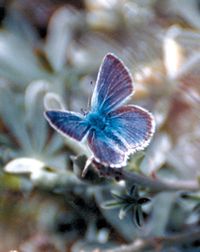
Mission Blue Butterfly
Icaricia icarioides missionensis
A small blue butterfly federally endangered since 1976. Restricted to coastal lupine grasslands threatened by urbanization, fire suppression…

Mosquito (Native)
Aedes sp.
Native mosquitoes. Multiple US species. Important prey for many predators despite human dislike.

Mourning Cloak
Nymphalis antiopa
One of North America's longest-lived butterflies — adults can live up to 10 months and overwinter as adults under loose bark. They're among …

Northern Pearly-eye
Lethe anthedon
A grayish-brown butterfly of dappled forest light, marked with eyespots. They're shade specialists in forest interiors — rare among butterfl…

Northern Walking Stick
Diapheromera femorata
Masters of camouflage — these 3-inch-long stick-mimics blend perfectly with twigs. They're slow-moving, harmless, and feed primarily on oak …

Orange Sulphur
Colias eurytheme
A close relative of the clouded sulphur with deeper orange-yellow color. Especially associated with alfalfa fields — sometimes called the "a…

Painted Lady
Vanessa cardui
The most widespread butterfly on Earth — found on every continent except Antarctica and Australia. Some years, massive irruptions sweep thro…

Paper Wasp (Native)
Polistes sp.
Generic reference to native paper wasps.

Periodical Cicada (13-year)
Magicicada tredecim
Southern counterpart to 17-year periodical cicada. Emerges every 13 years in synchronized mass emergences.

Polyphemus Moth
Antheraea polyphemus
A large tan-and-brown silkmoth with prominent eyespots on the hindwings, named for the Cyclops. Like other silkmoths, adults don't feed — th…
Promethea Silkmoth
Callosamia promethea
A large silkmoth — males almost black with mottled wings, females reddish-brown. Adults lack mouthparts; emerge, mate, lay eggs, die in 1–2 …

Question Mark
Polygonia interrogationis
A tawny-orange butterfly with jagged wing margins. Adults overwinter as adults under bark — among very few North American butterflies to do …

Quino Checkerspot
Euphydryas editha quino
A small federally endangered butterfly of southern California. Once one of the most abundant butterflies of the Los Angeles basin; now restr…

Red Admiral
Vanessa atalanta
A medium-sized butterfly with sharp black wings crossed by bold red bars and tipped in white spots. One of the most cosmopolitan butterflies…

Red Velvet Mite
Trombidiidae sp.
Brilliant scarlet-velvet arachnids about a quarter-inch long that emerge en masse after spring rains. Despite the "mite" name, they're ecolo…

Red-spotted Purple
Limenitis arthemis astyanax
A medium-large butterfly with iridescent blue wings and red spots. Closely related to (and hybridizes with) White Admiral.

Reddish-brown Stag Beetle
Lucanus capreolus
A massive (1.5-inch) glossy beetle whose males have antler-like mandibles used for combat over mates. Their larvae spend years inside decayi…

Saint Francis' Satyr
Neonympha mitchellii francisci
A small federally endangered butterfly restricted to a tiny area on Fort Bragg. The military's land use (training exercises, controlled fire…

Silver-spotted Skipper
Epargyreus clarus
A common large dark brown skipper with a distinctive silver-white patch on the underside of the hindwing. Caterpillars roll leaves into tube…

Six-spotted Tiger Beetle
Cicindela sexguttata
A brilliant metallic-green beetle with six white spots and long legs built for speed. Sprints after prey at incredible speeds across forest …

Spring Field Cricket
Gryllus veletis
A familiar black cricket whose cheerful chirp marks spring and summer evenings. Males chirp to attract females; chirp rate corresponds to te…

Twelve-spotted Skimmer
Libellula pulchella
A large dragonfly with three black spots on each wing (twelve total) and bright white markings between the dots in adult males. They're one …

Velvet Ant (Cow Killer)
Dasymutilla occidentalis
Not actually an ant — a wingless wasp. Females have famously painful stings.

Viceroy
Limenitis archippus
A medium-sized butterfly that mimics the toxic monarch — orange and black with a critical distinguishing feature: a horizontal black band ac…

Western Cicada Killer
Sphecius grandis
Western counterpart to eastern cicada killer. Female catches cicadas, drags to underground burrow.

Western Honey Bee
Apis mellifera
Not actually native to North America (introduced ~1622), but now economically essential — pollinating one in three bites of food we eat. Des…
White Admiral
Limenitis arthemis arthemis
A medium-large butterfly with dark wings and bold white bands. Northern counterpart to Red-spotted Purple; they hybridize.

Zebra Swallowtail
Eurytides marcellus
A striking white-and-black butterfly with the longest tails of any North American swallowtail. Caterpillars feed only on pawpaw — making the…
Looking for something specific?