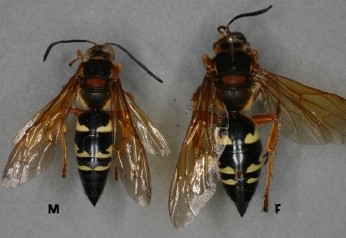
A massive (1.5–2 inch) wasp that hunts cicadas — paralyzing them with venom and dragging them to underground nests for larvae. Despite their fearsome size, they're remarkably docile to humans.
§ Quick facts
§ Encyclopedia
Sphecius speciosus, the eastern cicada-killer wasp, is a large, solitary digger wasp species in the family Bembicidae. They are so named because they hunt cicadas and provision their nests with them. Cicada killers exert a measure of natural control on cicada populations, and as such, they may directly benefit the deciduous trees upon which the cicadas feed. Sometimes, they are erroneously called sand hornets, despite not truly being hornets, which belong to the family Vespidae.
Source: Wikipedia — Sphecius speciosus Licensed under CC BY-SA 4.0
§ Identification
Field marks. Massive wasp — among the largest in North America. Black and yellow with rusty wings.
Similar species. Other large wasps. European Hornet (introduced; smaller, different pattern).
Voice. Loud buzzing flight.
§ Diet & behavior
Diet. Adults: nectar, fruit juices. Females: cicadas (provisioned to larvae).
Behavior. Females catch cicadas by stinging them paralytic, then drag them to underground burrows where eggs are laid on the still-living prey. Males are non-stinging.
§ Range
Eastern and central US
§ Habitat
Sandy, open soil for nest excavation; near forests with cicadas
§ Threats
Lawn pesticides, loss of sandy nest sites to landscaping.
§ Conservation status
According to the IUCN Red List, the eastern cicada killer is currently classified as Least Concern.
§ What helps
Skip lawn insecticides. Tolerate them — males can't sting at all; females rarely do unless trapped. Maintain sandy spots in garden corners.
§ Further reading
- Wikipedia — Sphecius speciosus
- www.nwf.org — authoritative profile of Sphecius speciosus
- iNaturalist · taxon 53138
- IUCN Red List — search for Sphecius speciosus
- GBIF occurrence records
- Encyclopedia of Life — Sphecius speciosus
§ Sources cited
- University of Kentucky Entomology
- iNaturalist
- BugGuide


