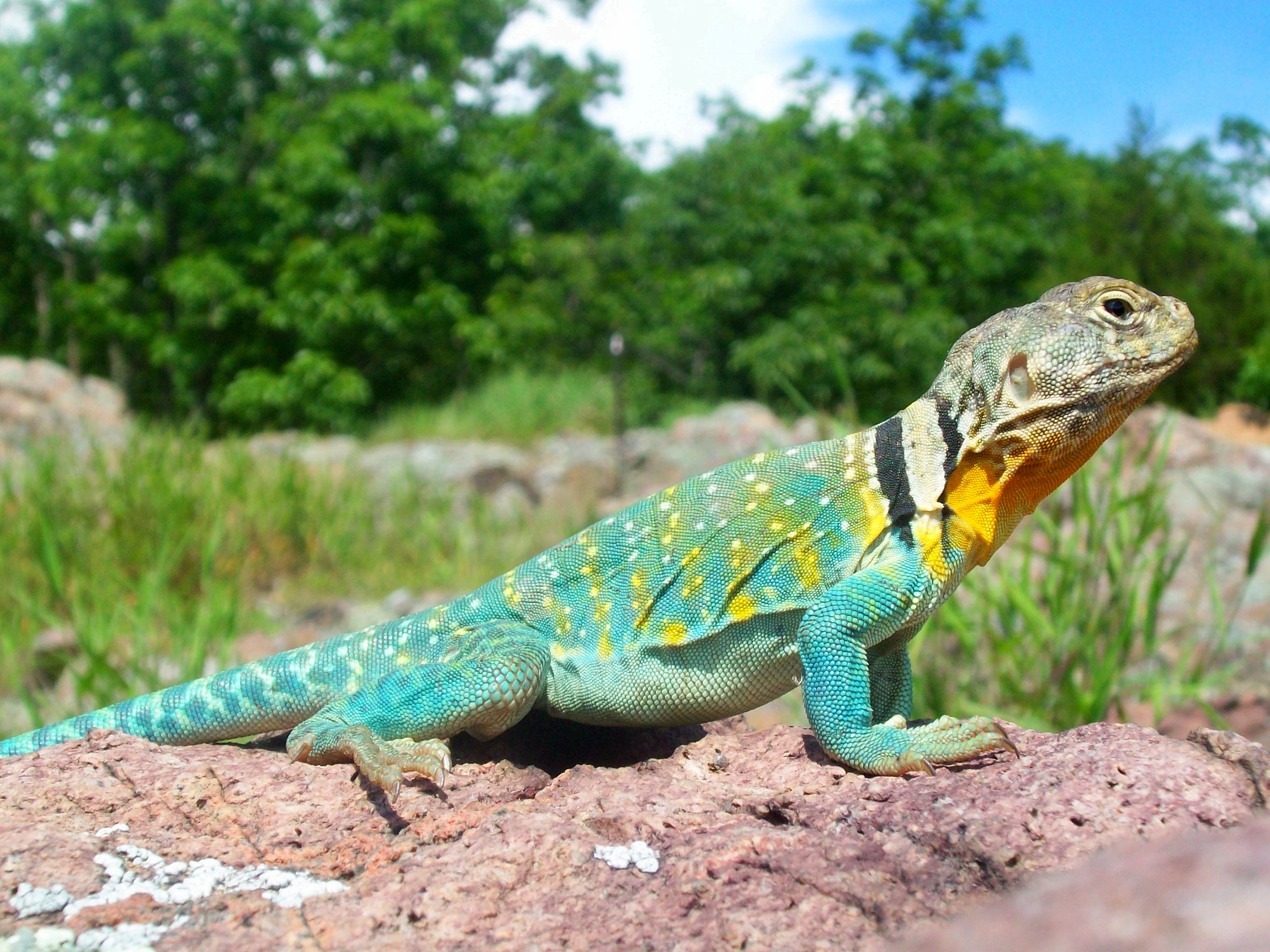
A striking lizard with bright turquoise-blue body, yellow head, and black neck collar. Famous for sprinting on hind legs only — like a tiny T. rex — when chased.
§ Quick facts
§ Encyclopedia
The common collared lizard, also commonly called eastern collared lizard, Oklahoma collared lizard, mountain boomer, yellow-headed collared lizard, and collared lizard, is a North American species of lizard in the family Crotaphytidae. The common name "collared lizard" comes from the lizard's distinct coloration, which includes bands of black around the neck and shoulders that look like a collar. Males can be very colorful, with blue green bodies, yellow stripes on the tail and back, and yellow orange throats. There are five recognized subspecies.
Source: Wikipedia — Common collared lizard Licensed under CC BY-SA 4.0
§ Identification
Field marks. Stocky lizard with large head, long tail, and prominent black-and-white "collar" of two dark bands across the back of the neck; males blue-green throat in breeding season; females with bright orange spots when gravid.
Similar species. Reticulate Collared Lizard (different range; reticulated pattern). Leopard Lizard (no collar). Other lizards lack the distinctive collar markings.
Voice. N/A; rarely hisses.
§ Diet & behavior
Diet. Insects (especially grasshoppers and crickets), spiders, smaller lizards, occasional small snakes.
Behavior. State reptile of Oklahoma. Famous for sprinting on hind legs (bipedal) when escaping predators — running up to 25 km/h on its long muscular hind legs while raising the front of the body off the ground. Distinctive black-and-white double "collar" around the neck. Males in breeding season develop brilliant blue-green throat and shoulders; pregnant females develop bright orange-red spots and bars. Lives on rocky glades, lava flows, and granite outcrops in the Ozarks, Edwards Plateau, and southwestern deserts.
§ Range
Southwestern US, especially Ozark glades and rocky desert
§ Habitat
Rocky outcrops, glades, lava flows in arid and semi-arid country
§ Threats
Habitat loss, fire suppression overgrowing rocky glades, off-road vehicle damage.
§ Conservation status
According to the IUCN Red List, the eastern collared lizard is currently classified as Least Concern.
§ What helps
Support glade restoration with prescribed fire. Stay on trails. Maintain rocky outcrop habitat.
§ Further reading
- Wikipedia — Common collared lizard
- www.nwf.org — authoritative profile of Crotaphytus collaris
- IUCN Red List · taxon 64051
- iNaturalist · taxon 32413
- GBIF occurrence records
- Encyclopedia of Life — Crotaphytus collaris
§ Sources cited
- Oklahoma Department of Wildlife Conservation
- Texas Parks and Wildlife
- Davidson College Department of Biology
- IUCN Red List 2007